


Post-Infinera integration, the Finnish vendor’s growth target is data center interconnect
Nokia’s optical pitch this year at OFC was crystalline, more intentional, and landed somewhere between breakthrough and inevitable.
A new building block-based approach
A diverse set of new applications have emerged in effect of AI, bringing explosive and variegated demands for bandwidth, reach, and efficiency. Engineers have been tackling this by building coherent optical products around the applications. The applications came first, and the optical products supporting it followed. Compared to off-the-shelf solutions, this involves significant engineering work, not to mention additional time and resources.
Now as AI is putting pressure on hyperscalers to pursue lower cost and power per bit, a new approach is required that finds a fair median between the one-size-fits-all and bespoke approach.
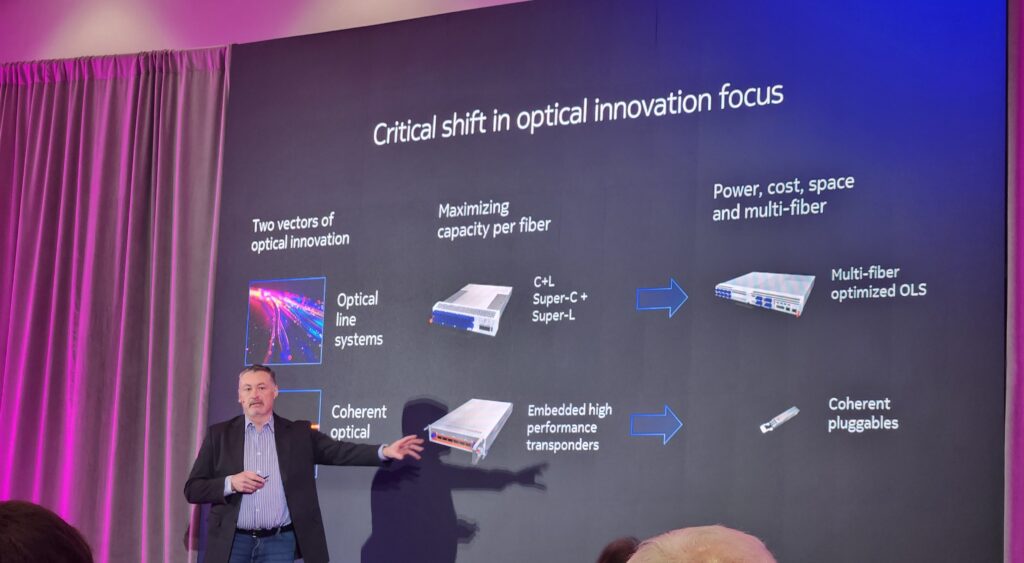
With a new line of optical assets ranging from short-reach campus data center interconnect (DCI) to long-haul subsea transmission, Nokia is proposing a new development methodology. The Finnish company is latching on to two key vectors of optical innovation: optical line systems and coherent optical solutions, promising reprieve from power, cost, and space crunch.
“We are at the right place, at the right time, with the right people, the right technology, and again, the right vertical integration to be able to win,” said David Heard, president of Network Infrastructure at Nokia, at a media briefing at OFC in Los Angeles.
Heard was specifically referring to Nokia’s recent buyout of San Jose-based Infinera, a maker of optical networking solutions, which brought in a talented team of engineers to Nokia’s Optical Networks business, sharpening the vendor’s focus on AI data center back-end network market. Together, the teams have co-developed a slate of coherent transport solutions built around four digital signal processors (DSPs) and 13 new coherent solutions.
Key to this is a new “building block” approach which Timothy Doiron, VP of solutions marketing, and Manish Gulyani, VP and head of marketing for network infra, delved into an exclusive interview with RCR Wireless News at OFC.
The new suite with its DSPs and already application-optimized pluggables is classified under four technology blocks named after the great lakes — Ontario, Huron, Superior — and Pacific. These can be mixed and matched to create a custom fit for any number of implementations — without any engineering work.
“When you hear about us talking about four engines, but 13 applications, it’s really because we’re taking those same building blocks and repackaging them in different ways to drive value and efficiencies in our development,” Ron Johnson, SVP and general manager, said.
“Each of these is indexed to lower Capex, Opex, and particularly power, performance, and reliability,” David Heard highlighted.
According to Nokia, the new coherent optical solutions, built using Indium Phosphide, borrowed from Infinera, and its own Silicon Photonics are designed to deliver up to 70% lower total cost of ownership (TCO) through reduced cost, space, and energy consumption.
The announcement is a bit forward-looking at this point, with sampling timeline set for mid-2027, with general availability in H2 of the same year.
Same footprint, more fiber
Nokia also announced a new multi-rail in-line amplifier hut which it describes as the “highest density solution” in the market. Designed to support multi-fiber deployments, the solution can provide up to 40 fold density improvement, the company claimed.
“This is all about density,” said Rob Shore, head of optical networks solution marketing at Nokia. “How can I create technical solutions that can enable us to enable our customers to amplify more fibers in this physical footprint? So they don’t have to modify and upgrade their infrastructure.”
As fiber deployments race on, there is a looming limit which in the engineering community is known as Shannon Limit. It states that only a finite number of bits can be squeezed into one optical fiber.
One way to avoid the fiber capacity plateau is to use modular consoles that can cram more fibers within the same footprint.
Nokia’s multi-line optical line system can fit 160 ILAs per rack. Both Ciena and Cisco offer similar solutions on their portfolios, but Shore was quick to draw a line of distinction between theirs and Nokia’s.
“You’ve probably heard some of our competitors out there talking about their version of this solution. They’re getting 128 ILAs per rack. We’re getting 160 ILAs per rack.”