


Customer Experience (CX) now sits at the intersection of Artificial Intelligence (AI)-enabled automation, identity and access journeys, AI-generated content dynamics, and intensifying regulatory and reputational scrutiny.
In this environment, every interaction, human or machine-led, introduces potential exposure to fraud loss, unfair outcomes, agent harm, and inconsistent enforcement. Enterprises are recognizing that when trust is not deliberately designed into customer journeys, it becomes expensive to reconstruct later through escalations, remediation, and reputation repair. As a result, Trust & Safety (T&S) is increasingly being treated as a core CX enabler that can materially influence loyalty, retention, and brand resilience.
This blog looks at why T&S now sits at the heart of CX, how the threat landscape is changing, and what enterprises should do to respond, without turning every interaction into a security checkpoint.
Reach out to discuss this topic in depth.
Why T&S is core to CXM operations
T&S is no longer a back-office concern. Customers and agents experience it directly, often in the most emotionally charged moments. The exhibit below highlights some of T&S threat scenarios in CX operations.
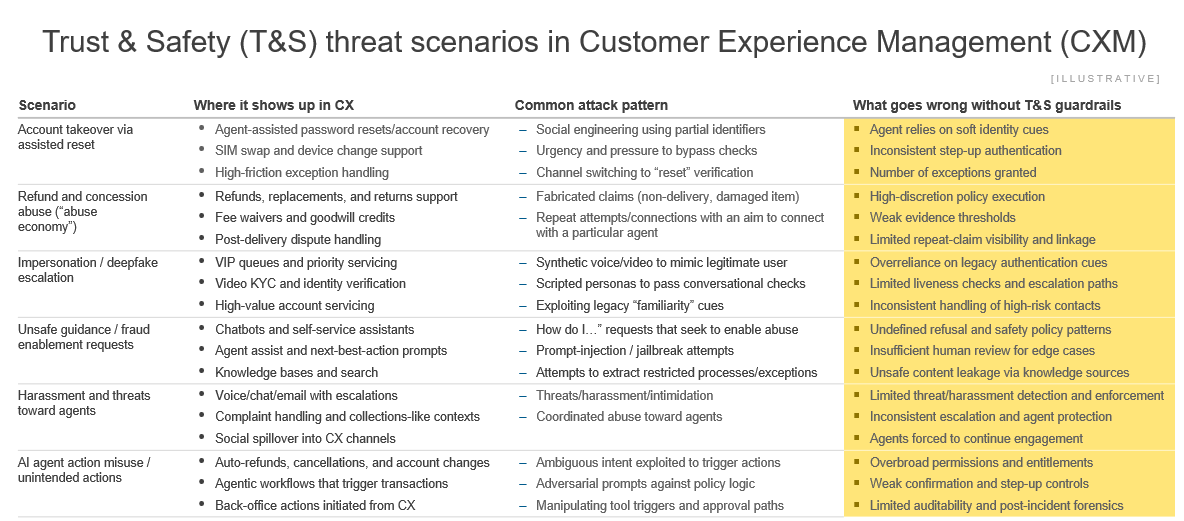
T&S is increasingly determining not only whether an issue is resolved, but whether the experience feels credible, fair, and worth staying with, especially with AI-driven interactions.
- CX can unintentionally create customer harm if safety isn’t designed into journeys
When customer interactions enable account takeover, scams, harassment, or unsafe guidance, the damage is immediate and emotionally salient, especially for vulnerable customers such as minors, elderly users, or customers in distress. If workflows are not designed to detect harm signals early and route them appropriately, enterprises may “resolve tickets” while failing to protect the customer, eroding trust faster than typical service failures. For example, a customer reports they can’t log in and stopped receiving One Time Passwords (OTPs). If treated as a routine reset, an agent may update recovery details or trigger credential changes, exactly what an attacker seeks during account takeover
- Weak trust controls in contact center workflows can drive revenue leakage and inflate cost-to-serve
When verification and governance are inconsistent, bad actors can exploit agent discretion through refund abuse, fabricated claims, repeat concessions, and agent shopping. These losses often get masked as credits, replacements, chargebacks, or goodwill adjustments, making leakage easy to miss and hard to control
- AI and self-service shift the last line of judgment, making trust governance a CX requirement
As CX shifts toward copilots and higher levels of automated resolution, humans are no longer always the last checkpoint. T&S becomes central to responsible CX automation by ensuring safe outputs, controlled actions, privacy-by-design, bias controls, and auditability, so CX can scale without scaling failure
- Regulatory and reputational stakes are rising, making trust failures structurally more expensive
Inconsistent handling of fraud and abuse cases can escalate quickly, from call recordings and screenshots to social media, regulators, and litigation. One high-profile mishandled case can undo years of CX investment. As a result, T&S has moved firmly into the board and regulator conversation, not just operational scorecards
- Agent experience is a core driver of policy consistency and customer trust
Agents face harassment, threats, and social engineering attempts, particularly in money-movement and enforcement work. This drives burnout, attrition, and inconsistent policy execution, which in turn affects service quality and increases leakage risk. Protecting agents, through guardrails, escalation support, and workflows designed for high-risk interactions, becomes part of protecting customers and the brand
Why today’s threat landscape feels different for CX
The case of integrating T&S into CX is being accelerated by changes in how threats are created and scaled today. What is new is the power of gen AI, deepfakes, and coordinated social engineering, and how they collide with legacy authentication and service models.
AI-generated scripts can mimic legitimate service conversations, adapt to customer emotions, and operate across languages. Attackers can iterate quickly by testing narratives, pressure tactics, and channels at low marginal cost. This increases the number of interactions that appear plausible and pushes enterprises beyond reliance on scripts and agent intuition
- Deepfakes and voice cloning are challenging legacy authentication cues
In voice and video channels, familiar signals such as tone, fluency, conversational confidence are becoming less reliable. Even where deepfakes are not yet pervasive, enterprises should assume that high-believability impersonation will grow over time, especially for high-value accounts and vulnerable segments
- Social engineering is becoming more effective because it exploits human process, not technical controls
Attackers exploit urgency, authority cues, empathy triggers, and procedural confusion. They also exploit policy exceptions and agent variability. These attacks become more effective when operating models reward speed over verification
- High-risk customer journeys are converging, increasing cascade impact from one failure
Password resets, SIM swaps, address/bank changes, refunds, and chargebacks are increasingly intertwined. One misstep in one channel can trigger large, multi-journey losses
- AI agents are both risk reducers and risk creators in CX
They can improve safety by enforcing policy consistently, spotting suspicious patterns, and triggering step-up verification. But if not governed, they can also amplify risk by issuing unintended refunds, exposing sensitive data, bypassing checks, or scaling bad decisions at machine speed, so they must be treated as privileged actors with strict permissions, monitoring, and audit trails
- Fragmentation across channels and teams is being exploited as an attack strategy
Channel switching, repeat contacts, agent shopping (interest to talk to a particular agent), and escalation manipulation are common tactics when systems are fragmented, and signals are not shared. In many enterprises, CX sees tickets, fraud teams see transactions, security sees alerts, and T&S sees policy violations, yet no function has the full narrative end-to-end
In this environment, minor gaps in CX design or operations can become major risk exposures.
What enterprises can do to strengthen existing CX protocols for stronger customer protection
Enterprises do not need to turn contact centers into investigation units. They do need to design CX as a trust function, capable of detecting risk, applying proportionate friction, and routing cases consistently.
1. Upgrade governance from periodic reviews to continuous trust operations
Most enterprises already run policy reviews and incident post-mortems, but the cadence is often too slow for gen AI-era threats. A next-step model is an always-on trust operations loop that monitors emerging scam patterns, policy drift, and automation failures, then pushes updates to scripts, workflows, and models in days rather than quarters. This reduces the gap between new attacker tactics and enterprise response.
2. Move from step-up checks to continuous identity assurance across the journey
OTPs, Knowledge Based Authentication (KBA), and static verification can work, but they are increasingly brittle and create uneven friction. Future-ready CX stacks use continuous, context-based identity signals such as device posture, behavioral patterns, interaction history, and network risk to adapt verification dynamically. The result is lower friction for legitimate customers and higher resistance to social engineering and impersonation.
3. Translate policies into “policy-as-code” so every channel behaves consistently
Policies are often documented well but executed inconsistently across agents, chatbots, and partners. An uplift approach is to encode key decision logic into machine-consumable rules that sit behind agent desktops and automated channels, controlling allowed actions and exception pathways. This reduces variation, limits loopholes, and makes enforcement more scalable without relying on individual judgment alone.
4. Evolve from ticket handling to journey-level containment using a unified trust timeline
Many organizations have case management, but attackers exploit gaps across channels and repeated attempts. The next step is linking sessions, identities, and actions into a single trust timeline so the enterprise can detect sequences such as: probing, escalation, exception request, and intervene earlier. This shifts CX from “resolving the contact” to “preventing the next loss event.”
5. Create automated “trust receipts” to make high-risk decisions explainable and defensible
As copilots and automation take on more resolution tasks, auditability becomes non-negotiable. A trust receipt is a structured record of what signals were considered, what checks were triggered, what action was taken, and why generated by default for sensitive journeys. This reduces manual reconstruction during disputes, audits, and escalations and strengthens confidence in automated decisions.
6. Upgrade QA from sampled evaluations to continuous trust monitoring
Traditional Quality Assurance (QA) catches issues late and at low coverage. A forward-leaning uplift is continuous monitoring for policy adherence, harmful outputs, coercion attempts, and leakage patterns across channels, feeding directly into coaching and model/policy tuning. This improves consistency and makes trust performance measurable at scale, not anecdotal.
Bottom line
The convergence of gen AI-driven threats, rising account takeover risk, and expanding self-service channels is pushing enterprises toward a new reality, where CX is not only a customer query resolution function, but also a customer protection capability. Treating T&S as a downstream escalation point may have worked when threats were slower-moving and less scalable, however, it is increasingly misaligned with today’s environment.
Enterprises that unify CX and T&S, through shared governance, risk-tiered journeys, unified case management, and recalibrated training and metrics, can reduce losses and operational volatility while delivering experiences that feel safer and more consistent. In a market where trust is becoming a competitive differentiator, customer protection is quickly becoming the next frontier of CX transformation.
If you enjoyed this blog, check out, Customer Experience Management (CXM) predictions for 2026: How customers, enterprises, technology, and the provider landscape will evolve, which delves deeper into some bold predictions for CX in 2026.
If you have any further questions relating to T&S and CXM, please contact Uday Gupta ([email protected]) and Dhruv Khosla ([email protected]).