

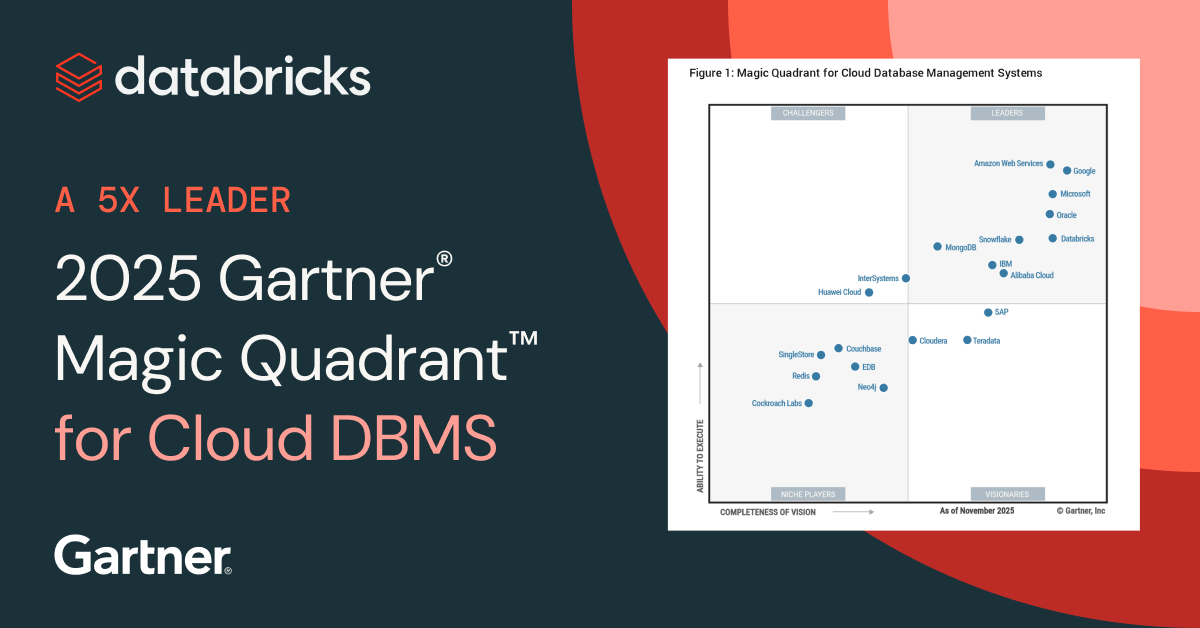
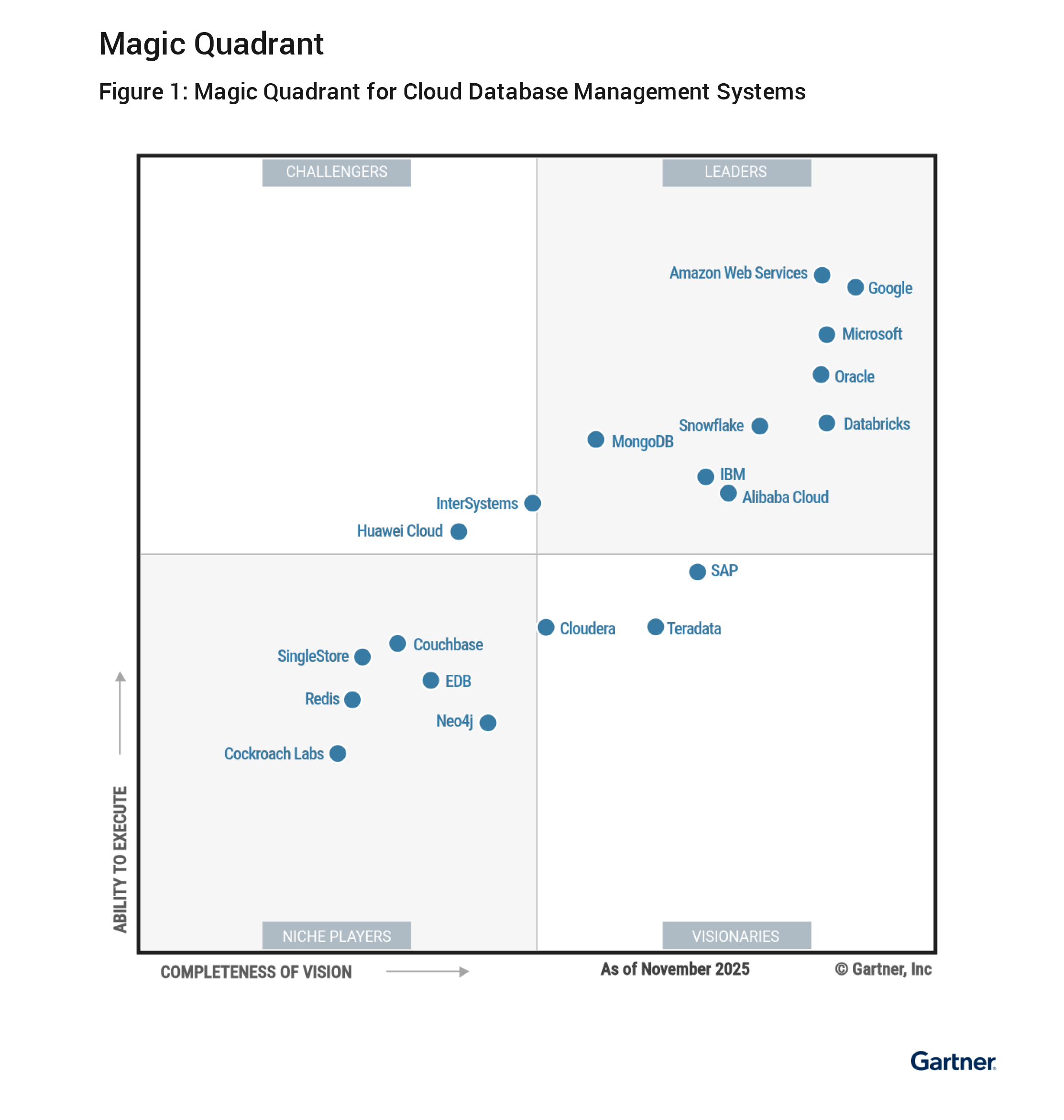
Databricks has been named a Leader in the 2025 Gartner Magic Quadrant for Cloud Database Management Systems for the fifth consecutive year.
Download a complimentary copy of the report here.
That said, this year’s report is different from previous editions for Databricks, because 2025 marks the first year Databricks participated in the operational aspects of this Magic Quadrant in addition to the analytical criteria. We did this through a new architecture and offering for OLTP databases called Lakebase.
Lakebase brings fully managed PostgreSQL capabilities into the same Databricks Data Intelligence Platform that already powers high-performance analytics and AI. It builds on core strengths in Databricks SQL and the lakehouse, including shared governance, a single metadata model and consistent performance.
Now, Databricks customers can build on a single platform for both operational and analytical workloads. This allows organizations to run applications, analytics and AI on a unified foundation instead of managing multiple engines and governance layers.
By bringing operational data into the lakehouse, Databricks removes the fragmentation that comes with traditional database stacks and offers a simpler, more scalable path forward.
Databricks’ lakehouse delivers a leading analytics engine built for performance and scale
Databricks remains a leading analytics platform in the market, as evidenced by Gartner’s scoring of Databricks at the top of the Lakehouse use case in this Magic Quadrant. Customers rely on Databricks SQL for fast, scalable analytics across both traditional BI and advanced analytical workloads, supported by tightly integrated data engineering capabilities in Lakeflow that simplify how data is prepared, transformed and delivered for analysis.
This recognition reflects more than performance alone. Gartner highlights the strength of our lakehouse vision, the unified governance layer that spans clouds, data types and workloads, and the platform’s AI-powered usability. These capabilities give teams a streamlined environment for analytics that is both high-performing and easier to operate.
This strong analytical foundation now supports the broader expansion of the platform, reinforcing why Databricks continues to stand out as a leader in modern data architectures.
Lakebase integrates operational workloads into the lakehouse foundation
Lakebase brings a fully managed, PostgreSQL-compatible operational database to the Databricks Data Intelligence Platform. Built on a serverless architecture, Lakebase separates compute and storage to provide fast provisioning, automatic scaling and an efficient, cost-effective operational model. It is designed for modern, data-intensive applications that need low-latency access to transactional data.
Lakebase also supports a git-like branching and time travel model, making it easier for developers to experiment, iterate and deploy changes safely. Paired with Databricks’ unified governance layer, every operational table inherits the same metadata, lineage and policy controls already used across analytical and AI assets.
This architecture supports next-generation use cases, including AI agents and intelligent applications that must operate on live transactional data while also accessing analytical signals and machine learning outputs. By bringing operational data into the lakehouse, Lakebase removes the need for pipelines between OLTP and OLAP systems and gives teams one platform for applications, analytics and AI.
Unity Catalog provides unified governance and intelligence across the platform
Unity Catalog provides unified governance and metadata across the entire platform. It connects operational data in Lakebase with analytics in Databricks SQL and AI workloads, ensuring consistent policies, semantics and lineage.
Customers use Unity Catalog for:
- Centralized discovery and metadata across data and AI assets
- Fine‑grained access control and policy enforcement
- End‑to‑end lineage across operational and analytical workloads
- Secure, open sharing with Delta Sharing and the Databricks Marketplace
With one governance layer, teams avoid the fragmentation and duplicated controls that come with maintaining separate systems. Unity Catalog ensures Lakebase, analytics and AI all operate within one trusted framework.
Databricks delivers strong innovation velocity
Gartner notes Databricks’ “velocity of innovation” as a particular strength for Databricks in this Magic Quadrant. Over the past year, Databricks has introduced new capabilities across the platform through ongoing development and strategic acquisitions, expanding functionality while also strengthening the lakehouse foundation.
Recent advancements include:
- Agent Bricks: enables teams to build and deploy AI agents that operate directly on a company’s own data with unified governance and context
- Data engineering and integration: Lakeflow continues to expand data engineering capabilities with no-code and low-code development options
- AI/BI and Databricks One: provides business users with natural language insights, governed metrics and interactive dashboards, all powered by the same unified data and AI foundation
- Open formats: full support for Delta Lake and Apache Iceberg across catalogs, engines and sharing, strengthened through the acquisition of Tabular
This continued velocity helps organizations modernize faster and prepare for workloads that bring together operational data, analytics and AI.
What this means for customers
Customers gain clear advantages from adopting the Databricks Data Intelligence Platform:
- Unified architecture: one platform for operational, analytical and AI workloads
- High-quality analytics: strong performance and a streamlined experience grounded in the lakehouse vision
- High-quality operations: efficient, low‑latency transactional capabilities from Lakebase, integrated directly into the same platform
- Consistent governance: shared metadata, lineage and policy controls through Unity Catalog
- Open foundation: support for Delta Lake, Iceberg, Spark, PostgreSQL and Unity Catalog without lock‑in
- AI readiness: native support for AI-driven applications, agents and real-time systems
These advantages align with what many readers of this Magic Quadrant are seeking as they evaluate how to modernize their data infrastructure with a unified and future‑ready platform.
Moving forward together
Thank you to our customers for the trust and collaboration that shape the Databricks Data Intelligence Platform. The future of data and AI depends on architectures that reduce fragmentation and bring operational, analytical and AI workloads together. We will continue to build in that direction.
Read the 2025 Gartner Magic Quadrant for Cloud Database Management Systems.
Gartner does not endorse any vendor, product or service depicted in its research publications and does not advise technology users to select only those vendors with the highest ratings or other designation. Gartner research publications consist of the opinions of Gartner’s Research & Advisory organization and should not be construed as statements of fact. Gartner disclaims all warranties, expressed or implied, with respect to this research, including any warranties of merchantability or fitness for a particular purpose.
GARTNER is a registered trademark and service mark of Gartner, Inc. and/or its affiliates in the U.S. and internationally, and MAGIC QUADRANT is a registered trademark of Gartner, Inc. and/or its affiliates and are used herein with permission. All rights reserved.
This graphic was published by Gartner, Inc. as part of a larger research document and should be evaluated in the context of the entire document. The Gartner document is available upon request from Databricks.