


As we look ahead to 2026, leading Customer Experience (CX) enterprises will start to move away from a collection of disconnected moments and will start operating as a coherent, seamless journey. Customer interactions will now be broken down into smaller, reusable components.
Artificial Intelligence (AI) will be visible and controllable, not just embedded in the background. Enterprises will expect to see experience-related impact in financial terms, not just scores and anecdotes. Under the surface, technology stacks and provider portfolios will be reshaped to support this new reality.
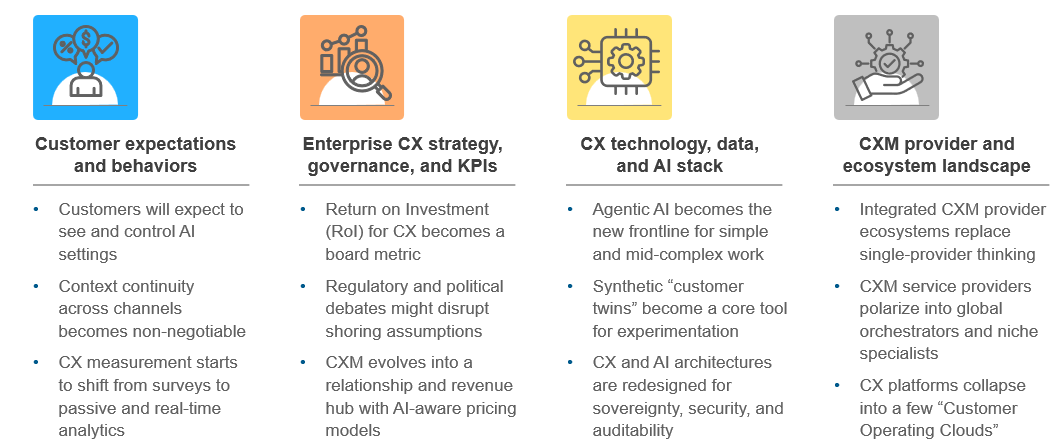
To help Customer Experience Management (CXM) leaders navigate what is coming, we have grouped Everest Group’s 2026 predictions into four themes:
Reach out to discuss this topic in depth.
- Customer expectations and behaviors
1.1 Customers will expect to see and control AI settings
In 2026, customers will expect visible control over how it is used in their interactions. They will want clear signals about when AI is being used, what decisions it can make, and how they can override or escalate to a human. CX interfaces will start to highlight AI settings for customers to adjust personalization levels, opt in/out of certain AI features, or see a short explanation of AI-driven decisions.
1.2 Context continuity across channels becomes non-negotiable
Context continuity will move from aspiration to expectation. When customers move, from bot to live agent, from chat to voice, from mobile app to web or in-store, they will expect every interaction to pick up exactly where the last one left off. That includes problem context, recent actions, authentication status, and stated preferences. Being asked to repeat information, re-explain issues, or restate authentication details will be perceived as a failure of the brand’s CX architecture, not an unavoidable cost of doing business.
1.3 CX measurement starts to shift from surveys to passive and real-time analytics
In 2026, pop-up surveys, Interactive Voice Response (IVR), Customer Satisfaction (CSAT) score prompts, and long feedback forms will increasingly be perceived as intrusive and outdated. Customers will expect enterprises to infer satisfaction, effort, and emotion using, speech analytics, text and interaction mining, behavioral patterns, and outcome-based signals (e.g., repeat contact, churn, complaints).
- Enterprise CX strategy, governance, and Key Performance Indicators (KPIs)
2.1 Return on Investment (RoI) from CX becomes a board metric
Leading enterprises will start to report a CX RoI metric at the board level, the impact of CX initiatives, including AI and automation, on revenue uplift, churn reduction, and cost-to-serve. Traditional metrics such as Net Promoter Score (NPS) and CSAT will remain, but they will increasingly be framed as leading indicators, not the end result. CX leaders will be expected to show traceable links between experience improvements and financial value creation.
2.2 Regulatory and political debates might disrupt shoring assumptions
Proposed and emerging regulations such as Keep Contact Centers in Americas (KCCA) and the HIRE Act are likely to create persistent uncertainty around where specific CX activities can be delivered from. Rather than a single, definitive regulatory outcome, enterprises will need to plan for multiple shoring scenarios, from stricter in-region requirements for particular processes, to disclosure and incentive regimes, to a continuation of today’s more flexible environment. Location strategy will become a risk-managed, multi-scenario discipline, not just a cost-optimization exercise.
2.3 CXM evolves into a relationship and revenue hub with AI-aware pricing models
In 2026, a growing share of CXM programs will explicitly bundle sales, upsell, retention, and collections objectives into their scope. CXM will increasingly operate as a relationship and revenue assistance hub, not just a service and support cost center.
In parallel, as AI handles more of the interaction volume, pricing will begin to decouple from traditional Full Time Equivalent (FTE)-based models. New units of pricing will emerge such as per journey, per bot-hour, and CX-as-a-Service constructs that bundle platforms, licenses, and operations, aligning commercials more tightly with outcomes and hybrid human+AI delivery.
- CX technology, data, and AI stack
3.1 Agentic AI becomes the new frontline for simple and mid-complex work
In 2026, agentic AI will move from being a smart assistant to the primary frontline worker for simple and mid-complex interactions. These AI agents will not just respond to queries; they will take actions across systems (such as adjust bills, rebook travel, or reset credentials), and trigger workflows and follow-ups. Human agents will focus increasingly on edge cases, judgment-intensive work, and emotionally-charged scenarios, with agentic AI handling the bulk of high-volume, rules-based tasks.
3.2 Synthetic “customer twins” become a core tool for experimentation
Leading CX organizations will use synthetic customer populations, algorithmically generated but behaviorally realistic stand-ins, to test journeys, policies, and AI strategies before rolling them out widely in a sandbox environment. These synthetic “customer twins” will allow teams to simulate how different segments might respond to new flows, offers, or automation levels, and identify unintended consequences faster and with less risk.
3.3 CX and AI architectures are redesigned for sovereignty, security, and auditability
IN 2026, sovereignty, security, and auditability will move to the center of CX and AI architecture design, especially in regulated sectors. Enterprises will prioritize data residency and local processing controls, granular decision logging and model lineage, integration with fraud, risk, and compliance engines, and audit trails that show who decided what, when, and why.
- CXM provider and ecosystem landscape
4.1 Integrated CXM providers ecosystems replace single provider thinking
In 2026, enterprises will increasingly buy into ecosystems, not individual providers. Business Process Outsourcers (BPOs), technology vendors, Global System Integrators (GSIs), and hyperscalers will work more tightly together on the same deals, with shared solution designs, integrated delivery roadmaps, and combined AI and data services. Standalone, isolated selections will give way to integrated CXM ecosystems where operational expertise, platforms, AI capabilities, and data services are tightly aligned to a common outcome.
4.2 CXM service providers polarize into global orchestrators and niche specialists
The CXM service market in 2026 will increasingly polarize into:
- A small set of global orchestrators that manage complex, multi-region, multi-tower CX ecosystems for large enterprises
- A long tail of high-value niche specialists, focused on specific domains, languages, industries, or AI-operations capabilities, plugging into those orchestrated ecosystems
Mid-sized, undifferentiated generalists will face consolidation, specialization, or gradual displacement as buyers gravitate toward either scale orchestrators or sharply differentiated specialists.
4.3 CX platforms collapse into a few “Customer Operating Clouds”
The CX technology stack comprising of solutions such as Contact center as a Service (CCaaS), Unified Communications as a Service (UCaaS), Customer Relationship Management (CRM), campaign tools, and core analytics will increasingly collapse into a small number of integrated “Customer Operating Clouds.” These clouds will serve as the primary substrate for omnichannel engagement, data and identity management, AI model deployment, and orchestration and workflow. Most other CX capabilities such as bots, Workforce Management (WFM), Quality Assurance (QA), vertical features, and specialized analytics will be delivered as apps or accelerators on top of these clouds, not as standalone platforms.
2026: CXM starts to evolve into an AI-orchestrated operating system
2026 will mark a pivotal shift in CXM. Customer experiences will be running atop Customer Operating Clouds, delivered by a mix of agentic AI and specialized human talent, and governed by tight CX + AI ethics frameworks.
For CXM leaders, the agenda is clear:
- Design around the customer of 2026: context continuity, passive measurement, and visible AI controls are the new baseline
- Elevate CX as a value engine: measure and govern CX RoI, couple revenue and relationship outcomes with responsible AI use
- Re-architect the stack: build sovereign-by-design, orchestrated architectures that can scale AI securely and audibly
- Choose ecosystems, not just vendors: navigate toward orchestrators, platforms, and specialists that fit their risk, growth, and differentiation strategy
The CXM revolution is no longer theoretical, it is operational, measurable, and accelerating. 2026 will reward organizations that combine ambition in AI and experience design with discipline in governance, architecture, and ecosystem strategy.
If you enjoyed this blog, check out The top 10 CXM predictions: how 2025 really played out - Everest Group Research Portal, which delves deeper into 2025 CXM predictions.
To discuss these 2026 predictions and broader CXM trends, please reach out to Sharang Sharma ([email protected]), Aishwarya Barjatya ([email protected]), or Uday Gupta ([email protected]).