


Traditional OMS platforms were designed for stability not volatility. Built around static rules and linear workflows, they now struggle to keep pace with dynamic pricing, omnichannel fulfillment, and real-time customer expectations. As commerce becomes more interconnected, enterprises need an OMS that does more than record transactions; it must perceive, decide, and act intelligently across the fulfillment network.
A new architecture is taking shape: the control-tower OMS. Combining Artificial Intelligence (AI)-driven decisioning, modular design, and omnichannel visibility, it enables enterprises to deliver on promises with precision, resilience, and trust. The OMS is no longer just a back-office tool; it is becoming the real-time intelligence layer that connects demand, supply, and delivery decisions.
This transformation marks the shift from execution to orchestration and from orchestration to intelligence. To understand where the future is heading, it helps to look at how OMS has evolved, from a System of Record to the intelligent core of commerce operations.
Reach out to discuss this topic in depth.
Evolution of OMS: from execution to orchestration and intelligence
The evolution of order management reflects the broader journey of digital commerce. Early OMS platforms were transactional systems built to capture and fulfill orders accurately. As global supply chains expanded and customer touchpoints multiplied, these systems evolved into orchestration engines that connected with Enterprise Resource Planning (ERP), warehouse, and logistics platforms to manage routing and fulfillment efficiently.
Exhibit 1 shows the evolution of OMS from transactional execution to ecosystem orchestration, now progressing toward decision intelligence in commerce.
Exhibit 1: OMS evolution
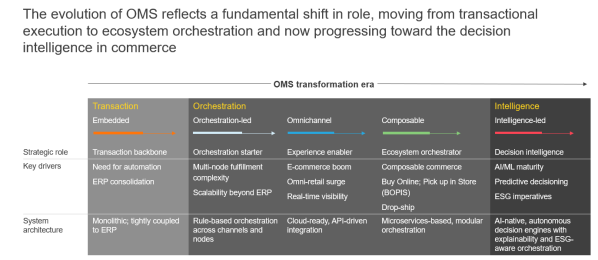
OMS is entering the intelligence era today. Modern platforms use AI and Machine Learning (ML) to anticipate demand fluctuations, adjust allocations, and respond to disruptions in real time. They are designed on modular, microservices-based architectures that enable faster upgrades and continuous optimization. An intelligent OMS no longer just coordinates processes; it makes informed decisions, balancing cost efficiency, delivery accuracy, and environmental impact.
Enterprises are starting to treat OMS as a dynamic decision-support layer rather than a static transaction system. With cloud-native and Application Programming Interface (API)-first architectures, they can plug in new capabilities, partners, or channels without complex replatforming. This agility has become essential as businesses expand into marketplaces, subscription models, and region-specific fulfillment requirements.
In this new model, OMS is not simply processing orders. It is orchestrating intelligence across the fulfillment network, driving operational resilience, and strengthening customer trust.
As OMS platforms gain intelligence, enterprises need a design framework to guide the evolution of these systems. The SMART OMS model provides that structure, defining what modern order management should look like across agility, intelligence, and trust.
SMART OMS: the operating system for promises
As OMS platforms evolve into control centers for commerce, enterprises need a design approach that ensures both agility and accountability. The SMART OMS framework captures this shift. It defines what a next-generation OMS should deliver to balance efficiency, intelligence, and trust at scale. SMART stands for Sustainable, Modular, AI-guided, Resilient, and Trust-centered.
- Sustainable and circular fulfillment
Embeds re-commerce, reverse logistics, and carbon-aware fulfillment into order orchestration
- Modular architecture
Uses API-first, microservices-based components with prebuilt connectors that enable modernization and scalability without replatforming
- AI-driven decisioning
Applies predictive analytics, promise accuracy models, and agentic automation to dynamically optimize order flows in real time
- Resilience and trust
Incorporates fraud prevention, audit trails, and compliance features to ensure secure, transparent, and reliable order operations
- Touchpoints and experience integration
Connects digital and physical channels to give users consistent, real-time visibility across the order life cycle
Together, these pillars move OMS from reactive order management to proactive promise management. A SMART OMS does not just process transactions; it creates the foundation for resilience, adaptability, and long-term customer confidence.
While SMART defines what good design looks like, the market is already signaling where this evolution is heading. Four structural shifts are shaping how enterprises build and scale modern OMS platforms.
Exhibit 2: Four shifts to act on now
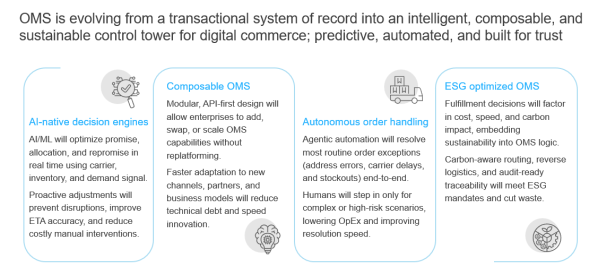
We take a closer look at these shifts below.
AI-native decision engines
OMS platforms are shifting from static rules to adaptive, learning-based policies. AI-driven decision engines use carrier, inventory, and demand signals to optimize promises in real time, improving delivery accuracy and reducing manual adjustments.
Composable OMS
Modular, API-first OMS designs allow enterprises to expand into new channels and fulfillment models without major rebuilds. Composability accelerates deployment, simplifies integration, and reduces time to market as business needs evolve.
Autonomous order handling
Agentic automation now resolves common exceptions such as carrier delays or stockouts without manual input. Human teams focus on complex scenarios, improving response time and lowering costs. Autonomy in OMS is about eliminating idle time, not eliminating people.
Environmental, Social and Governance (ESG)-optimized OMS
Sustainability is becoming a design principle. OMS platforms now factor carbon and exposure data into routing and sourcing decisions, balancing speed, cost, and environmental impact. Credible, sustainable promises are emerging as a new measure of customer trust.
These four shifts illustrate how OMS is transforming from a process automation layer into a self-optimizing system of intelligence. Both enterprises and technology providers will need to adjust their strategies, capabilities, and operating models to capture this new value.
What this means for enterprises and technology providers
For enterprises, the buy side
- Start at the promise: ensure every order commitment is data-backed and achievable
- Use intelligent inventory signals and AI-driven routing to improve speed and accuracy
- Offer flexible fulfillment models such as ship-from-store, Buy, Online, Pickup in Store (BOPIS), and curbside pickup
- Adopt a modular, API-first OMS architecture to plug in new partners and capabilities quickly
- Build for trust through transparent tracking, easy returns, and reliable delivery
For technology providers, the sell side
- Deliver modular, API-based building blocks for visibility, promise management, and fulfillment
- Prove scalability and real-time accuracy across diverse fulfillment networks
- Embed AI-led automation to reduce exceptions and optimize routing decisions
- Provide seamless integrations with ERP, Warehouse Management System (WMS), Third-party Logistics (3PL), logistics, and payment systems
- Productize flexibility and enable clients to orchestrate fulfillment, resilience, and sustainability from a single intelligent platform
The final mile
OMS has moved from the back office to the command center of commerce, becoming the foundation of credible, data-driven promises.
The fastest way to improve customer experience is not through new marketing touchpoints but through promises that can be kept. A control-tower OMS achieves this by uniting intelligence, agility, and trust across every order flow.
Enterprises that turn their OMS into a system of intelligence will build stronger customer confidence and long-term resilience. Those that continue to treat it as a transaction engine will fall behind in a market defined by precision, speed, and reliability.
If this blog interests you, Everest Group’s reports on the topic offer deeper insights.
Learn more about OMS platforms and the provider landscape in Everest Group’s Into the Order Management System (OMS) Verse: Market Outlook, Trends, Challenges, and Provider Landscape report.
To take the conversation forward, please contact Tanishqa Singh ([email protected]), Divya Baweja ([email protected]), or Aakash Verma ([email protected]).