
Close Menu
geekfence.comgeekfence.com
    What's Hot

    The Human Behind the Door – O’Reilly

    January 26, 2026

    Report: Apple may preview a Gemini-enabled Siri update in February

    January 26, 2026

    Announcing Amazon EC2 G7e instances accelerated by NVIDIA RTX PRO 6000 Blackwell Server Edition GPUs

    January 26, 2026
    Facebook X (Twitter) Instagram
    • About Us
    • Contact Us
    Facebook Instagram
    geekfence.comgeekfence.com
    • Home
    • UK Tech News
    • AI
    • Big Data
    • Cyber Security
      • Cloud Computing
      • iOS Development
    • IoT
    • Mobile
    • Software
      • Software Development
      • Software Engineering
    • Technology
      • Green Technology
      • Nanotechnology
    • Telecom
    geekfence.comgeekfence.com
    Home»Nanotechnology»Continuous phase hydrophobicity exerts substantial influence on the surface functional group prevalence in protein nanocapsules synthesized in inverse miniemulsion
    Nanotechnology

    Continuous phase hydrophobicity exerts substantial influence on the surface functional group prevalence in protein nanocapsules synthesized in inverse miniemulsion

    AdminBy AdminNovember 16, 2025No Comments2 Mins Read0 Views
    Facebook Twitter Pinterest LinkedIn Telegram Tumblr Email
    Continuous phase hydrophobicity exerts substantial influence on the surface functional group prevalence in protein nanocapsules synthesized in inverse miniemulsion
    Share
    Facebook Twitter LinkedIn Pinterest Email


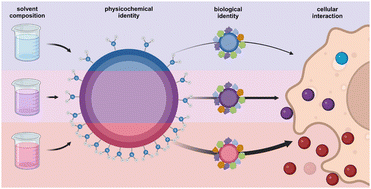
    Precise control over surface properties is crucial for the design of nanocarriers in biomedical applications. These properties influence biological interactions. Functional co-monomers can be used to tailor the surface chemistry of nanocarriers synthesized in radical heterophase polymerization in aqueous phase. However, achieving similar control over nanocarriers derived from natural materials in inverse miniemulsion, such as protein nanocapsules, remains challenging. Here, we demonstrate how the surface functional group density of protein nanocapsules can be tuned systematically by varying the hydrophobicity of the continuous phase during the synthesis via the click reaction between hydrophilic azide-modified proteins and a hydrophobic dialkyne crosslinker. By adjusting the solvent mixture of toluene and cyclohexane, the interfacial properties of the droplets are modified, influencing the partial denaturation of the protein and orientation of the amine-terminated lysine residues. This, in turn, affects the accessibility of the azide groups for the crosslinking. Changes in solvent composition furthermore influence the solubility and reactivity of the crosslinker, thereby modulating the degree of azide functionalization. This allows for precise control over the number of unreacted azide groups available for subsequent biorthogonal click reactions. We demonstrate that the multifunctional surface, with amine, azide and alkyne groups, enables the simultaneous attachment of different molecules to the nanocapsule. Finally, we show that while changes in continuous phase hydrophobicity lead only to minor changes in protein corona composition, they significantly affect macrophage uptake, likely due to differences in surface amine density. Our combined findings provide a novel approach for tailoring the surface functionality of nanocapsules, facilitating more precise and versatile biofunctionalization strategies, particularly for targeted drug delivery.


    Source link

    Share. Facebook Twitter Pinterest LinkedIn Tumblr Email

    Related Posts

    A surprising critical state emerges in active nematic materials – Physics World

    January 26, 2026

    Nanomaterials Transformed by Engineering Shape, Not Chemistry

    January 25, 2026

    New catalyst makes plastic upcycling 10x more efficient than platinum

    January 24, 2026

    Surface-enhanced thermal dissipation in 3D vertical resistive memory arrays with top selector transistors

    January 23, 2026

    Gold nanoclusters – A promising atomically precise atomic aggregation-based drug and its biomedical applications

    January 22, 2026

    Ultrafast transition from coherent to incoherent polariton nonlinearities in a hybrid 1L-WS2/plasmon structure

    January 21, 2026
    Top Posts

    Understanding U-Net Architecture in Deep Learning

    November 25, 202511 Views

    Hard-braking events as indicators of road segment crash risk

    January 14, 202610 Views

    Microsoft 365 Copilot now enables you to build apps and workflows

    October 29, 20258 Views
    Don't Miss

    The Human Behind the Door – O’Reilly

    January 26, 2026

    The following article originally appeared on Mike Amundsen’s Substack Signals from Our Futures Past and is…

    Report: Apple may preview a Gemini-enabled Siri update in February

    January 26, 2026

    Announcing Amazon EC2 G7e instances accelerated by NVIDIA RTX PRO 6000 Blackwell Server Edition GPUs

    January 26, 2026

    Modernising Data Rules for Europe’s AI Future

    January 26, 2026
    Stay In Touch
    • Facebook
    • Instagram
    About Us

    At GeekFence, we are a team of tech-enthusiasts, industry watchers and content creators who believe that technology isn’t just about gadgets—it’s about how innovation transforms our lives, work and society. We’ve come together to build a place where readers, thinkers and industry insiders can converge to explore what’s next in tech.

    Our Picks

    The Human Behind the Door – O’Reilly

    January 26, 2026

    Report: Apple may preview a Gemini-enabled Siri update in February

    January 26, 2026

    Subscribe to Updates

    Please enable JavaScript in your browser to complete this form.
    Loading
    • About Us
    • Contact Us
    • Disclaimer
    • Privacy Policy
    • Terms and Conditions
    © 2026 Geekfence.All Rigt Reserved.

    Type above and press Enter to search. Press Esc to cancel.