

A puddle on the kitchen floor often sends homeowners straight to the plumbing, but a dishwasher leak is not always a pipe problem. In many cases, the clues point back to the appliance itself: water gathering at the front edge, foam pushing out from the door area, drainage trouble at the sink-side connection, or a machine that stops and drains after detecting a leak condition. Current user manuals and maintenance guides make the same basic point: before assuming a hidden pipe failure, pay attention to where the water appears and what the dishwasher was doing when it happened.
Start With Where the Water Appears
The location of the water usually tells you more than the puddle alone. If the mess starts at the front of the machine, the problem often comes from the door area, spray pattern, detergent foam, or how the unit is loaded. If the water shows up closer to the sink-side drain path, the cause may be a clogged air gap, a blocked disposer connection, or a drain-line issue rather than a failed pipe inside the wall. University-hosted homeowner manuals specifically warn that a clogged air gap or a disposal connection problem can cause water to back up and spill out where homeowners do not expect it.
The Door Area Is Still the First Place to Check
The door zone remains one of the most common places where leak problems begin. Dishwasher manuals warn users not to load sharp items where they can damage the door seal, and maintenance guidance also notes that damaged or leaking door seals need attention rather than wishful thinking. Just as important, loading matters. If tall items, utensils, or shifted dishes interfere with the spray arms or get trapped near the gasket area, water can be driven toward the front of the machine instead of staying contained inside the tub.
Some front-edge moisture is not a dramatic mechanical failure at all. User manuals also note that moisture from the dishwasher vent can collect near the counter area on some built-in models, which is another reason the exact location of the water matters. A small recurring leak at the door line usually deserves closer attention to the seal, the load, and the spray pattern before anyone blames the house plumbing.
Sometimes the Problem Is Not a Hole but a Misdirected Spray
A dishwasher can leak even when no hose has split and no pipe has burst. Manuals repeatedly tell users to make sure nothing blocks the spray arms and nothing prevents them from spinning freely. That guidance exists for a reason: when the spray pattern is obstructed or redirected, water can be pushed toward the door area or other weak points instead of circulating normally through the tub. In real kitchens, that often happens because of oversized dishes, utensils placed awkwardly, or items that shift during the cycle.
Detergent Mistakes Can Create Real Leak Symptoms
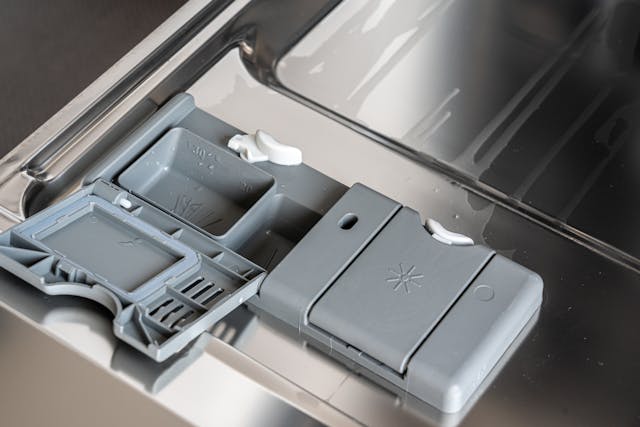
The detergent section is where many leak articles go vague, but the chemistry here is straightforward. NIH’s cleaning-products reference explains that hand dishwashing products are built around high-sudsing surfactants, while automatic dishwasher detergents and rinse aids are designed for low-sudsing performance. That distinction matters because excessive suds can push foam and water out of a dishwasher in ways that look like a leak. Housing maintenance guidance says the same thing in plain language: do not use hand dish detergent in a dishwasher, because it can cause the machine to overfill with suds. Manuals also warn that too much detergent or a detergent that creates excess foam can cause performance and residue problems.
That is why visible foam at the bottom of the door should not be treated like a mysterious plumbing failure. It is often a product-use problem first. The practical fix is simple: use only detergent made for automatic dishwashers, use a reasonable amount for your water conditions, and check the rinse-aid cap and dispenser if suds or drips keep showing up.
Do Not Ignore the Drain Side of the System
Drain-side problems are another place where dishwasher leaks get misdiagnosed. A clogged air gap can force water back out near the sink, and a drain connection issue at the garbage disposal can do the same. User manuals advise cleaning the air gap when the dishwasher is not draining properly, and homeowner maintenance material warns that a plugged disposal connection can send water spraying out through the air gap instead of draining away normally. That kind of backup can look like a plumbing emergency even though the dishwasher and sink connection are the real trouble spots.
Modern Dishwashers Are More Sensor-Driven Than They Used to Be
Leak diagnosis has also changed because modern dishwashers rely more heavily on sensors and fault logic. Current manuals describe optical sensors that adjust cycles based on water conditions, soil level, and detergent amount, and some manuals also state that when a leak is detected the dishwasher will stop the cycle and drain. That means a sudden stop, a draining cycle, or a leak message can be part of the appliance’s protective response rather than proof that a household pipe has failed behind the wall.
That sensor-driven approach also fits a broader home-maintenance trend. EPA guidance now highlights moisture-detection and flow-monitoring devices as practical tools for reducing water waste and limiting leak damage in homes. In other words, leak detection is no longer just a repair issue. It is increasingly part of how modern homes and appliances are designed to contain damage early.
When It Is Time to Stop Troubleshooting and Call for Service
A homeowner can reasonably check the load, the door area, the detergent, the air gap, and the drain connection. But once the leak appears to come from underneath the machine, once the dishwasher repeatedly stops and drains because it has detected a leak, or once the problem moves beyond basic cleaning and loading corrections, it usually makes sense to step back. Consumer manuals routinely warn against repairing or replacing parts unless the manual specifically recommends it, and they direct other servicing to a qualified technician. For owners dealing with persistent leak codes, internal faults, or model-specific component issues, that can include model-specific Electrolux appliance repair support rather than trial-and-error fixes.
The Real Point
The strongest assumption is not always the right one. A dishwasher leak can start at the drain connection, the air gap, the door seal, the spray pattern, the detergent, or the appliance’s own sensing system. The water on the floor is only the symptom. The real job is to identify whether the failure began in the home’s plumbing or inside the dishwasher itself, then act quickly before a small appliance problem turns into damaged flooring, swollen cabinetry, or mold. EPA guidance is clear on that last point: fix the water problem and dry wet materials promptly, ideally within 24 to 48 hours.