

Front-end development is shaped, much as it has been for years, by React’s continued dominance. For a long stretch, its chief rival, Angular, was borderline unusable for lean, fast-moving use cases. Yet perceptions are shifting. With the latest releases, Angular has resolved many of its historical weaknesses, and in many respects, the two frameworks now feel closer in capability than at any point in the last decade.
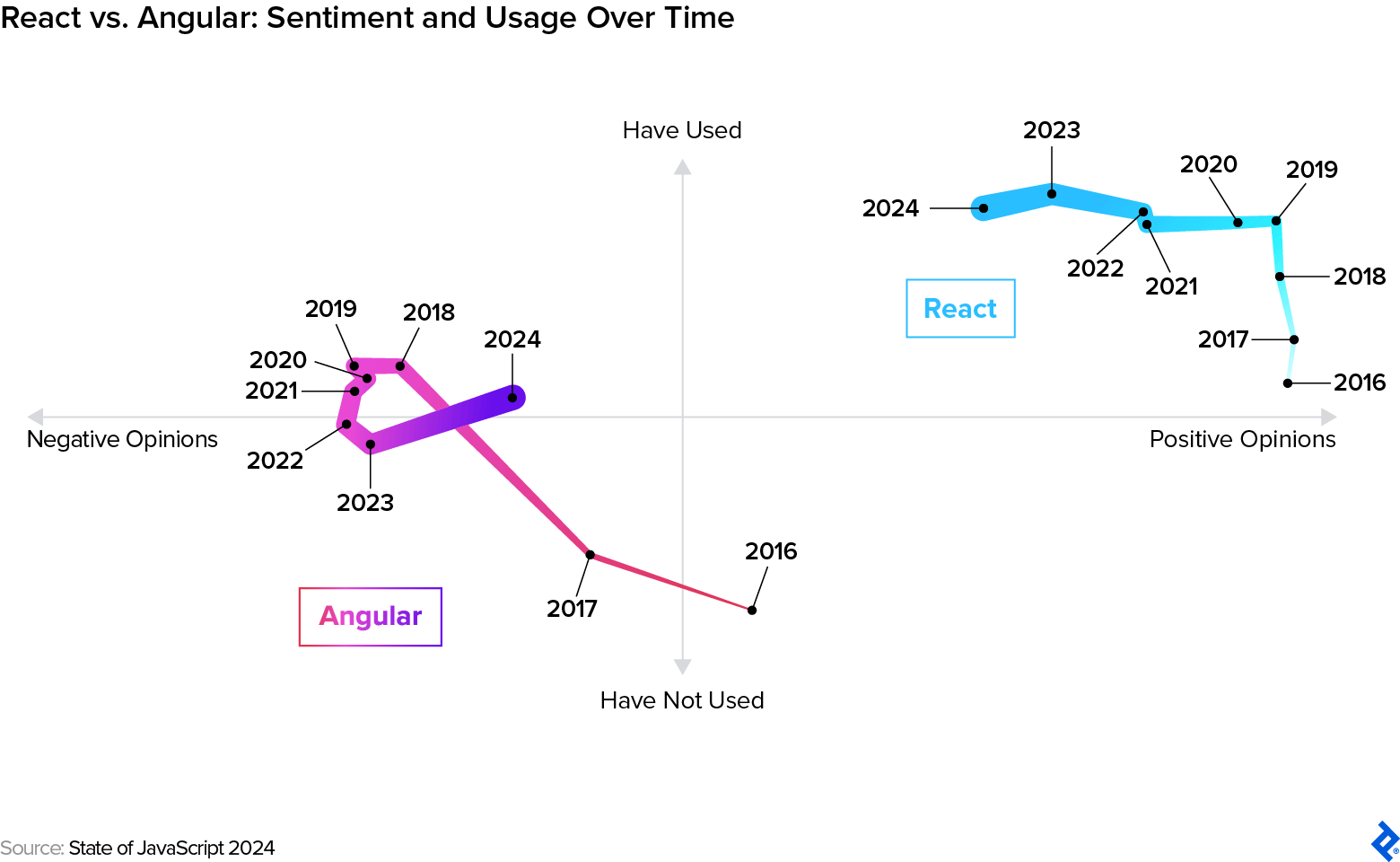
Recent State of JavaScript surveys reflect these changing dynamics. React remains the most widely used option, but developer satisfaction has been steadily declining due to a trend often labeled as “React fatigue.” Angular, long dismissed as the heavy corporate alternative, has seen its sentiment rebound as new features reduce boilerplate and move it toward the fine-grained reactivity developers expect from modern UI architectures.
I first compared Angular and React back in 2017, when Angular was new, and React was far simpler. This article revisits that rivalry for 2026, providing a practical, opinionated comparison for both developers and decision-makers who need more than another superficial “pros and cons” list.
After years of shipping production systems with both frameworks, I’ve learned that the right question isn’t “Which framework is better?” but “Which one aligns with the realities of the system you’re trying to build, and the people building it?”
At a Glance: Angular vs. React Comparison
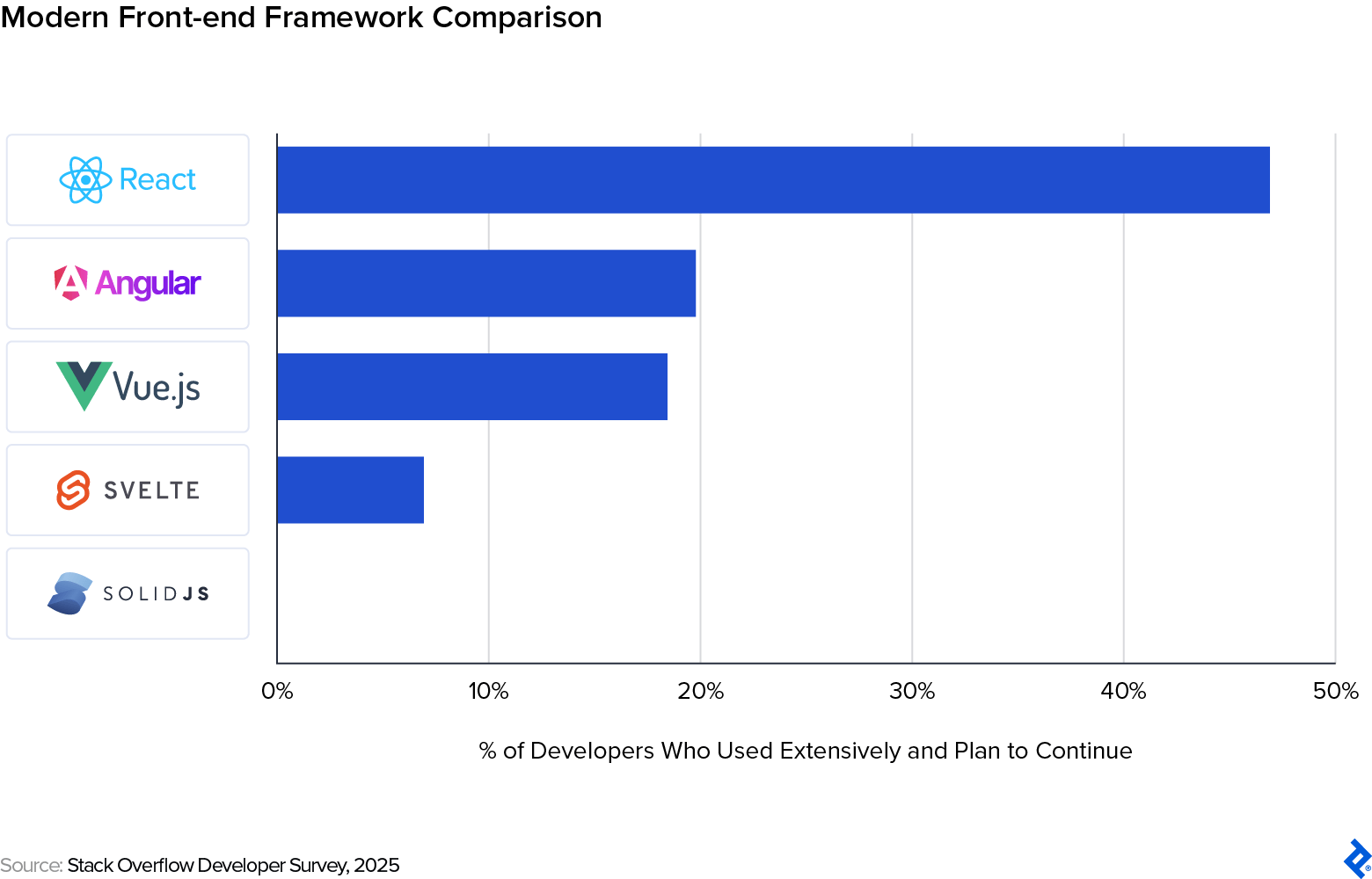
While Angular is on the rise in terms of sentiment, Stack Overflow’s 2025 Developer Survey shows that React remains the industry leader by a large margin, with 46.9% of professional developers reporting extensive work with it over the past year. Angular, meanwhile, clocks in at 19.8%, making it the second-most used front-end framework or library.
Before diving into deeper architectural and business considerations, I’ll provide a quick snapshot of how the two compare across core attributes: what they are, how they’re built, how they perform, and where each tends to excel.
|
Criteria |
Angular |
React |
Implications |
|
Creator and Stewardship Model |
Developed and maintained by Meta, but much of the real innovation comes from the wider community
|
Angular’s development is steadier; React evolves faster and sometimes more chaotically due to its ecosystem-driven nature. |
|
|
Initial Release |
2016 |
2013 |
React has had a longer uninterrupted run; Angular effectively restarted in 2016 with Angular 2, a full rewrite of AngularJS. |
|
Type |
Full-featured, opinionated framework |
Flexible, modular UI library |
Angular provides a complete system out of the box; React requires assembling a framework from parts. |
|
Primary Language |
TypeScript |
JavaScript or TypeScript |
Angular enforces type safety and structure; React allows flexibility, which can help or hurt depending on discipline. |
|
Architecture Style |
Integrated tools (e.g., Angular CLI), strong conventions, batteries-included |
Unopinionated, ecosystem-driven, choose-your-own-stack |
Angular reduces decision fatigue; React offers freedom but increases architectural responsibility. |
|
Reactivity Model |
Signals, dependency injection, and optional two-way data binding |
Virtual DOM, hooks, user-selected state libraries (e.g., Redux, Zustand, Jotai) |
The two are converging on fine-grained reactivity, but Angular provides it by default while React makes it optional. |
|
Performance Baseline |
Historically slower due to Zone.js; now significantly improved with signals |
Fast with selective DOM updates; performance depends heavily on chosen state management |
Neither has a decisive edge anymore; defaults matter more than raw engine speed. |
|
Ecosystem Maturity |
Smaller but stable; predictable releases; strong enterprise support |
Vast ecosystem; abundant libraries; faster-moving but more chaotic |
React’s ecosystem enables almost anything; Angular’s limits reduce risk and churn. |
|
Learning Curve |
Steeper upfront, smoother once conventions are learned |
Easier onboarding; harder-to-master ecosystem choices |
Angular rewards investment; React rewards experience and architectural maturity. |
|
Companies Using It |
Google, Delta Air Lines, Deutsche Bank |
Meta, Airbnb, New York Times |
Angular clusters in enterprise and long-lived systems; React dominates among consumer-facing platforms. |
What Is React? Distinctive Features and Examples
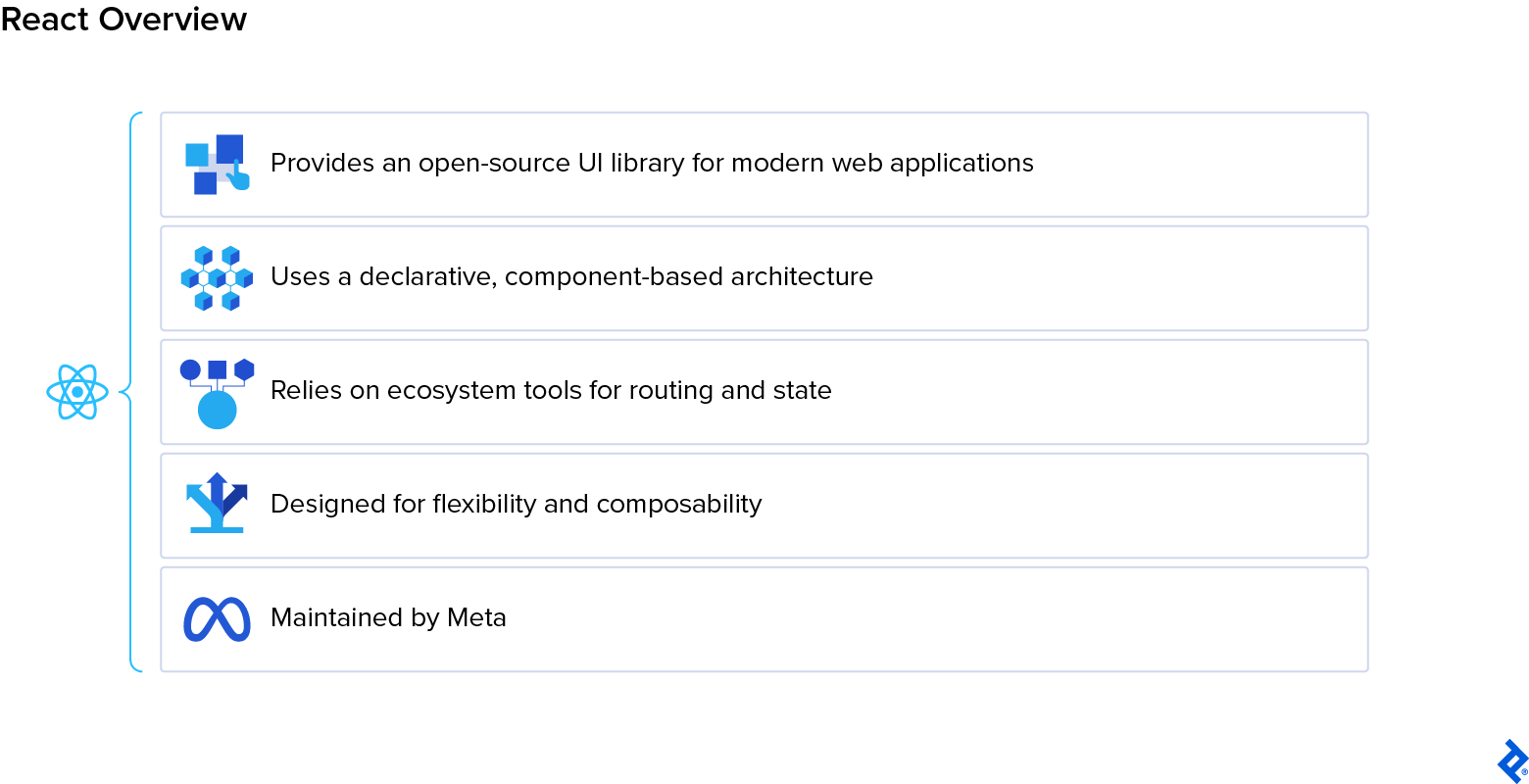
React is an open-source JavaScript library introduced by Meta in 2013 for building modern web applications. It became popular because it offered something radically simpler and more intuitive than the heavyweight frameworks of its era: a declarative, component-based architecture paired with unidirectional data binding, which made UI behavior more predictable and easier to reason about.
As a library rather than a full framework, React focuses primarily on the view layer, allowing developers to integrate other libraries to achieve more robust framework-style functionality.
React Features
React’s flexible design is a big reason the library became the de facto standard for front-end development. Its virtual DOM enables efficient, selective DOM updates by comparing a lightweight representation against the real DOM and applying only necessary changes. JSX makes UI code feel natural and declarative, and the later introduction of hooks made component logic far more expressive and reusable.
While React continues to dominate, there’s a growing sense among experienced developers that parts of the ecosystem have become increasingly overengineered. This isn’t a deal-breaker, but it does mean React’s advantages feel less uniquely differentiated than they once did.
Where Is React Used?
React is used for everything from small prototypes to massive production systems, including web apps, interactive dashboards, SaaS platforms, marketing sites, and hybrid architectures. It powers some of the world’s most widely used applications, including Facebook and Instagram, Airbnb, and Uber.
What Is Angular? Distinctive Features and Examples
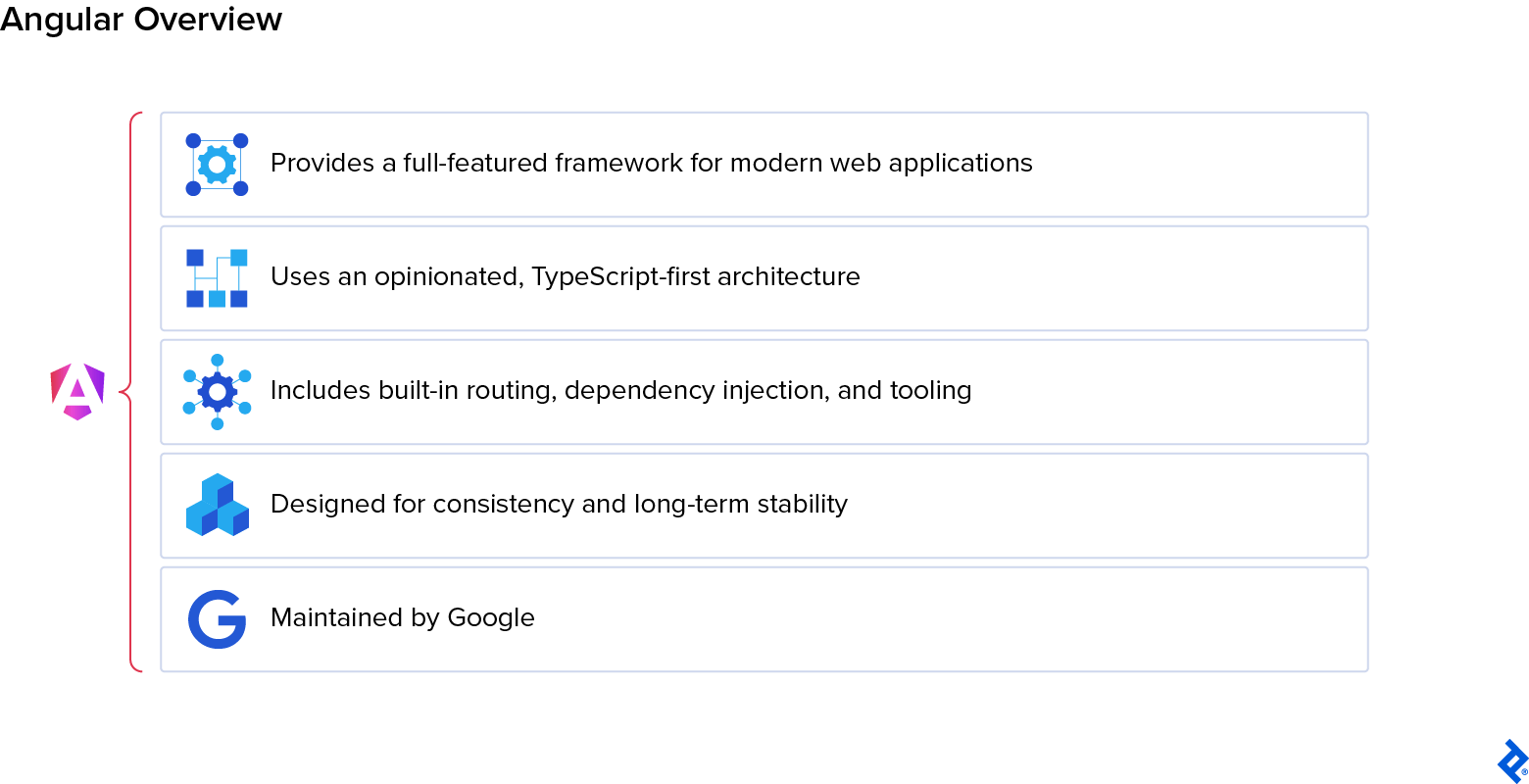
Angular is Google’s full-featured, TypeScript-based framework designed for building large-scale, enterprise-ready applications. Its first generation, AngularJS, eventually became obsolete, and the team replaced it with a complete rewrite in 2016 known as Angular 2. This rewrite marked the true beginning of modern Angular.
Angular Features
For teams that prefer a well-defined structure and don’t want to assemble their own framework from dozens of libraries, Angular’s batteries-included approach remains a major advantage. First-party tools like the Angular CLI standardize how projects are built and upgraded, while Angular’s integrated testing utilities reinforce consistent patterns across teams.
Angular has a reputation for being too heavy, too ceremonial, and too full of boilerplate, but recent versions have changed that dramatically. It has borrowed many of the best ideas from the React ecosystem without inheriting the same level of architectural complexity and messiness.
For instance, the introduction of signals in 2023 brought Angular much closer to the fine-grained reactivity that powers modern front-end frameworks like Solid and Svelte, while standalone components eliminated layers of boilerplate developers had complained about for nearly a decade. Angular’s updated change detection model also removed many of the performance pitfalls that once held it back.
In many ways, Angular today feels like the version many of us hoped for in the mid-2010s. Its modern architecture is more reactive, more predictable, and far more pleasant to work with.
Where Is Angular Used?
Angular continues to shine in enterprise-scale projects such as internal dashboards, content management systems, and long-life cycle B2B products, where consistency and predictability matter more than rapid experimentation. This is why companies such as Google and Siemens continue to rely on Angular for mission-critical applications.
That said, we’ve also seen some notable defections in recent years: For example, Microsoft Teams moved from Angular to React in 2021. High-profile shifts from React to Angular remain far less common.
Key Technical Differences Between Angular and React
In the past, some people have said that comparing Angular and React is a bit like comparing apples and oranges. One is an opinionated framework with predictable conventions (Angular), while the other is a flexible UI library (React). Although this remains true in theory, the two have also converged in significant ways.
This section focuses on the technical distinctions that still matter. While these distinctions rarely determine whether something is possible, they shape how hard it is to scale and maintain a system over time.
Architecture and Flexibility
Angular and React approach architecture from fundamentally different starting points.
Angular is opinionated by design. It provides a complete, integrated framework with routing, dependency injection, forms, HTTP tooling, and testing conventions built in. This reduces ambiguity and decision fatigue, especially on large or distributed teams, but it also constrains how applications are structured. Angular expects developers to work within its conventions rather than assemble their own architecture piece by piece.
React intentionally takes the opposite stance. It solves a narrower problem (rendering the user interface) and delegates all other tasks to the ecosystem. Routing, state management, data fetching, testing libraries, and even build tooling are left to the developer.
React’s modularity is its greatest strength but also its biggest risk. Teams gain flexibility, but they also assume responsibility for choosing, integrating, and maintaining the right combination of tools. When that work is done well, React can be extraordinarily powerful; when it’s done poorly, complexity accumulates quickly.
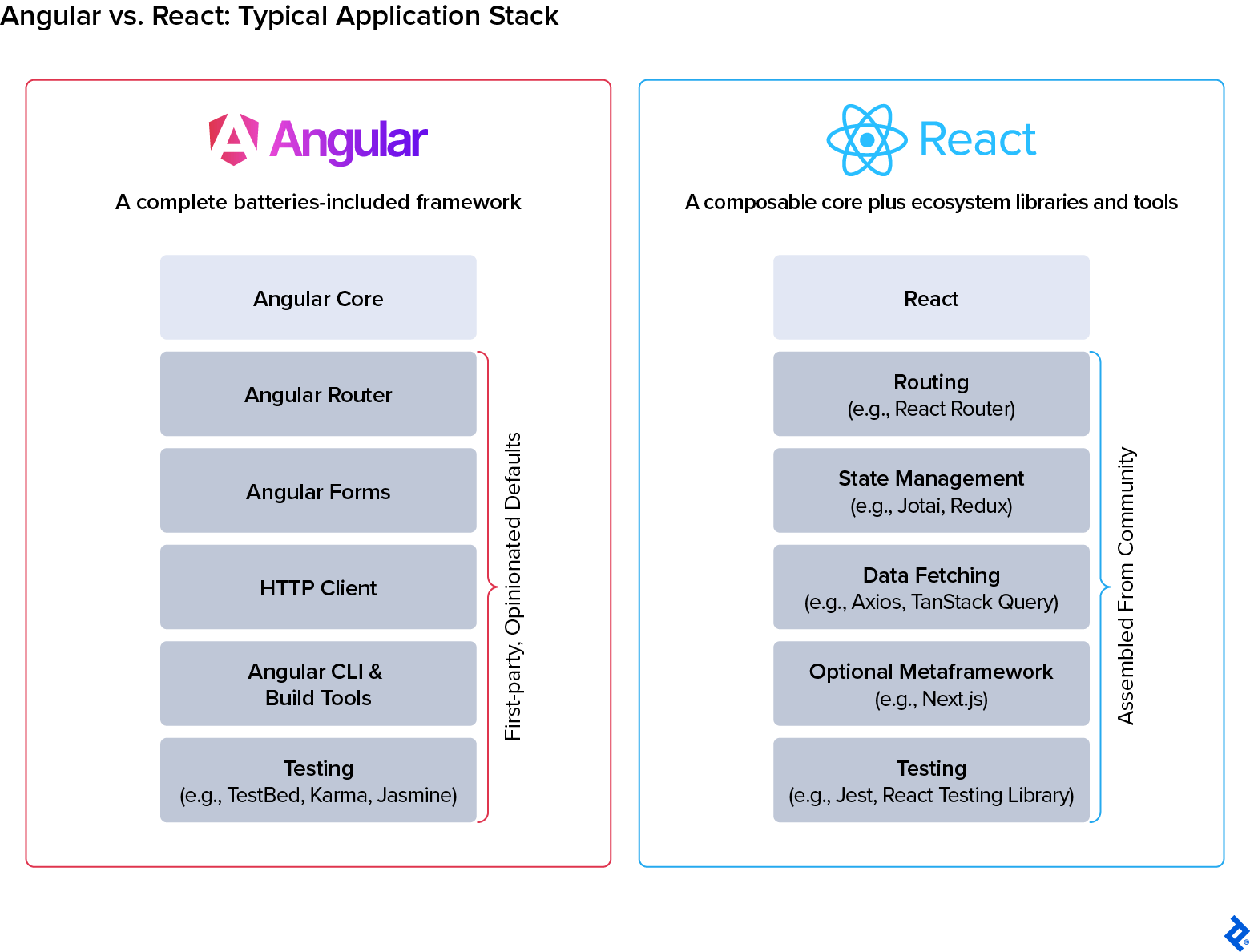
Increasingly, these two architectural approaches feel more similar than ever before. Angular’s introduction of signals has pushed the framework toward a more explicit, increasingly zoneless model that reduces implicit framework behavior. This brings Angular much closer to the fine-grained reactive state patterns React developers have refined over years of experimentation with Redux, MobX, and other state libraries.
At the same time, React has gained complexity. Server Components now allow parts of a React application to run on the server, where they can fetch data directly and stream rendered output to the client, reducing the amount of JavaScript sent to the browser. Alongside other server-driven features, this shift has added new layers of abstraction to the React ecosystem, making it feel less lightweight than it once did, even as it enables more powerful rendering models.
Takeaway: The architectural difference between Angular and React is less about mechanics and more about defaults. Angular optimizes for predictable structure out of the box. React optimizes for architectural freedom and assumes teams will design their own conventions.
Reactivity and State Management
Because state management has historically been the real fault line between Angular and React, and because that gap has largely narrowed, it’s worth looking at these changes more closely.
The Original Divide: Convenience vs. Control
Early Angular was optimized for developer convenience above all else. Features like two-way data binding and Zone.js-based change detection meant you didn’t need to think much about state at all: When anything changed, Angular would check everything. That made Angular easy to reason about, especially for newcomers, but it came at a cost. As applications grew, this model became increasingly expensive and unpredictable.
React went in the opposite direction. It pushed developers toward explicit state updates and unidirectional data flow. In theory, this offered better performance and clearer data flow. In practice, early React state management often felt like rocket science. Solutions like Redux, MobX, and hooks worked, but most came with significant boilerplate or sharp edges. React apps could be fast and elegant, but only if you really knew what you were doing.
Convergence on Fine-grained Reactivity
What’s changed is that both ecosystems have converged on the idea of dependency-tracked reactivity. Angular’s transition from Zone.js to signals in 2023 was a turning point. Signals are reactive primitives that automatically track which components depend on specific pieces of state and update only those components when the state changes, eliminating the need for broad change detection sweeps.
React has arrived at a similar place through fine-grained state libraries such as Jotai and Zustand, which provide similar selective update patterns, but these remain optional rather than the default.
Takeaway: Angular and React now offer comparable fine-grained state management. The real distinction lies in ownership: Angular now encodes its preferred reactivity model directly into the framework, while React continues to treat state management as an explicit design decision for each team.
Component Reusability and Modularity
At the component level, the historical differences between Angular and React were even more pronounced than for state management.
React’s model always felt saner for building small, reusable components at scale. You take a piece of JSX, wrap it in a function, and you have a component. That’s it. This simplicity made React’s component-based architecture especially attractive for teams building complex user interfaces composed of many small, independently evolving pieces.
Classic Angular, by contrast, came with a great deal of ceremony. Until relatively recently, creating a component meant dealing with NgModules, declarations, selectors, dependency injection metadata, and scoping rules that could easily introduce subtle errors. This overhead discouraged the creation of many small UI components, which is exactly where React thrived. For applications that required rapid iteration and fine-grained UI composition, Angular often felt like it was working against you.
Recent versions of Angular have resolved many of these issues. Standalone components remove much of the module-level boilerplate, and the overall ergonomics of defining and reusing components are far closer to what React developers have taken for granted for years. Angular still enforces more structure, but that structure now feels intentional rather than obstructive.
Takeaway: Both React and Angular now support modular design effectively, but the difference lies in how that modularity is controlled. React’s component model favors teams that want maximum composability and autonomy, while Angular’s modern component system favors reuse embedded within a shared architectural framework.
Developer Experience and Learning Curve
At first glance, it may feel easier to create React apps. If you know JavaScript, you can be productive almost immediately. This low barrier to entry is a big part of why React spread so quickly, especially among teams coming from traditional web development. You can start small, add libraries gradually, and learn the ecosystem as you go.
Angular asks more of developers upfront. TypeScript is mandatory, dependency injection is central, and there is a distinct Angular approach for doing almost everything. That initial learning curve remains, but in my experience, once developers internalize Angular’s conventions, productivity increases. The framework removes entire classes of decisions and inconsistencies that otherwise slow development over the long run.
Takeaway: The learning curve trade-off between React and Angular is primarily temporal. React minimizes friction early but shifts complexity into long-term architectural decisions, while Angular front-loads difficulty in exchange for lower cognitive overhead as systems and teams grow.
Performance Considerations
For years, performance debates around Angular and React were loud, polarized, and often misleading. Angular was “slow,” React was “fast,” and that was the end of the discussion. That framing was never entirely fair, and today it’s largely outdated.
When you look at contemporary benchmarks, the results often surprise people. If you compare modern Angular using signals and without its legacy Zone-based change detection to React using only its default hooks-based state (i.e., without fine-grained state libraries such as Zustand), Angular can match or even outperform React in several common UI workloads.
The snapshot below highlights representative findings from a benchmark analysis from October 2025.
|
Scenario |
Angular 20 (Signals, No Zone.js) |
React 19 (Hooks) |
What This Shows |
|
Swap Rows |
14.4 ms |
105.8 ms |
Fine-grained updates strongly favor Angular’s signals over React’s default hook-based state. |
|
Partial Update (Every 10th Row) |
12.3 ms |
14.9 ms |
Localized updates put modern Angular and React in a similar range. |
|
Clear Rows |
15.5 ms |
18.3 ms |
Bulk teardown costs are broadly comparable. |
|
Overall Score (Weighted Geometric Mean) |
1.49 |
1.51 |
Across mixed workloads, both frameworks fall into the same performance band. |
That comparison, however, is only half the story. In my experience, React 19 paired with modern, fine-grained state management libraries such as Zustand or MobX can perform as well as, or even better than, Angular’s signal-based approach. The difference lies in the defaults. React can be exceptionally fast, but it demands intentional setup.
Other implementation details will also shape real-world performance. Optimization increasingly depends on techniques like server-side rendering, streaming, and partial hydration, all of which are now common across front-end stacks. Still, the benchmarks above suggest that neither Angular nor React has a decisive raw performance advantage anymore.
Takeaway: With both frameworks capable of strong performance, the real difference lies in the safety margin. Angular’s modern defaults reduce the risk of accidental inefficiencies, while React offers a higher performance ceiling for teams with the discipline and experience to reach it.
React vs. Angular: Comparing Ecosystem, Community, and Long-term Support
Beyond raw technical capabilities, the long-term success of a front-end framework depends on its ecosystem, community support, and how well it holds up over years of maintenance. This is an area where Angular and React differ in ways that matter less on day one than years down the road.
Community and Ecosystem
Before diving deeper, it’s worth grounding the discussion in community and ecosystem metrics. As we’ve seen already, React continues to be the most widely used front-end library or framework according to developer surveys. It also leads by wide margins in other indicators of ecosystem gravity, such as GitHub stars (a proxy for community interest) and weekly npm downloads (a measure of active use).
*Approximate figures as of March 2026
React Community and Ecosystem
React’s ecosystem is, quite simply, unmatched. React has multiple mature, competing libraries in every major category, including routing (React Router, TanStack Router), state management (Redux, Zustand, Jotai, Recoil), data fetching (TanStack Query, SWR), and metaframeworks (Next.js, Astro, Remix).
This breadth gives teams enormous flexibility. If you need a library for routing, forms, state management, charts, authentication, or anything else, it almost certainly exists, and often in multiple competing forms. This abundance is a major reason React remains the go-to choice for startups and fast-moving teams. React also has the largest global community in front-end development and a deep hiring pool.
However, the scale of React’s community and ecosystem comes with trade-offs. Choice quickly turns into decision fatigue, and quality varies widely. Teams often discover too late that a critical dependency is poorly maintained or abandoned. React gives you enormous freedom, but it also asks you to make many architectural decisions correctly, and early mistakes can be expensive to unwind.
Angular Community and Ecosystem
Angular takes the opposite approach. Its ecosystem is smaller and less flashy but far more integrated. Google’s stewardship results in first-party solutions for routing, forms, HTTP, and dependency injection, reducing the need for third-party libraries in core application concerns. The framework also benefits from strong documentation and a predictable release cadence.
Angular may get less love in developer surveys, and its community is smaller; yet it continues to deliver real value in enterprise contexts that demand long-term consistency and maintainability across teams.
Migration, Maintenance, and Long-term Stability
These differences become even clearer when it comes to maintenance and upgrades. Angular is known for regular updates. Even when these involve breaking changes, they are deliberate, well-documented, and supported by automated migration tooling. Upgrading Angular is work, but it’s usually work you can plan and budget for.
React, by contrast, tends to offer smoother incremental upgrades at the core library level. However, major shifts often arrive through ecosystem evolution rather than explicit framework versioning. Server Components are a good example: Although they are powerful, they introduce new execution boundaries and architectural constraints that teams must adopt deliberately, often without a single, standardized migration path.
Neither model is strictly better. Teams that value centralized architectural decisions and predictable developer experience often find Angular easier to sustain. Teams that value optionality, rapid experimentation, and access to a massive talent pool are often willing to accept React’s maintenance complexity as the cost of that freedom.
Suitability of React and Angular for Different Projects
Once you move past feature comparisons, the Angular versus React decision becomes much more contextual. Both can power serious production systems, but they excel under very different team and project constraints.
Use Cases for React
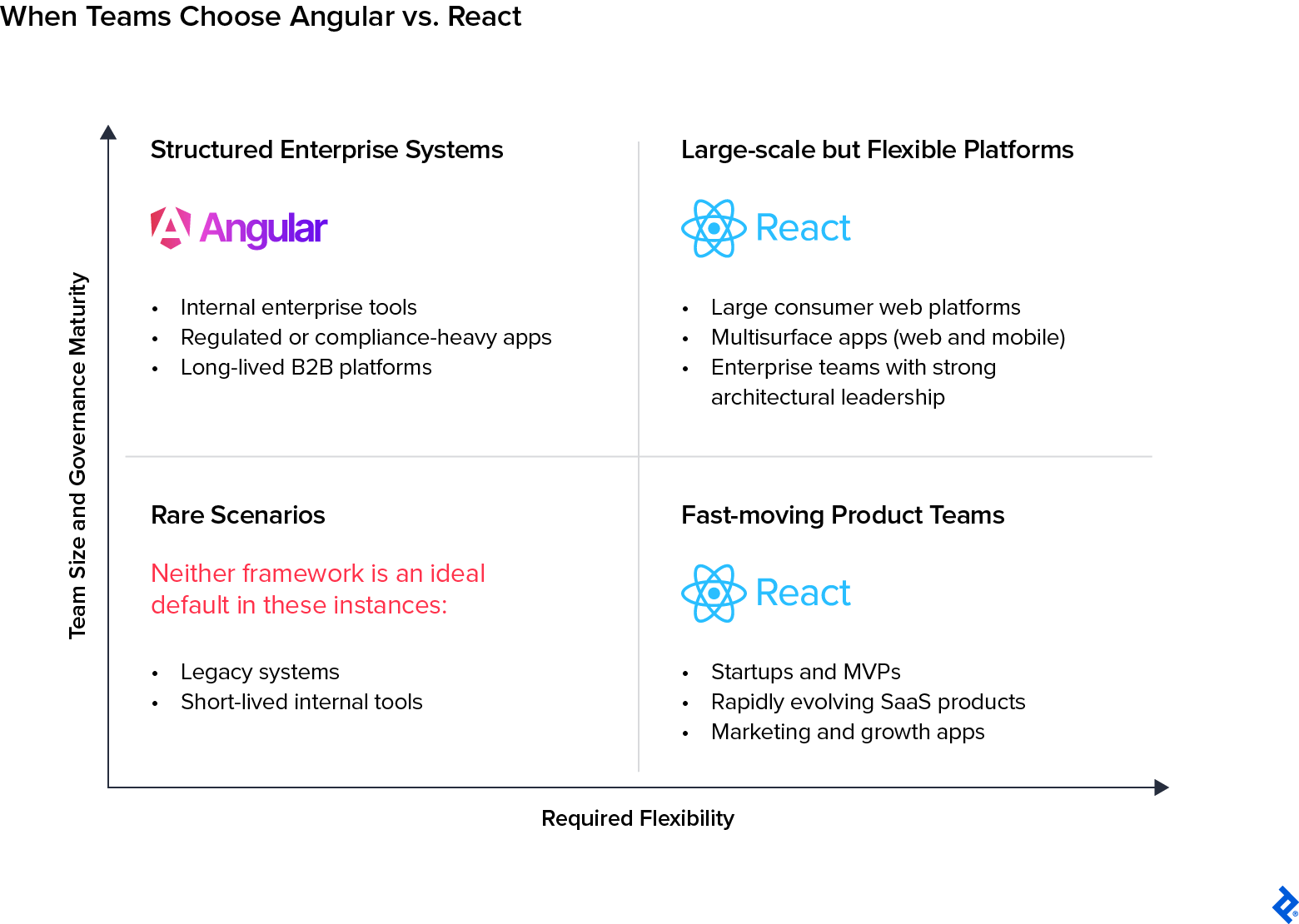
For most new projects today, React still ends up as the most popular choice among JavaScript frameworks and libraries. That’s not because it’s inherently cleaner or simpler, but because its ecosystem is unrivaled. The sheer breadth of libraries, tooling, and integrations allows React to adapt to almost any kind of product, including:
- Lightweight single-page applications (SPAs).
- SaaS dashboards and analytics products.
- Mobile-first applications built with React Native.
- Consumer-facing products with fast iteration cycles.
- Startups and greenfield projects where architecture will evolve over time.
Even with growing fatigue around parts of the ecosystem, React’s composability and reach make it hard to beat when flexibility and optionality matter. This means teams can start small, evolve architectures incrementally, and tap into a vast global talent pool when scaling becomes necessary.
Use Cases for Angular
At the same time, Angular has become a viable choice again in a way it simply wasn’t for years. There was a long period when Angular struggled in lean environments, although it was and remains commonly used in large-scale, long-lived applications, such as:
- Internal enterprise tools.
- Complex dashboards and workflow systems.
- Multiteam B2B platforms.
- Regulated or compliance-heavy applications.
- Products with long maintenance horizons and stable requirements.
Recent versions of Angular have removed many of Angular’s historic pain points, and for enterprise applications where it has always excelled, Angular is now more competitive than ever. Still, it’s hard to imagine startups or teams explicitly seeking a lightweight, experimental stack choosing Angular today. In those scenarios, React remains a more pragmatic option due to its ecosystem and hiring advantages.
Business Perspective on Angular vs. React: Cost, Talent, and Scalability
From a business standpoint, there is no universally cheaper or safer choice when deciding between React or Angular. React tends to minimize friction at the start, while Angular often minimizes risk over the lifetime of a system.
The right decision depends less on framework ideology and more on how confident you are in your team’s ability to design, enforce, and maintain architectural standards over time.
Talent Availability
A strong talent market remains one of React’s biggest advantages. Its popularity translates into a broader global developer pool and generally easier hiring, especially for teams operating in JavaScript environments. Historically, this came with intense competition for experienced React developers, but to my surprise, I’ve seen that imbalance soften as market conditions have shifted in recent years.
Angular developers, by contrast, tend to be more specialized and often come from enterprise backgrounds. That can make them harder to find, and potentially more expensive to hire, but it also means they often bring deeper experience with large, long-lived systems, internal tooling, and multiteam coordination.
Hiring Costs
From a pure hiring-cost perspective, the gap between React and Angular has largely melted away.
React developers are more plentiful, which has eased salary pressure, while Angular developers tend to be more specialized and can sometimes command a modest premium. In the United States, for instance, Glassdoor reports that React developers earn an average annual salary of $121,000, whereas Angular developers average $132,000 as of March 2026.
|
Experience Level |
Angular |
React |
|
0-1 years |
$96,000 |
$101,000 |
|
1-3 years |
$109,000 |
$108,000 |
|
4-6 years |
$120,000 |
$116,000 |
|
7-9 years |
$125,000 |
$123,000 |
|
10-14 years |
$133,000 |
$131,000 |
|
15+ years |
$145,000 |
$146,000 |
|
Average |
$132,000 |
$121,000 |
Approximate Glassdoor figures as of March 2026
Overall Development Costs
On paper, React often looks cheaper. Teams can start quickly because React has a narrower scope and fewer built-in concepts to learn upfront. A well-architected React stack can be extremely productive and cost-efficient. However, its benefits can disappear if you don’t know what you’re doing. Choosing the wrong libraries, overengineering early, or failing to standardize patterns can quietly drive costs up over time.
Angular, on the other hand, tends to front-load its costs. Teams invest more upfront in learning the framework and accepting its conventions, but that investment often pays off in long-lived systems. Because Angular ships with a coherent set of defaults (e.g., routing, dependency injection, forms, and build tooling), the cost of architectural indecision is much lower, leading to more predictable delivery over time.
Long-term Scalability
Scalability is where Angular continues to justify its place. Its opinionated architecture and integrated tooling make it easier to sustain large applications across years of organizational change. This becomes especially important in multiteam environments. Angular makes it easier to onboard new developers, transfer ownership between teams, and maintain consistency across workstreams.
React scales best when teams invest deliberately in architecture and governance. Without that discipline, flexibility can quietly turn into fragmentation (e.g., multiple state management approaches or divergent build pipelines), which becomes expensive to unwind later. React tends to work best for organizations that prioritize speed and experimentation, so long as they can commit to the architectural governance that freedom requires.
Real-world Applications Using Angular and React
Users rarely know (or care) whether an application is built with Angular or React. Modern implementations of both frameworks can deliver fast, polished user experiences. The differences that matter most tend to surface behind the scenes, shaping trends in real-world use cases.
Angular in Production
Angular continues to appear most often in large, long-lived, enterprise-scale web applications, where structure and predictable evolution matter more than rapid experimentation. As the framework’s creator, Google unsurprisingly makes extensive use of Angular across its organization, including in products like Google Cloud and Gemini.
Beyond Google, Angular shows up across the enterprise landscape, including transportation companies such as Delta Air Lines and Amtrak, financial institutions like Deutsche Bank and Citibank, and technology giants like Siemens.
These organizations tend to value Angular’s opinionated architecture and predictable release cadence. In environments with many teams, frequent handoffs, and long product life cycles, Angular’s architecture reduces ambiguity and makes systems easier to maintain, even if that comes at the cost of a slower initial ramp-up.
React in Production
React dominates in consumer-facing products, fast-moving teams, and ecosystem-heavy platforms, where flexibility and integration options matter most. Many prominent examples of React use cases come from Meta itself, which developed and continues to steward the library. React underpins user interfaces across Meta’s product ecosystem, such as Facebook, Instagram, WhatsApp, and Messenger.
Beyond Meta, React is used by media organizations like the New York Times and BBC, as well as consumer-facing companies like Airbnb and Shopify. These organizations benefit from React’s composability and vast ecosystem, which makes it easier to evolve products quickly and support a wide range of user-facing surfaces.
React’s strength in these environments isn’t that it produces inherently better user interfaces, but that it allows teams to assemble exactly the architecture they need around a shared mental model. This flexibility supports traditional web and mobile apps (via React Native) and offers mature paths to server-side rendering through metaframeworks like Next.js, Astro, and Remix.
React vs. Angular: Future Outlook and Trends in 2026
The future of Angular and React is less about dramatic disruption and more about gradual convergence under real-world pressure. As we’ve seen, many of the sharp philosophical differences that once defined the debate have softened, not because either framework won but because both were forced to evolve in response to developer demands and lessons learned from newer tools.
React and Angular’s Current Evolution
For Angular, the roadmap is clear. The framework is continuing its move away from legacy mechanisms like Zone.js toward a fully zoneless, signal-driven architecture. This direction prioritizes predictable performance and fine-grained updates, with tooling that nudges developers toward efficient patterns by default. If this trajectory holds, as it almost certainly will, Angular’s future lies in offering a tightly integrated, reactive platform that reduces accidental complexity.
React’s evolution is moving along a different axis. Rather than redefining its core mental model, React is pushing complexity into compiler-level optimizations and server-centric abstractions. Efforts around the React Compiler, Server Components, and streaming rendering aim to improve performance and developer ergonomics without forcing a single architectural style. The trade-off is that React applications increasingly rely on metaframeworks like Next.js and Astro to define best practices that React deliberately avoids prescribing.
Broader Front-end Industry Trends
Across the industry, broader front-end development trends are shaping both React and Angular. Partial hydration and islands architecture are pushing frameworks toward fine-grained updates and less monolithic rendering models. At the same time, AI-assisted development has reduced the importance of syntax and boilerplate, shifting attention toward architectural defaults and long-term ergonomics. In that context, frameworks that make the right thing easier out of the box gain an edge.
Perhaps the most telling signal comes from outside both camps. Newer frameworks like Solid and Svelte show what modern reactive systems look like when built around fine-grained dependency tracking from the outset. From a purely technical standpoint, they are often cleaner and faster. Still, ecosystem gravity matters: React and Angular will almost certainly maintain their prominent positions, even as newer ideas continue to influence their evolution.
Takeaway: The future of the React and Angular competition is not a dramatic reversal of fortunes. React will continue to dominate, but Angular will remain strong where structure and stability are prized. Both will keep borrowing ideas from smaller, more focused frameworks.
How to Choose Between Angular and React
Once you strip away hype and historical baggage, choosing between Angular and React comes down to how much structure your team wants and how much architectural responsibility it’s prepared to carry.
There’s no simple answer to a question like, “Is React better than Angular?” or vice versa. Neither approach is inherently better, but one will usually fit your team far more naturally than the other.
|
A Practical Decision Guide: Angular vs. React |
||
|---|---|---|
|
Your Constraint |
Choose Angular |
Choose React |
|
Project Lifespan |
Long-lived, multiyear system |
Rapidly evolving product or MVP |
|
Hiring Strategy |
Stable team, less frequent hiring |
Frequent hiring or rapid team growth |
|
Architecture Flexibility |
Prefer enforced conventions |
Comfortable making and enforcing architectural choices |
|
Platform Targets |
Primarily web, internal systems |
Web and mobile (React Native), hybrid apps |
|
Risk Profile |
Minimize long-term maintenance risk |
Optimize for speed and flexibility |
Ultimately, the most reliable heuristic for Angular versus React is this: Choose your paradigm first, not the framework. If your team thrives under clear rules and shared structure, Angular will feel empowering rather than restrictive. If your team prefers assembling systems from composable parts and has the experience to manage that freedom responsibly, React will continue to be the most practical choice.