


In today’s advertising ecosystem, the orchestration of strategy, execution, measurement, and optimization remains both fragmented and resource intensive. The drift across disparate systems, not least planning platforms, ad servers, Digital Signal Processors (DSPs)/Supply Side Platforms (SSPs), clean rooms, and analytics engines, creates delays, errors, and missed opportunities.
The emergence of the Ad Context Protocol (AdCP) offers a compelling strategic pivot: a unified, normative interface that enables automation-capable workflows, accelerates time-to-market, and unlocks scale in an agentic environment. A coalition of key industry players, representing the buy- and sell-side, data and measurement partners, is actively developing AdCP to define standardized “verbs” across key tasks of the supply chain.
For advertisers, this means smarter media buying. Artificial Intelligence (AI) models can now understand page context, tone, and brand safety nuances with precision, allowing creative and message adaptation in real time. For publishers, it unlocks fairer value exchange, giving them a standardized way to represent premium inventory quality and context richness to demand-side systems.
For platforms and ad tech providers, it creates interoperability, aligning algorithms, clean rooms, and measurement frameworks around consistent metadata standards. And for consumers, it restores trust, replacing invasive tracking with intelligent, privacy-safe relevance. In this blog, we examine ad context protocol and its implications for key stakeholders in the AdTech ecosystem.
The 4P framework powering privacy-first, AI-driven advertising
AdCP establishes a new foundation for contextual, intelligent, and verifiable marketing. This unified 4P framework, Policy, Protocol, Prediction, and Performance, redefines how digital advertising operates across the ecosystem, balancing compliance, interoperability, and measurable outcomes.
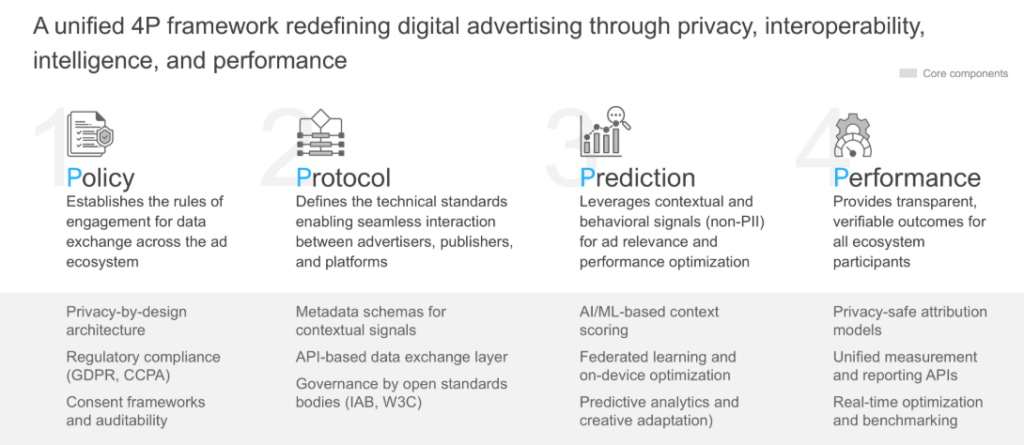
Policy sets the foundational guardrails, ensuring that all data exchange is privacy-by-design, governed by global regulations such as General Data Protection Regulation (GDPR) and California Consumer Privacy Act (CCPA), and enabled by robust consent frameworks. Protocol provides the connective infrastructure, standardizing metadata, Application Programming Interfaces (APIs), and governance mechanisms that allow advertisers, publishers, and platforms to interact seamlessly within an open yet secure environment.
Prediction introduces intelligence into the ecosystem, leveraging AI and machine learning to analyze contextual and behavioral signals without relying on personally identifiable information to enhance relevance, targeting precision, and creative adaptability. Finally, Performance anchors the framework in accountability, establishing privacy-safe attribution models, unified measurement APIs, and real-time optimization loops that validate the effectiveness of every ad dollar spent.
Together, these four pillars create a trust-based digital advertising architecture, enabling stakeholders to achieve personalization without intrusion, optimization without surveillance, and performance without compromising privacy. The 4P framework positions ACP as the strategic operating system for next-generation, AI-enabled, context-driven marketing.
Startups and ad-tech incumbents are ramping investments to back the evolution of the AdCP ecosystem. Firms like AdsGency raised a US$12 million seed round to build agentic AI platforms that automate cross-platform ad buying, aligning directly with AdCP’s vision of AI-to-AI workflows. At the same time, large ad-tech players such as PubMatic, Yahoo, and Triton Digital are backing the open standard’s founding coalition, enabling shared APIs, metadata protocols and context-based signal exchange.
Implications for key stakeholders
Advertisers
- Acceleration and agility: Standardization across vendors reduces lead time for campaign launches and iterations
- Governance and transparency: With machine-readable policies baked into planning and activation, advertisers can enforce brand safety, sustainability commitments, and measurement goals consistently
- Measurement integrity: While data clean rooms remain critical for privacy-safe attribution, AdCP enables leaner hand‐offs, linking clean-room outputs into activation loops rather than bespoke APIs
- Strategic risk: Over-reliance on automation without strong governance can amplify sub-optimal decisions, human oversight remains essential
Publishers & platforms
- Operational efficiency: Sell-side agents can now expose packaging, availability, rates, holds, and make-goods via standardized verbs, reducing friction in complex deals across linear, Connected TV (CTV), and retail media
- New access pathways: Brands and agencies gain more direct access to premium inventory and first-party data through unified endpoints, diminishing the ‘Request for Proposal (RFP) tax.’
- Revenue opportunity: With lower integration cost, sellers can scale new formats and bundles faster
- Competitive risk: Standards flatten the infrastructure cost curve, publishers must differentiate via data quality, creative innovation, service, and attention metrics rather than solely by access
Agencies and service provider
- Value-shift: Agencies move from manual execution to ‘playbook architects’, defining strategy, policies, and machine-legible rules that drive automation
- Margin protection: By owning the orchestration and policy layer atop AdCP, agencies preserve high-value consulting and optimization roles rather than being commoditized
- Capability build-up: Investment in policy engines, orchestration fabric, and talent becomes critical to staying relevant
- Execution risk: Without strong automation infrastructure, agencies may struggle to compete against in-house operations or platform-native models leveraging AdCP
Final thoughts
The emergence of the Ad Context Protocol signals a strategic inflection point in advertising operations. Rather than adding another layer of complexity, it promises to simplify the infrastructure underlying automation, enabling organizations to focus on outcomes rather than integrations.
In essence, AdCP is less about technology and more about workflow reinvention, a critical enabler for the agentic era of marketing. The organizations that adopt early and adapt their operating model accordingly will be business-agnostic to tools and vendor shifts.
The question is not if your stack will support agentic advertising, it’s when. And the answer is: the sooner you standardize the interface, the faster you can start treating advertising as a self-optimizing system rather than a series of disconnected tasks.
If you enjoyed this blog, check out, The Merger Mirage: Why Agency Consolidation Can Be A Slippery Slope | Blog – Everest Group, which delves deeper into another topic relating to advertising and marketing.
If you have questions about ad tech and media services, please reach out to Nitish Mittal and Aakash Verma.