
Close Menu
geekfence.comgeekfence.com
    What's Hot

    From transparency to action: What the latest Microsoft email security benchmark reveals

    March 13, 2026

    Twenty years of Amazon S3 and building what’s next

    March 13, 2026

    Threat Protection Updates in Secure Firewall 10.0

    March 13, 2026
    Facebook X (Twitter) Instagram
    • About Us
    • Contact Us
    Facebook Instagram
    geekfence.comgeekfence.com
    • Home
    • UK Tech News
    • AI
    • Big Data
    • Cyber Security
      • Cloud Computing
      • iOS Development
    • IoT
    • Mobile
    • Software
      • Software Development
      • Software Engineering
    • Technology
      • Green Technology
      • Nanotechnology
    • Telecom
    geekfence.comgeekfence.com
    Home»Nanotechnology»A surprising critical state emerges in active nematic materials – Physics World
    Nanotechnology

    A surprising critical state emerges in active nematic materials – Physics World

    AdminBy AdminJanuary 26, 2026No Comments2 Mins Read2 Views
    Facebook Twitter Pinterest LinkedIn Telegram Tumblr Email
    A surprising critical state emerges in active nematic materials – Physics World
    Share
    Facebook Twitter LinkedIn Pinterest Email


    A transition in active nematics produces slow, strongly interacting defects, a behaviour confirmed in living cells

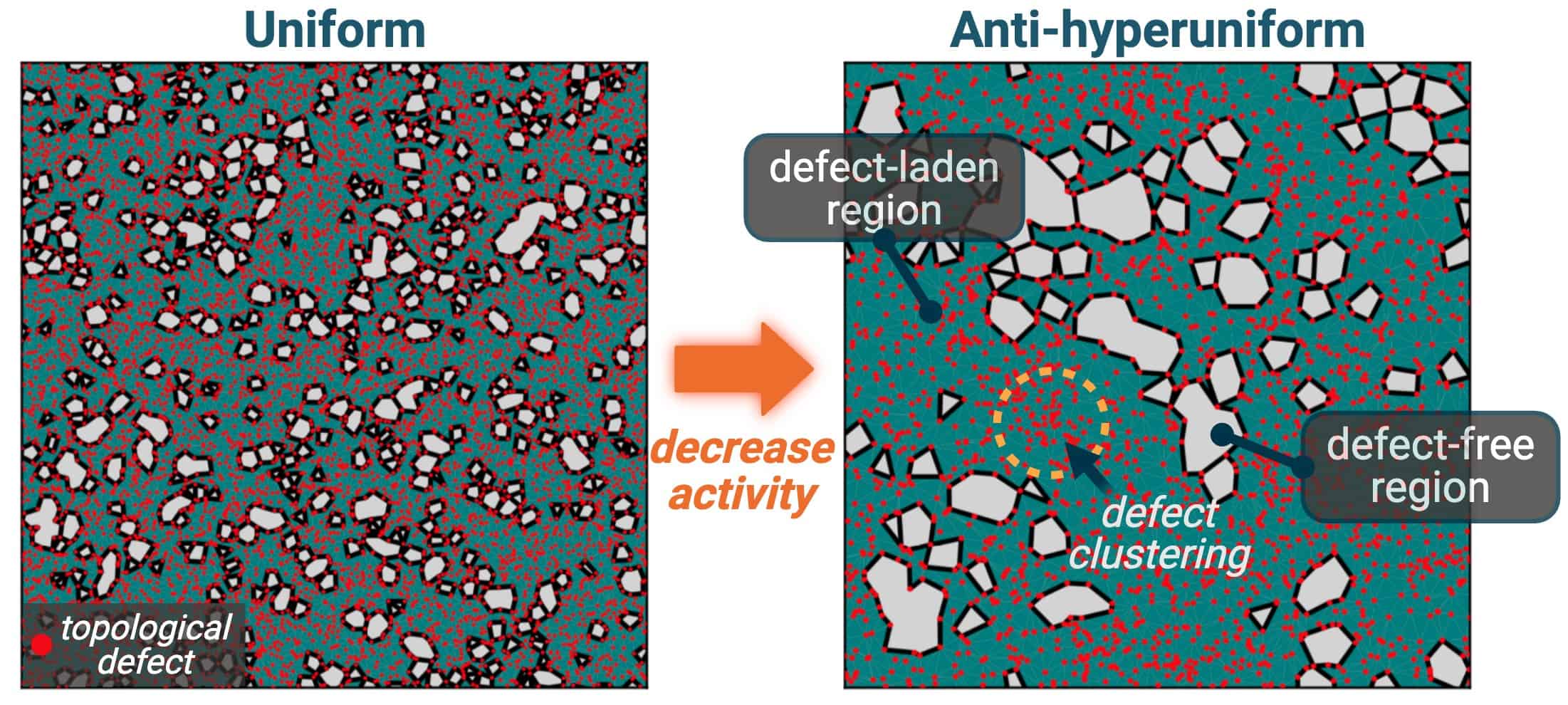
    Emergence of anti-hyperuniform defect organization in active nematics. At high activity (left), topological defects are distributed nearly uniformly throughout the system. Reducing activity toward a critical point (right) triggers defect clustering, and large defect-free regions exist alongside defect-rich ones

    Emergence of anti-hyperuniform defect organization in active nematics. At high activity (left), topological defects are distributed nearly uniformly throughout the system. Reducing activity toward a critical point (right) triggers defect clustering, and large defect-free regions exist alongside defect-rich ones (Courtesy: Doostmohammadi/University of Copenhagen)

    Nematics are materials made of rod‑like particles that tend to align in the same direction. In active nematics, this alignment is constantly disrupted and renewed because the particles are driven by internal biological or chemical energy. As the orientation field twists and reorganises, it creates topological defects-points where the alignment breaks down. These defects are central to the collective behaviour of active matter, shaping flows, patterns, and self‑organisation.

    In this work, the researchers identify an active topological phase transition that separates two distinct regimes of defect organisation. As the system approaches this transition from below, the dynamics slow dramatically: the relaxation of defect density becomes sluggish, fluctuations in the number of defects grow in amplitude and lifetime, and the system becomes increasingly sensitive to small changes in activity. At the critical point, defects begin to interact over long distances, with correlation lengths that grow with system size. This behaviour produces a striking dual‑scaling pattern, defect fluctuations appear uniform at small scales but become anti‑hyperuniform at larger scales, meaning that the number of defects varies far more than expected from a random distribution.

    A key finding is that this anti‑hyperuniformity originates from defect clustering. Rather than forming ordered structures or undergoing phase separation, defects tend to appear near existing defects, creating multiscale clusters. This distinguishes the transition from well‑known defect‑unbinding processes such as the Berezinskii-Kosterlitz-Thouless transition in passive nematics or the nematic-isotropic transition in screened active systems. Above the critical activity, the system enters a defect‑laden turbulent state where defects are more uniformly distributed and correlations become short‑ranged and negative.

    The researchers confirm these behaviours experimentally using large‑field‑of‑view measurements of endothelial cell monolayers which are the cells that line blood vessels. The same dual‑scaling behaviour, long‑range correlations, and clustering appear in these living tissues, demonstrating that the transition is robust across system sizes, parameter variations, frictional damping, and boundary conditions.

    Do you want to learn more about this topic?

    Active phase separation: new phenomenology from non-equilibrium physics M E Cates and C Nardini (2025)


    Source link

    Share. Facebook Twitter Pinterest LinkedIn Tumblr Email

    Related Posts

    Deep tumor penetration of supramolecular Fmoc-Glyco/ Fmoc-diphenylalanine-DOX drug loaded nanorods for targeted chemotherapy

    March 12, 2026

    AND logic nanoparticle for precision immunotherapy of metastatic cancers

    March 11, 2026

    Resolving the spin of sound – Physics World

    March 10, 2026

    pH-Responsive Nanocarrier for Targeted Doxorubicin Delivery

    March 9, 2026

    AI discovers the hidden signal of liquid-like ion flow in solid-state batteries

    March 8, 2026

    Structural morphology of peptide nanofibrils dictates viral capture and cellular uptake in gene therapy applications

    March 6, 2026
    Top Posts

    Hard-braking events as indicators of road segment crash risk

    January 14, 202619 Views

    Understanding U-Net Architecture in Deep Learning

    November 25, 202519 Views

    How to integrate a graph database into your RAG pipeline

    February 8, 202610 Views
    Don't Miss

    From transparency to action: What the latest Microsoft email security benchmark reveals

    March 13, 2026

    In our last benchmarking post, Clarity in complexity: New insights for transparent email security,1 we…

    Twenty years of Amazon S3 and building what’s next

    March 13, 2026

    Threat Protection Updates in Secure Firewall 10.0

    March 13, 2026

    Growth at any cost is losing its luster

    March 13, 2026
    Stay In Touch
    • Facebook
    • Instagram
    About Us

    At GeekFence, we are a team of tech-enthusiasts, industry watchers and content creators who believe that technology isn’t just about gadgets—it’s about how innovation transforms our lives, work and society. We’ve come together to build a place where readers, thinkers and industry insiders can converge to explore what’s next in tech.

    Our Picks

    From transparency to action: What the latest Microsoft email security benchmark reveals

    March 13, 2026

    Twenty years of Amazon S3 and building what’s next

    March 13, 2026

    Subscribe to Updates

    Please enable JavaScript in your browser to complete this form.
    Loading
    • About Us
    • Contact Us
    • Disclaimer
    • Privacy Policy
    • Terms and Conditions
    © 2026 Geekfence.All Rigt Reserved.

    Type above and press Enter to search. Press Esc to cancel.