

In this article, you will learn practical prompt-engineering patterns that make large language models useful and reliable for time series analysis and forecasting.
Topics we will cover include:
- How to frame temporal context and extract useful signals
- How to combine LLM reasoning with classical statistical models
- How to structure data and prompts for forecasting, anomalies, and domain constraints
Without further delay, let’s begin.
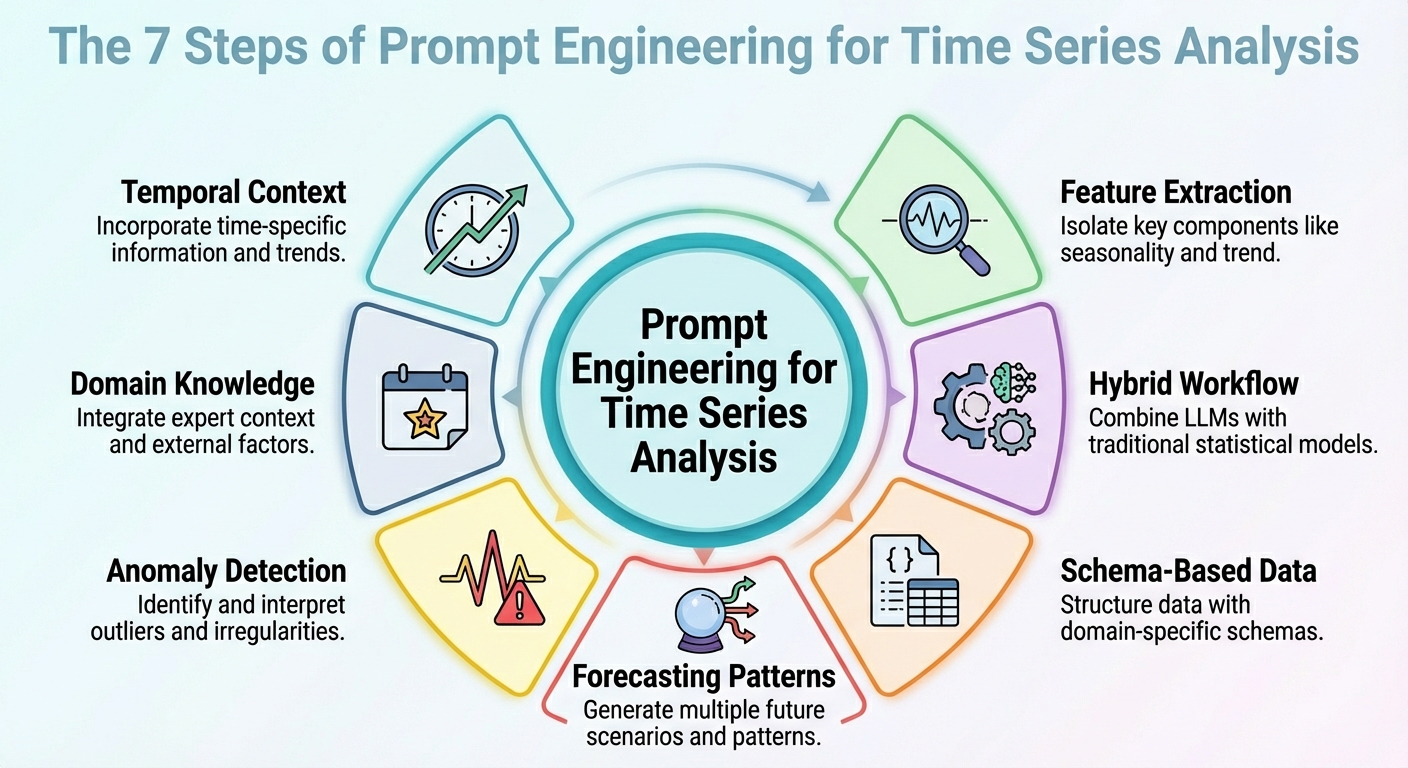
Prompt Engineering for Time Series Analysis
Image by Editor
Introduction
Strange as it may sound, large language models (LLMs) can be leveraged for data analysis tasks, including specific scenarios such as time series analysis. The key is to correctly translate your prompt engineering skills into the specific analysis scenario.
This article outlines seven prompt engineering strategies that can be used to leverage time series analysis tasks with LLMs.
Unless said otherwise, the descriptions of these strategies are accompanied by illustrative examples revolving around a retail sales data scenario, concretely, considering a time series dataset consisting of daily sales over time for its analysis.
1. Contextualizing Temporal Structure
First, an effective prompt to get a useful model output should be one that helps it understand the temporal structure of the time series dataset. This includes possible mentions of upward/downward trends, seasonality, known cycles like promotions or holidays, and so on. This context information will help your LLM interpret, for instance, temporal fluctuations as — well, just that: fluctuations, rather than noise. In sum, describing the structure of the dataset clearly in the context accompanying your prompts often goes further than intricate reasoning instructions in prompts.
Example prompt:
“Here is the daily sales (in units) for the last 365 days. The data shows a weekly seasonality (higher sales on weekends), a gradually increasing long-term trend, and monthly spikes at the end of each month due to pay-day promotions. Use that knowledge when forecasting the next 30 days.”
2. Feature and Signal Extraction
Instead of asking your model to perform direct forecasts from raw numbers, why not prompt it to extract some key features first? This could include latent patterns, anomalies, and correlations. Asking the LLM to extract features and signals and incorporate them into the prompt (e.g., through summary statistics or decomposition) helps reveal the reasons behind future predictions or fluctuations.
Example prompt:
“From the past 365 days of sales data, compute the average daily sales, the standard deviation, identify any days where sales exceeded mean plus twice the standard deviation (i.e., potential outliers), and note any recurring weekly or monthly patterns. Then interpret what factors might explain high-sales days or dips, and flag any unusual anomalies.”
3. Hybrid LLM + Statistical Workflow
Let’s face it: LLMs in isolation will often struggle with tasks requiring numeric precision and capturing temporal dependencies in time series. For this reason, simply combining their use with classical statistical models is a formula to yield better outcomes. How could a hybrid workflow like this be defined? The trick is to inject LLM reasoning — high-level interpretation, hypothesis formulation, and context comprehension — alongside quantitative models such as ARIMA, ETS, or others.
For instance, LeMoLE (LLM-Enhanced Mixture of Linear Experts) is an example of a hybrid approach that enriches linear models with prompt-derived features.
The result blends contextual reasoning and statistical rigor: the best of two worlds.
4. Schema-based Data Representation
While raw time series datasets are usually poorly suited formats to pass as LLM inputs, using structured schemas like JSON or compact tables could be the key that allows the LLM to interpret these data much more reliably, as demonstrated in several studies.
Example JSON snippet to be passed alongside a prompt:
|
{ “sales”: [ {“date”: “2024-12-01”, “units”: 120}, {“date”: “2024-12-02”, “units”: 135}, ..., {“date”: “2025-11-30”, “units”: 210} ], “metadata”: { “frequency”: “daily”, “seasonality”: [“weekly”, “monthly_end”], “domain”: “retail_sales” } } |
Prompt to accompany the JSON data with:
“Given the above JSON data and metadata, analyze the time series and forecast the next 30 days of sales.”
5. Prompted Forecasting Patterns
Designing and properly structuring forecasting patterns within the prompt — such as short-term vs. long-term horizons or simulating specific “what-if” scenarios — can help guide the model to produce more usable responses. This approach is effective for generating highly actionable insights for your requested analysis.
Example:
|
Task A — Short–term (next 7 days): Forecast expected sales.
Task B — Long–term (next 30 days): Provide a baseline forecast plus two scenarios: – Scenario 1 (normal conditions) – Scenario 2 (with a planned promotion on days 10–15)
In addition, provide a 95% confidence interval for both scenarios. |
6. Anomaly Detection Prompts
This one is more task-specific and focuses on properly crafting prompts that may help not only forecast with LLMs but also detect anomalies — in combination with statistical methods — and reason about their likely causes, or even suggest what to investigate. The key is, once more, to first preprocess with traditional time series tools and then prompt the model for interpretation of findings.
Example prompt:
“Using the sales data JSON, first flag any day where sales deviate more than 2× the weekly standard deviation from the weekly mean. Then for every flagged day, explain possible causes (e.g., out-of-stock, promotion, external events) and recommend whether to investigate (e.g., check inventory logs, marketing campaign, store foot traffic).”
7. Domain-Infused Reasoning
Domain knowledge like retail seasonality patterns, holiday effects, etc., uncovers valuable insights, and embedding it into prompts helps LLMs perform analyses and predictions that are more meaningful and also interpretable. This boils down to leveraging the relevance of “dataset context,” both semantically and domain-specific, as the lighthouse that guides model reasoning.
A prompt like this could help the LLM do better at anticipating month-end spikes or sales drops due to holiday discounts:
“This is the daily sales data of a retail chain. Sales tend to spike at the end of each month (customers receive salaries), drop on public holidays, and increase during promotional events. There is also an occasional stock shortage, resulting in dips for certain SKUs. Use this domain knowledge when analyzing the series and forecasting.”
Wrapping Up
This article described seven different strategies, largely founded and supported by recent studies, to make more effective prompts for time series analysis and forecasting tasks aided by LLMs.