

Close Menu
geekfence.comgeekfence.com
    What's Hot

    HCLTech acquires HPE telco unit

    December 29, 2025

    This tiny chip could change the future of quantum computing

    December 29, 2025

    What’s In a Name? Mainframe GDGs Get the Job Done

    December 29, 2025
    Facebook X (Twitter) Instagram
    • About Us
    • Contact Us
    Facebook Instagram
    geekfence.comgeekfence.com
    • Home
    • UK Tech News
    • AI
    • Big Data
    • Cyber Security
      • Cloud Computing
      • iOS Development
    • IoT
    • Mobile
    • Software
      • Software Development
      • Software Engineering
    • Technology
      • Green Technology
      • Nanotechnology
    • Telecom
    geekfence.comgeekfence.com
    Home»Nanotechnology»DNA as a molecular architect – Physics World
    Nanotechnology

    DNA as a molecular architect – Physics World

    AdminBy AdminNovember 27, 2025No Comments3 Mins Read0 Views
    Facebook Twitter Pinterest LinkedIn Telegram Tumblr Email
    DNA as a molecular architect – Physics World
    Share
    Facebook Twitter LinkedIn Pinterest Email


    A new model shows how programmable DNA strands control interactions between diverse colloidal particles
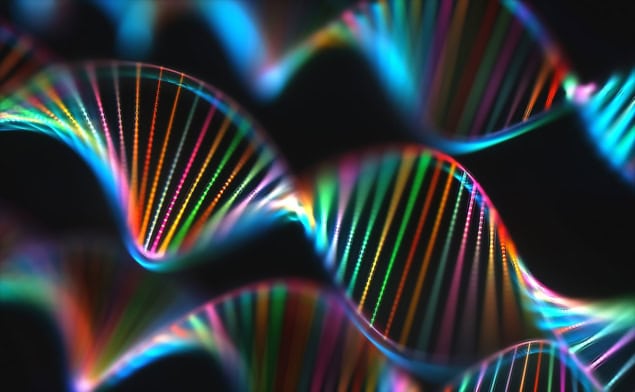
    DNA illustration

    DNA illustration (Courtesy: iStock/Ktsimage)

    DNA is a fascinating macromolecule that guides protein production and enables cell replication. It has also found applications in nanoscience and materials design.

    Colloidal crystals are ordered structures made from tiny particles suspended in fluid that can bond to other particles and add functionalisation to materials. By controlling colloidal particles, we can build advanced nanomaterials using a bottom-up approach. There are several ways to control colloidal particle design, ranging from experimental conditions such as pH and temperature to external controls like light and magnetic fields.

    An exciting approach is to use DNA-mediated processes. DNA binds to colloidal surfaces and regulates how the colloids organize, providing molecular-level control. These connections are reversible and can be broken using standard experimental conditions (e.g., temperature), allowing for dynamic and adaptable systems. One important motivation is their good biocompatibility, which has enabled applications in biomedicine such as drug delivery, biosensing, and immunotherapy.

    Programmable Atom Equivalents (PAEs) are large colloidal particles whose surfaces are functionalized with single-stranded DNA, while separate, much smaller DNA-coated linkers, called Electron Equivalents (EEs), roam in solution and mediate bonds between PAEs. In typical PAE-EE systems, the EEs carry multiple identical DNA ends that can all bind the same type of PAE, which limits the complexity of the assemblies and makes it harder to program highly specific connections between different PAE types.

    In this study, the researchers investigate how EEs with arbitrary valency, carrying many DNA arms, regulate interactions in a binary mixture of two types of PAEs. Each EE has multiple single-stranded DNA ends of two different types, each complementary to the DNA on one of the PAE species. The team develops a statistical mechanical model to predict how EEs distribute between the PAEs and to calculate the effective interaction, a measure of how strongly the PAEs attract each other, which in turn controls the structures that can form.

    Using this model, they inform Monte Carlo simulations to predict system behaviour under different conditions. The model shows quantitative agreement with simulation results and reveals an anomalous dependence of PAE-PAE interactions on EE valency, with interactions converging at high valency. Importantly, the researchers identify an optimal valency that maximizes selectivity between targeted and non-targeted binding pairs. This groundbreaking research provides design principles for programmable self-assembly and offers a framework that can be integrated into DNA nanoscience.

    Do you want to learn more about this topic?

    Assembly of colloidal particles in solution by Kun Zhao and Thomas G Mason (2018)


    Source link

    Share. Facebook Twitter Pinterest LinkedIn Tumblr Email

    Related Posts

    Emerging quantitative techniques for characterizing nucleic acid-involved molecular interactions

    December 29, 2025

    A self-delivering antimicrobial peptide hydrogel for treatment of staphylococcal infections in orthopedic implants

    December 28, 2025

    A biohybrid chiral hydrogel enhances preclinical postoperative glioblastoma therapy by multi-pronged inhibition of tumour stemness

    December 27, 2025

    The Graphene Investment Opportunity Report 2025

    December 26, 2025

    How does quantum entanglement move between different particles? – Physics World

    December 25, 2025

    Safer, Cheaper Method for Creating Futuristic MXenes

    December 24, 2025
    Top Posts

    Understanding U-Net Architecture in Deep Learning

    November 25, 20258 Views

    Microsoft 365 Copilot now enables you to build apps and workflows

    October 29, 20258 Views

    Here’s the latest company planning for gene-edited babies

    November 2, 20257 Views
    Don't Miss

    HCLTech acquires HPE telco unit

    December 29, 2025

    HCLTech moves toward a future of AI-driven growth In sum – what we know: The…

    This tiny chip could change the future of quantum computing

    December 29, 2025

    What’s In a Name? Mainframe GDGs Get the Job Done

    December 29, 2025

    Microsoft named a Leader in Gartner® Magic Quadrant™ for AI Application Development Platforms

    December 29, 2025
    Stay In Touch
    • Facebook
    • Instagram
    About Us

    At GeekFence, we are a team of tech-enthusiasts, industry watchers and content creators who believe that technology isn’t just about gadgets—it’s about how innovation transforms our lives, work and society. We’ve come together to build a place where readers, thinkers and industry insiders can converge to explore what’s next in tech.

    Our Picks

    HCLTech acquires HPE telco unit

    December 29, 2025

    This tiny chip could change the future of quantum computing

    December 29, 2025

    Subscribe to Updates

    Please enable JavaScript in your browser to complete this form.
    Loading
    • About Us
    • Contact Us
    • Disclaimer
    • Privacy Policy
    • Terms and Conditions
    © 2025 Geekfence.All Rigt Reserved.

    Type above and press Enter to search. Press Esc to cancel.