

In the world of deep learning, especially within the realm of medical imaging and computer vision, U-Net has emerged as one of the most powerful and widely used architectures for image segmentation. Originally proposed in 2015 for biomedical image segmentation, U-Net has since become a go-to architecture for tasks where pixel-wise classification is required.
What makes U-Net unique is its encoder-decoder structure with skip connections, enabling precise localization with fewer training images. Whether you’re developing a model for tumor detection or satellite image analysis, understanding how U-Net works is essential for building accurate and efficient segmentation systems.
This guide offers a deep, research-informed exploration of the U-Net architecture, covering its components, design logic, implementation, real-world applications, and variants.
What is U-Net?
U-Net is one of the architectures of convolutional neural networks (CNN) created by Olaf Ronneberger et al. in 2015, aimed for semantic segmentation (classification of pixels).
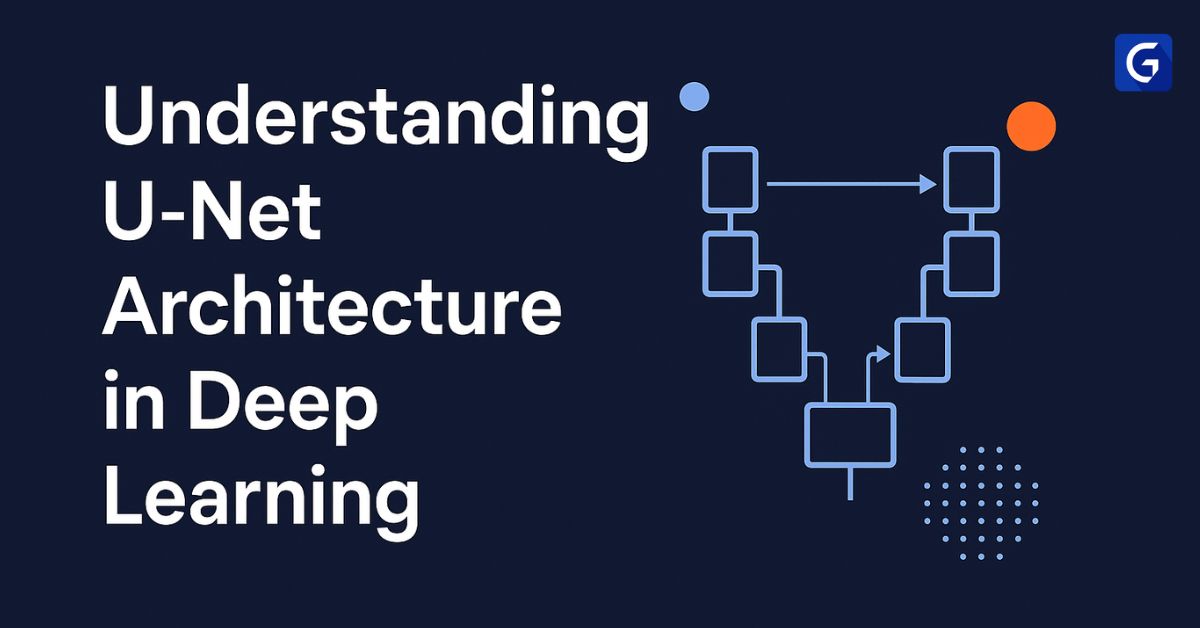
The U shape in which it is designed earns it the name. Its left half of the U being a contracting path (encoder) and its right half an expanding path (decoder). These two lines are symmetrically joined using skip connections that pass on feature maps directly from encoder layer to decoder layers.
Key Components of U-Net Architecture
1. Encoder (Contracting Path)
- Composed of repeated blocks of two 3×3 convolutions, each followed by a ReLU activation and a 2×2 max pooling layer.
- At each downsampling step, the number of feature channels doubles, capturing richer representations at lower resolutions.
- Purpose: Extract context and spatial hierarchies.
2. Bottleneck
- Acts as the bridge between encoder and decoder.
- Contains two convolutional layers with the highest number of filters.
- It represents the most abstracted features in the network.
3. Decoder (Expanding Path)
- Uses transposed convolution (up-convolution) to upsample feature maps.
- Follows the same pattern as the encoder (two 3×3 convolutions + ReLU), but the number of channels halves at each step.
- Purpose: Restore spatial resolution and refine segmentation.
4. Skip Connections
- Feature maps from the encoder are concatenated with the upsampled output of the decoder at each level.
- These help recover spatial information lost during pooling and improve localization accuracy.
5. Final Output Layer
- A 1×1 convolution is applied to map the feature maps to the desired number of output channels (usually 1 for binary segmentation or n for multi-class).
- Followed by a sigmoid or softmax activation depending on the segmentation type.
How U-Net Works: Step-by-Step

1. Encoder Path (Contracting Path)
Goal: Capture context and spatial features.
How it works:
- The input image passes through several convolutional layers (Conv + ReLU), each followed by a max-pooling operation (downsampling).
- This reduces spatial dimensions while increasing the number of feature maps.
- The encoder helps the network learn what is in the image.
2. Bottleneck
- Goal: Act as a bridge between the encoder and decoder.
- It’s the deepest part of the network where the image representation is most abstract.
- Includes convolutional layers with no pooling.
3. Decoder Path (Expanding Path)
Goal: Reconstruct spatial dimensions and locate objects more precisely.
How it works:
- Each step includes an upsampling (e.g., transposed convolution or up-conv) that increases the resolution.
- The output is then concatenated with corresponding feature maps from the encoder (from the same resolution level) via skip connections.
- Followed by standard convolution layers.
4. Skip Connections
Why they matter:
- Help recover spatial information lost during downsampling.
- Connect encoder feature maps to decoder layers, allowing high-resolution features to be reused.
5. Final Output Layer
A 1×1 convolution is applied to map each multi-channel feature vector to the desired number of classes (e.g., for binary or multi-class segmentation).
Why U-Net Works So Well
- Efficient with limited data: U-Net is ideal for medical imaging, where labeled data is often scarce.
- Preserves spatial features: Skip connections help retain edge and boundary information crucial for segmentation.
- Symmetric architecture: Its mirrored encoder-decoder design ensures a balance between context and localization.
- Fast training: The architecture is relatively shallow compared to modern networks, which allows for faster training on limited hardware.
Applications of U-Net
- Medical Imaging: Tumor segmentation, organ detection, retinal vessel analysis.
- Satellite Imaging: Land cover classification, object detection in aerial views.
- Autonomous Driving: Road and lane segmentation.
- Agriculture: Crop and soil segmentation.
- Industrial Inspection: Surface defect detection in manufacturing.
Variants and Extensions of U-Net
- U-Net++ – Introduces dense skip connections and nested U-shapes.
- Attention U-Net – Incorporates attention gates to focus on relevant features.
- 3D U-Net – Designed for volumetric data (CT, MRI).
- Residual U-Net – Combines ResNet blocks with U-Net for improved gradient flow.
Each variant adapts U-Net for specific data characteristics, improving performance in complex environments.
Best Practices When Using U-Net
- Normalize input data (especially in medical imaging).
- Use data augmentation to simulate more training examples.
- Carefully choose loss functions (e.g., Dice loss, focal loss for class imbalance).
- Monitor both accuracy and boundary precision during training.
- Apply K-Fold Cross Validation to validate generalizability.
Common Challenges and How to Solve Them
| Challenge | Solution |
| Class imbalance | Use weighted loss functions (Dice, Tversky) |
| Blurry boundaries | Add CRF (Conditional Random Fields) post-processing |
| Overfitting | Apply dropout, data augmentation, and early stopping |
| Large model size | Use U-Net variants with depth reduction or fewer filters |
Learn Deeply
Conclusion
The U-Net architecture has stood the test of time in deep learning for a reason. Its simple yet strong form continues to support the high-precision segmentation transversally. Regardless of whether you are in healthcare, earth observation or autonomous navigation, mastering the art of U-Net opens the floodgates of possibilities.
Having an idea about how U-Net operates starting from its encoder-decoder backbone to the skip connections and utilizing best practices at training and evaluation, you can create highly accurate data segmentation models even with a limited number of data.
Join Introduction to Deep Learning Course to kick start your deep learning journey. Learn the basics, explore in neural networks, and develop a good background for topics related to advanced AI.
Frequently Asked Questions(FAQ’s)
1. Are there possibilities to use U-Net in other tasks except segmenting medical images?
Yes, although U-Net was initially developed for biomedical segmentation, its architecture can be used for other applications including analysis of satellite imagery (e.g., satellite images segmentation), self driving cars (roads’ segmentation in self driving-cars), agriculture (e.g., crop mapping) and also used for text based segmentation tasks like Named Entity Recogn
2. What is the way U-Net treats class imbalance during segmentation activities?
On its own, class imbalance is not a problem of U-Net. However, you can reduce imbalance by some loss functions such as Dice loss, Focal loss or weighted cross-entropy that focuses more on poorly represented classes during training.
3. Can U-Net be used for 3D image data?
Yes. One of the variants, 3D U-Net, extends the initial 2D convolutional layers to 3D convolutions, therefore being appropriate for volumetric data, such as CT or MRI scans. The general architecture is about the same with the encoder-decoder routes and the skip connections.
4. What are some popular modifications of U-Net for improving performance?
Several variants have been proposed to improve U-Net:
- Attention U-Net (adds attention gates to focus on important features)
- ResUNet (uses residual connections for better gradient flow)
- U-Net++ (adds nested and dense skip pathways)
- TransUNet (combines U-Net with Transformer-based modules)
5. How does U-Net compare to Transformer-based segmentation models?
U-Net excels in low-data regimes and is computationally efficient. However, Transformer-based models (like TransUNet or SegFormer) often outperform U-Net on large datasets due to their superior global context modeling. Transformers also require more computation and data to train effectively.