

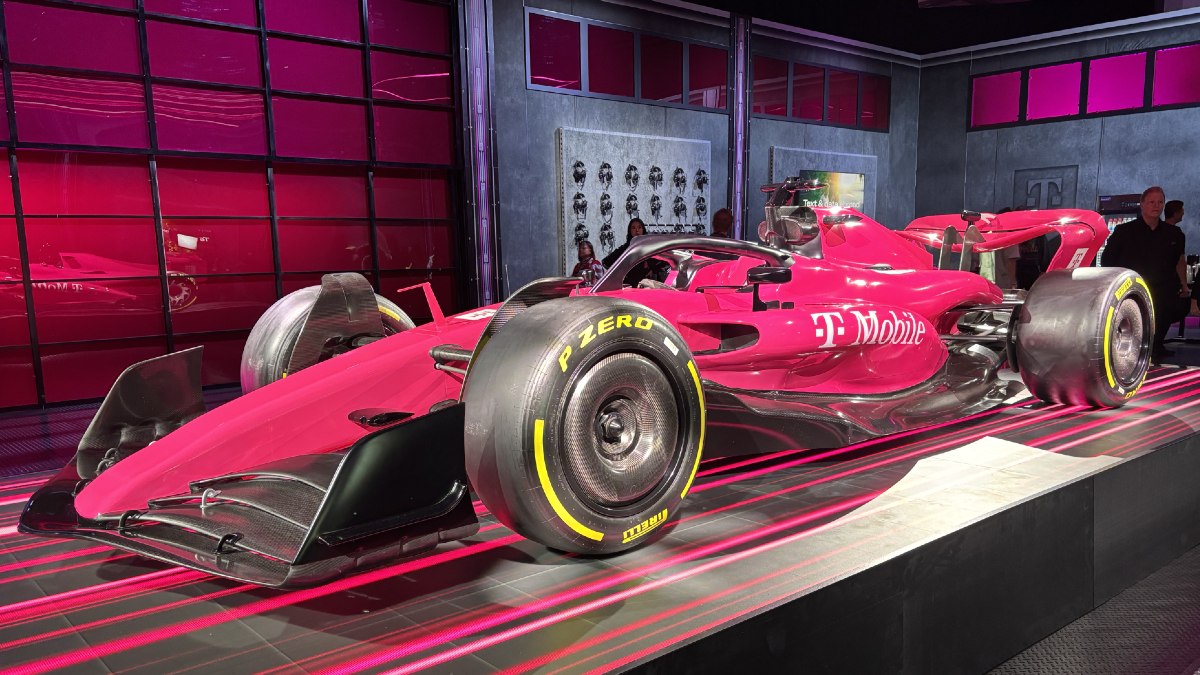
T-Mobile US’ Las Vegas Formula 1 Grand Prix event has been loud, high-velocity, and laser-focused on extending its F1 partnership while tackling one of consumers’ most persistent pain points. It’s been a lot to keep pace with — especially at six months pregnant — though any trip without my rambunctious toddler still counts as a form of rest.
The excitement started early (I’m talking DJs and cocktails — none for me sadly — at 10 in the morning) with the announcement that the carrier has signed a multi-year extension as the exclusive 5G partner of Formula 1. Under the new agreement, T-Mobile will deliver 5G broadcast innovations, immersive fan experiences, and behind-the-scenes access to U.S. Grand Prix events, beginning at this weekend’s event and rolling out at the Circuit of the Americas in Austin in 2026.
President of T-Mobile’s Consumer Group, Jon Freier, said that the carrier’s ability to support the race in Vegas is a testament to the capabilities of its nationwide network. “We can support this entire event off the 5G network. And so we think about all the people that are here to attend the race, how we’re supporting that through network slicing, the event operations, all the point of sales terminals on the track, capabilities for all the different teams — no other 5G network can support all of this,” he said. The network utilizes T-Mobile’s 2.5 GHz spectrum, which it obtained primarily through its merger with Sprint and has been putting into commercial use over the last few years.
AI is also doing a lot of heavy lifting here, though: “When you think about AI helping us, we have something that we call customer-driven coverage, which is a broad kind of application for the performance issues, coverage needs, et cetera, across the entire country. But, when you look at it specifically for this race, this is the third time that we’ve been sponsoring this and having the network deployed here, so we have that much more information and data to be able to apply AI on top of that to kind of perfect the network.”
After having done this even for three years, Freier claimed that the only real challenge that remains is knowing exactly what those usage metrics are going to be: “We have an expectation of the traffic that we’re going to handle … [but] we have it forecasted … And we apply that, of course, to the traffic demands that we expect and the capacity needs, so we have all that in our modeling. After doing it the last two or three years, we really get this perfected.”
Switching made smooth
The carrier also announced “Switching Made Easy,” a revamped switching experience that enables new customers to join the network in just 15 minutes via the company’s T-Life app. The program leverages advanced AI-driven tools — including “Easy Switch,” currently in beta — to assess users’ existing AT&T or Verizon accounts and recommend optimized T-Mobile plans, highlighting the savings and advantages competitors may leave behind.
According to CEO Srini Gopalan, the move underscores T-Mobile’s continued push to disrupt the wireless-carrier status quo. Gopalan, who stepped into the CEO role earlier this year, framed the move as part of a broader reset in how T-Mobile removes consumer friction. The hope, of course, is that by reducing barriers to switching, T-Mobile will capture more share from legacy rivals.
And it’s confident this will work because, as Freier told me, the problem isn’t that T-Mobile’s network isn’t worth switching to: “We have an unbelievable [customer] experience, but it’s still hard,” he said, explaining that less than 1% of the country switches carriers every year almost exclusivelt do to how time-consuming and frustrating the process is. “And for us, a big opportunity for continued growth is to differentiate in this [switching] experience,” he said. He went so far as to promise I could make the switch to T-Mobile in just a few minutes after putting my toddler to bed — cute, he thinks I do anything productive after that, but point taken.
Rural growth still a major engine
Beyond the event-focused announcements, Freier also sketched out where T-Mobile sees its next phase of growth. T-Mobile US, he said, continues to see some of its strongest expansion opportunities outside major metros, particularly across rural America. The company defines rural America as “smaller markets and rural areas. It’s everything outside of the top 100 markets. It’s about 40% of the country.”
Despite years of investment, the operator still holds “a little north of 20% shared households” in those regions — a gap it views as prime runway. Even in major markets where it already leads, Freier said there is still meaningful room to climb. “We see enormous growth there in the top 100 markets. Even when we’re number one from a shared household perspective, we’re number two or number three. We’re still growing in those areas.”
He acknowledged that the competition is “vibrant,” but added: “We like it that way, though.”
Preparing the network for AI workloads
While operators everywhere are positioning for AI-driven demand, Freier said T-Mobile’s approach centers on customer-directed evolution rather than hype cycles. “We try to really be guided by the customer. This is not some crap on a poster somewhere. We really try to be guided by the customer,” the executive said.
That framework applies to emerging AI use cases as well. “As there’s AI solutions that more and more work into people’s mainstream way of living, yeah, there’s going to be some interesting benefits and things that we should be exploring. But that’s not really happening yet. Not yet. Not at scale.”
Still, the company expects AI-driven demand to materialize — just not overnight. “Will it happen? I think so.”
It was clear to me, as I waddled my way back to my hotel room, that T-Mobile is using the Grand Prix as a proving ground for its network, for its AI-assisted planning, and for its push to make switching carriers as easy as tapping through an app after bedtime. From rural expansion to future AI workloads, the company is positioning itself for the long haul and expects to win the race.