
Close Menu
geekfence.comgeekfence.com
    What's Hot

    HCLTech acquires HPE telco unit

    December 29, 2025

    This tiny chip could change the future of quantum computing

    December 29, 2025

    What’s In a Name? Mainframe GDGs Get the Job Done

    December 29, 2025
    Facebook X (Twitter) Instagram
    • About Us
    • Contact Us
    Facebook Instagram
    geekfence.comgeekfence.com
    • Home
    • UK Tech News
    • AI
    • Big Data
    • Cyber Security
      • Cloud Computing
      • iOS Development
    • IoT
    • Mobile
    • Software
      • Software Development
      • Software Engineering
    • Technology
      • Green Technology
      • Nanotechnology
    • Telecom
    geekfence.comgeekfence.com
    Home»Cyber Security»The Stars Scammers Love Most: McAfee Reveals World’s Most Deepfaked Celebs
    Cyber Security

    The Stars Scammers Love Most: McAfee Reveals World’s Most Deepfaked Celebs

    AdminBy AdminNovember 14, 2025No Comments4 Mins Read1 Views
    Facebook Twitter Pinterest LinkedIn Telegram Tumblr Email
    The Stars Scammers Love Most: McAfee Reveals World’s Most Deepfaked Celebs
    Share
    Facebook Twitter LinkedIn Pinterest Email


    You’ve seen the videos: a too-perfect Taylor Swift promoting free cookware. A fake Tom Hanks offering dental insurance.

    They look real—but they’re not.

    New research from McAfee Labs shows just how common these scams have become.

    Our 2025 Most Dangerous Celebrity: Deepfake Deception List ranks the stars and influencers whose likenesses are most hijacked by scammers, and reveals a growing market for AI-powered fake endorsements.

    At the top of the list? Taylor Swift, followed by Scarlett Johansson, Jenna Ortega, and Sydney Sweeney. Globally, names like Brad Pitt, Billie Eilish, and Emma Watson also appear among the most exploited.

    McAfee also released its first-ever Influencer Deepfake Deception List, led by gamer and streamer Pokimane, showing that scammers are now targeting social platforms just as aggressively as Hollywood.

    Top 10 Most Dangerous Celebrities (2025): U.S 
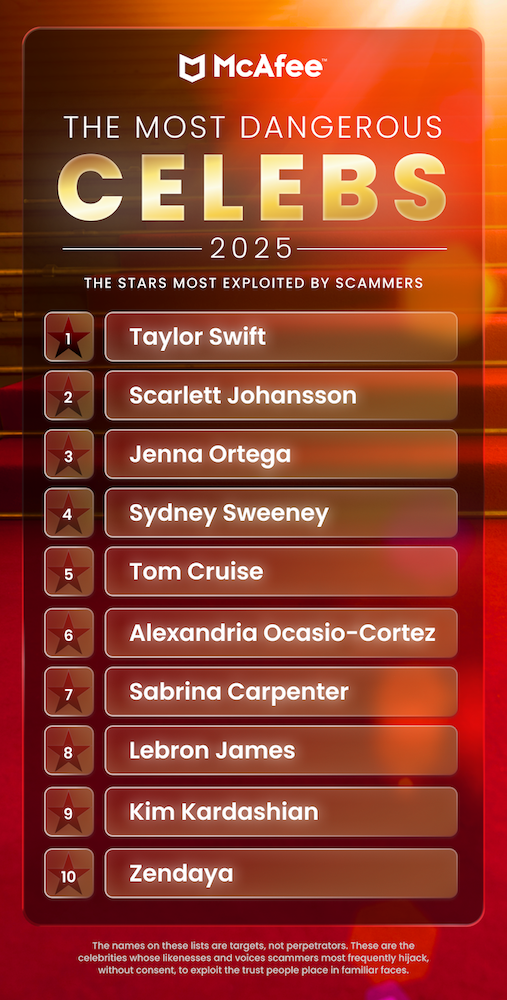
    List of the top 10 celebrities most exploited by scammers in 2025 according to McAfee, led by Taylor Swift.
    McAfee’s 2025 report reveals the most impersonated celebrities in online scams, with Taylor Swift ranking number one in the U.S.

    Top 10 Most Dangerous Celebrities (2025): Global
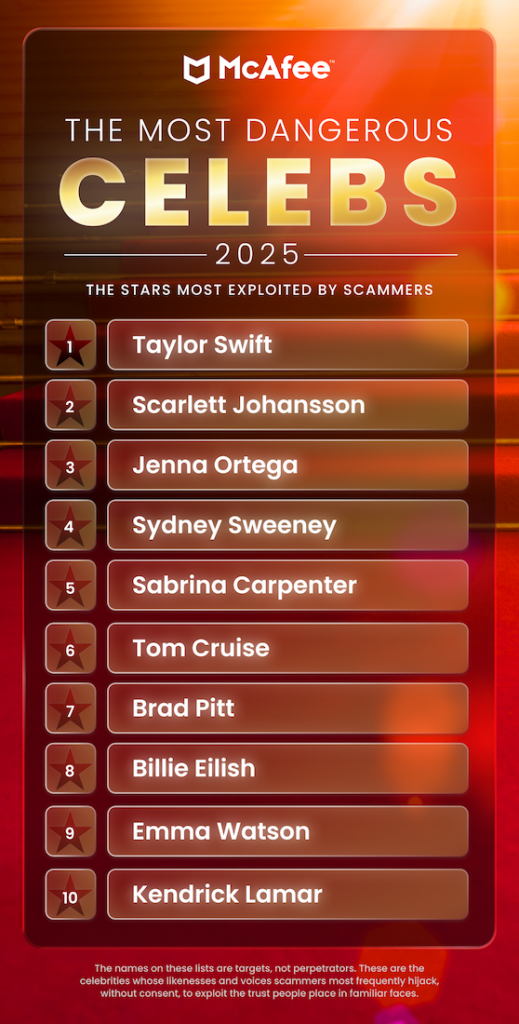
    McAfee’s 2025 global ranking of the most exploited celebrity names used in online scams.
    Taylor Swift tops McAfee’s global list of celebrities most hijacked by scammers in 2025, followed by Scarlett Johansson and Jenna Ortega.

    Top 10 Most Dangerous Influencers  (2025): Global 
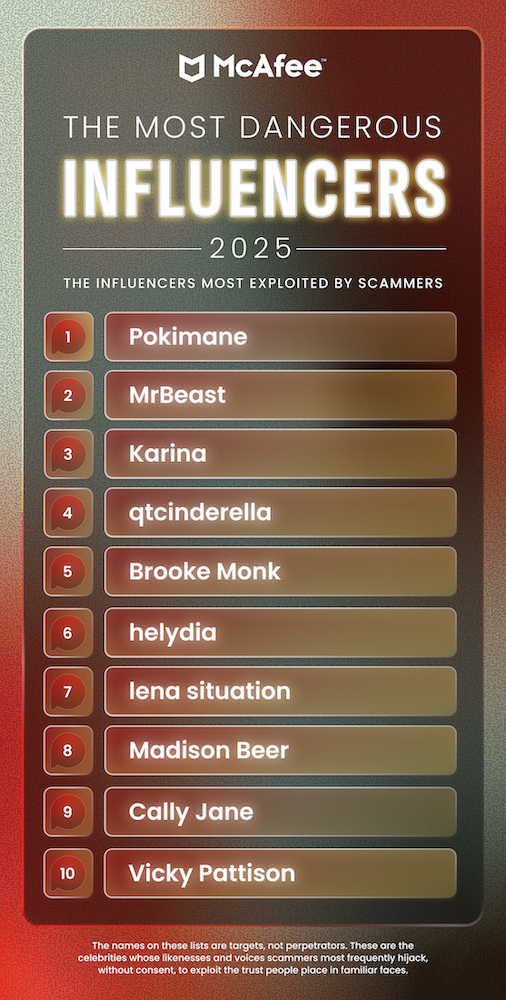
    Top 10 influencers most impersonated by scammers online in 2025, according to McAfee, with Pokimane ranking first.
    From Pokimane to MrBeast, McAfee’s 2025 list shows which influencers’ likenesses are most exploited in scams.

    Why Scammers Love Famous Faces

    The formula is simple: use someone people trust to sell something that doesn’t exist.

    Criminals clone celebrity voices and faces with AI to promote fake giveaways, skincare products, crypto investments, or “exclusive” deals that lead straight to malware or payment fraud.

    According to McAfee’s survey of 8,600 people worldwide:

    • 72% of Americans have seen fake celebrity or influencer endorsements.
    • 39% have clicked on one.
    • 1 in 10 lost money or personal data, an average of $525 per victim.

    Scammers exploit trust. When you see a familiar face, your brain automatically lowers its guard. And that’s exactly what they count on.

    How Deepfakes Are Making Headlines

    AI has made these scams look frighteningly real.

    Modern deepfake generators can mimic voices, facial movements, and even micro-expressions with uncanny precision. Only 29% of people feel confident identifying a fake, and 21% admit to having low confidence spotting deepfakes.

    That’s how fake endorsements and AI romance scams have exploded online.

    • A woman in France lost nearly $900,000 to a scammer posing as Brad Pitt, complete with AI-generated images and voice messages.
    • TV host Al Roker was recently targeted by a fake deepfake video claiming he’d suffered heart attacks.
    • Tom Hanks, Oprah, and Scarlett Johansson have all been used in fraudulent ads for products they never touched.

    “Seeing is believing” doesn’t apply anymore, and scammers know it.

    The Psychology of The Scam

    Deepfake scams don’t just rely on technology; they prey on parasocial relationships, the one-sided emotional bonds fans form with public figures.

    When a “celebrity” DMs you, it doesn’t always feel strange. It feels personal. That sense of intimacy makes people act before thinking.

    It’s the same psychological playbook behind romance scams, now supercharged by AI tools that make fake videos and voice messages sound heartbreakingly real.

    How to Protect Yourself

    1. Pause before you click. If an ad or post seems out of character or “too good to be true,” it probably is.
    2. Verify at the source. Check the celebrity’s verified account on social media. Scammers often copy profile photos and bios but miss subtle details like posting style or engagement patterns.
    3. Look for signs of AI manipulation. Watch for off-sync lip movements, robotic tone, or lighting that looks inconsistent.
    4. Never share personal or payment details via messages, even if the sender appears to be verified.
    5. Use McAfee’s Scam Detector, included in all core plans, to automatically analyze texts, emails, and videos for signs of fraud or deepfake manipulation.

    Key Takeaways

    Celebrity and influencer culture has always shaped what we buy, but now it’s shaping how scammers deceive. These deepfakes don’t just steal money; they chip away at our trust in what we see, hear, and share online.

    The celebrities at the center of these scams aren’t accomplices, they’re victims, too, as criminals hijack their likenesses to exploit the bond between fans and the people they admire. And as deepfake tools become easier to use, the line between real and fake is vanishing fast.

    The next viral “giveaway” might not be an ad at all…it could be bait.

    You can’t stop scammers from cloning famous faces, but you can stop them from fooling you. Use McAfee’s Scam Detector to scan links, messages, and videos before you click.

    Introducing McAfee’s Scam Detector

    Get all-in-one protection against text, email, and video scams.


    Source link

    Share. Facebook Twitter Pinterest LinkedIn Tumblr Email

    Related Posts

    MongoDB Vulnerability CVE-2025-14847 Under Active Exploitation Worldwide

    December 29, 2025

    How Russia’s Largest Private University is Linked to a $25M Essay Mill – Krebs on Security

    December 28, 2025

    What are brushing scams and how do I stay safe?

    December 27, 2025

    Black or Scrambled Phone Screen? Here’s How to Spot a Hacked vs Broken Phone

    December 26, 2025

    Closing the gap: bitsIO wins Splunkie Award for data and AI-powered nonprofit solutions

    December 25, 2025

    Google Online Security Blog: Further Hardening Android GPUs

    December 23, 2025
    Top Posts

    Understanding U-Net Architecture in Deep Learning

    November 25, 20258 Views

    Microsoft 365 Copilot now enables you to build apps and workflows

    October 29, 20258 Views

    Here’s the latest company planning for gene-edited babies

    November 2, 20257 Views
    Don't Miss

    HCLTech acquires HPE telco unit

    December 29, 2025

    HCLTech moves toward a future of AI-driven growth In sum – what we know: The…

    This tiny chip could change the future of quantum computing

    December 29, 2025

    What’s In a Name? Mainframe GDGs Get the Job Done

    December 29, 2025

    Microsoft named a Leader in Gartner® Magic Quadrant™ for AI Application Development Platforms

    December 29, 2025
    Stay In Touch
    • Facebook
    • Instagram
    About Us

    At GeekFence, we are a team of tech-enthusiasts, industry watchers and content creators who believe that technology isn’t just about gadgets—it’s about how innovation transforms our lives, work and society. We’ve come together to build a place where readers, thinkers and industry insiders can converge to explore what’s next in tech.

    Our Picks

    HCLTech acquires HPE telco unit

    December 29, 2025

    This tiny chip could change the future of quantum computing

    December 29, 2025

    Subscribe to Updates

    Please enable JavaScript in your browser to complete this form.
    Loading
    • About Us
    • Contact Us
    • Disclaimer
    • Privacy Policy
    • Terms and Conditions
    © 2025 Geekfence.All Rigt Reserved.

    Type above and press Enter to search. Press Esc to cancel.