

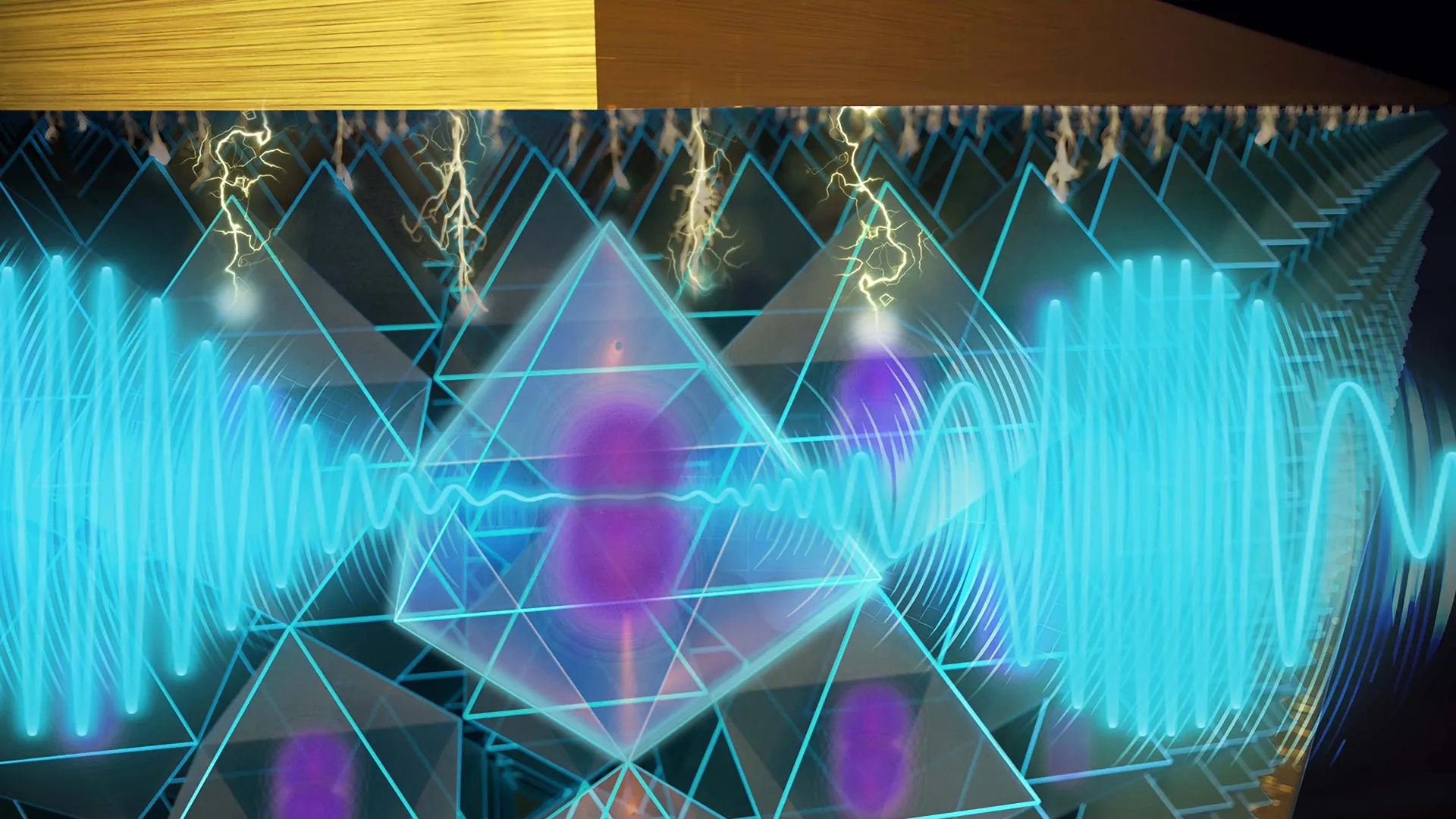
- Stanford engineers have discovered a standout material, strontium titanate (STO), that performs even better in extreme cold. Instead of weakening, its optical and mechanical properties improve at cryogenic temperatures.
- STO outperforms every comparable material tested in low-temperature environments, revealing exceptional strength, stability, and tunability.
- Its unique capabilities could accelerate advances in quantum computing, laser systems, and space exploration, where high performance under freezing conditions is essential.
Superconductivity and quantum computing have moved from theoretical physics into real-world innovation. The 2025 Nobel Prize in Physics recognized breakthroughs in superconducting quantum circuits that could lead to ultra-powerful computers. Yet many of these technologies only function at cryogenic temperatures (near absolute zero), where most materials lose their defining properties. Finding materials that perform under such extreme cold has long been one of science’s biggest hurdles.
A Crystal That Defies the Cold
In a new Science publication, engineers at Stanford University report a breakthrough with strontium titanate (STO), a material that not only maintains but enhances its optical and mechanical performance in freezing conditions. Instead of deteriorating, it becomes significantly more capable, outperforming other known materials by a wide margin. The researchers believe this discovery could open the door to a new class of light-based and mechanical cryogenic devices that propel quantum computing, space exploration, and other advanced technologies.
“Strontium titanate has electro-optic effects 40 times stronger than the most-used electro-optic material today. But it also works at cryogenic temperatures, which is beneficial for building quantum transducers and switches that are current bottlenecks in quantum technologies,” explained the study’s senior author Jelena Vuckovic, professor of electrical engineering at Stanford.
Pushing the Limits of Performance
STO’s optical behavior is “non-linear,” meaning that when an electric field is applied, its optical and mechanical properties shift dramatically. This electro-optic effect allows scientists to adjust the frequency, intensity, phase, and direction of light in ways that other materials cannot. Such versatility could enable entirely new types of low-temperature devices.
STO is also piezoelectric, meaning it physically expands and contracts in response to electric fields. This makes it ideal for developing new electromechanical components that function efficiently in extreme cold. According to the researchers, these capabilities could be especially valuable for use in the vacuum of space or in the cryogenic fuel systems of rockets.
“At low temperature, not only is strontium titanate the most electrically tunable optical material we know of, but it’s also the most piezoelectrically tunable material,” said Christopher Anderson, co-first author and now a faculty member at the University of Illinois, Urbana-Champaign.
An Overlooked Material Finds New Purpose
Strontium titanate is not a newly discovered substance. It has been studied for decades and is inexpensive and abundant. “STO is not particularly special. It’s not rare. It’s not expensive,” said co-first author Giovanni Scuri, a postdoctoral scholar in Vuckovic’s lab. “In fact, it has often been used as a diamond substitute in jewelry or as a substrate for growing other, more valuable materials. Despite being a ‘textbook’ material, it performs exceptionally well in a cryogenic context.”
The decision to test STO was guided by an understanding of what characteristics make materials highly tunable. “We knew what ingredients we needed to make a highly tunable material. We found those ingredients already existed in nature, and we simply used them in a new recipe. STO was the obvious choice,” Anderson said. “When we tried it, surprisingly, it matched our expectations perfectly.”
Scuri added that the framework they developed could help identify or enhance other nonlinear materials for a variety of operating conditions.
Record-Breaking Performance at Near Absolute Zero
When tested at 5 Kelvin (-450°F), STO’s performance stunned researchers. Its nonlinear optical response was 20 times greater than that of lithium niobate, the leading nonlinear optical material, and nearly triple that of barium titanate, the previous cryogenic benchmark.
To push its properties even further, the team replaced certain oxygen atoms in the crystal with heavier isotopes. This adjustment moved STO closer to a state called quantum criticality, producing even greater tunability.
“By adding just two neutrons to exactly 33 percent of the oxygen atoms in the material, the resulting tunability increased by a factor of four,” Anderson said. “We precisely tuned our recipe to get the best possible performance.”
Building the Future of Cryogenic Devices
According to the team, STO also offers practical advantages that could make it appealing to engineers. It can be synthesized, structurally modified, and fabricated at wafer scale using existing semiconductor equipment. These features make it well-suited for next-generation quantum devices, such as laser-based switches used to control and transmit quantum information.
The research was partially funded by Samsung Electronics and Google’s quantum computing division, both of which are searching for materials to advance their quantum hardware. The team’s next goal is to design fully functional cryogenic devices based on STO’s unique properties.
“We found this material on the shelf. We used it and it was amazing. We understood why it was good. Then the cherry on the top — we knew how to do better, added that special sauce, and we made the world’s best material for these applications,” Anderson said. “It’s a great story.”
Alongside Samsung and Google, the study received support from a Vannevar Bush Faculty Fellowship through the U.S. Department of Defense and the Department of Energy’s Q-NEXT program.
Contributors include Aaron Chan and Lu Li from the University of Michigan; Sungjun Eun, Alexander D. White, Geun Ho Ahn, Amir Safavi-Naeini, and Kasper Van Gasse from Stanford’s E. L. Ginzton Laboratory; and Christine Jilly from the Stanford Nano Shared Facilities.