

In a volatile macroeconomic environment, enterprise risk management today is constrained less by modeling sophistication and more by data latency. While financial modeling has evolved significantly over the past two decades, the underlying data architecture supporting these models often remains anchored in legacy, batch-oriented architectures.
For many Tier-1 financial institutions, risk aggregation continues to rely on fragmented data estates, nightly batch processing, manual data reconciliation across business units, and retrospective reporting frameworks. However, recent market events demonstrate that when risk materializes in modern, interconnected markets, legacy architecture creates severe visibility gaps that prevent timely intervention.
That gap matters because the role of the Chief Risk Officer is changing. Deloitte’s survey of risk management found that more than 90 percent of respondents believe risk management is becoming more important to achieving strategic goals, and that organizations with more integrated risk programs tend to outperform those with less integrated approaches. The implication is clear: boards increasingly expect the risk function to contribute to growth, resilience, and decision quality, not simply act as a retrospective control point.
That strategic shift requires a different operating foundation.
Architectural Blind Spots are now strategic liabilities
Recent market shocks have made one pattern unmistakable: institutions often have ample information, but lack the timely, integrated, decision-ready view.
Episodes such as Silicon Valley Bank, Archegos, and the UK LDI disruption exposed recurring weaknesses in modern risk architecture.
1. Silicon Valley Bank (2023): The Impact of Digitized Liquidity Run Velocity
Silicon Valley Bank (SVB) maintained a balance sheet heavily exposed to long-duration, fixed-rate U.S. Treasuries funded by concentrated venture capital deposits. When interest rates rose rapidly, the bank accumulated substantial unrealized losses. To meet deposit withdrawal requests, SVB liquidated a portion of its available-for-sale securities, realizing a $1.8 billion loss.
- The Data Architecture Gap: Traditional Asset Liability Management (ALM) models and regulatory reporting frameworks (such as FR 2052a) were historically designed around weekly or monthly batch cycles, assuming deposit outflows would occur over extended horizons. Fueled by digital banking channels and rapid information dissemination via social and digital channels, SVB customers initiated withdrawal requests totaling $42 billion in a single day. The bank’s risk infrastructure lacked the real-time, streaming data pipelines necessary to dynamically track intraday liquidity position changes during a hyper-velocity run.
2. Archegos Capital Management (2021): The High Cost of Fragmented Counterparty Data
Archegos Capital Management, a family office, utilized extreme leverage to build concentrated positions in a small number of equities through Total Return Swaps (TRS). Because these synthetic positions were distributed across multiple prime brokers, including Credit Suisse, Nomura, Morgan Stanley, and Goldman Sachs, the true scale of the fund’s total exposure remained hidden from individual market participants. When the underlying equities declined in value, Archegos defaulted on margin calls, generating over $10 billion in collective losses for its lending institutions.
- The Data Architecture Gap: Credit Suisse alone sustained a $5.5 billion loss, which contributed to a broader loss of market confidence. Internal investigations revealed that the bank’s risk systems did not suffer from a lack of data, but from severe systemic fragmentation. Exposure metrics were siloed across independent business units and geographic systems. Because the architecture lacked a unified data platform capable of aggregating counterparty credit risk across disparate trading desks in real time, risk managers could not see the institution’s total aggregated exposure to a single client.
3. The UK Liability-Driven Investment (LDI) Crisis (2022): Static vs. Dynamic Stress Testing
In September 2022, sudden fiscal policy announcements in the United Kingdom caused British government bond (Gilt) yields to spike at an unprecedented rate. This volatility severely impacted UK pension funds that utilized Liability-Driven Investment (LDI) strategies, which rely on derivatives to hedge long-term liabilities. As bond prices crashed, these funds faced immediate, massive collateral margin calls from their counterparties. To raise cash, pension funds were forced to liquidate their underlying gilts, driving bond prices even lower and creating an adverse feedback loop that required emergency intervention by the Bank of England.
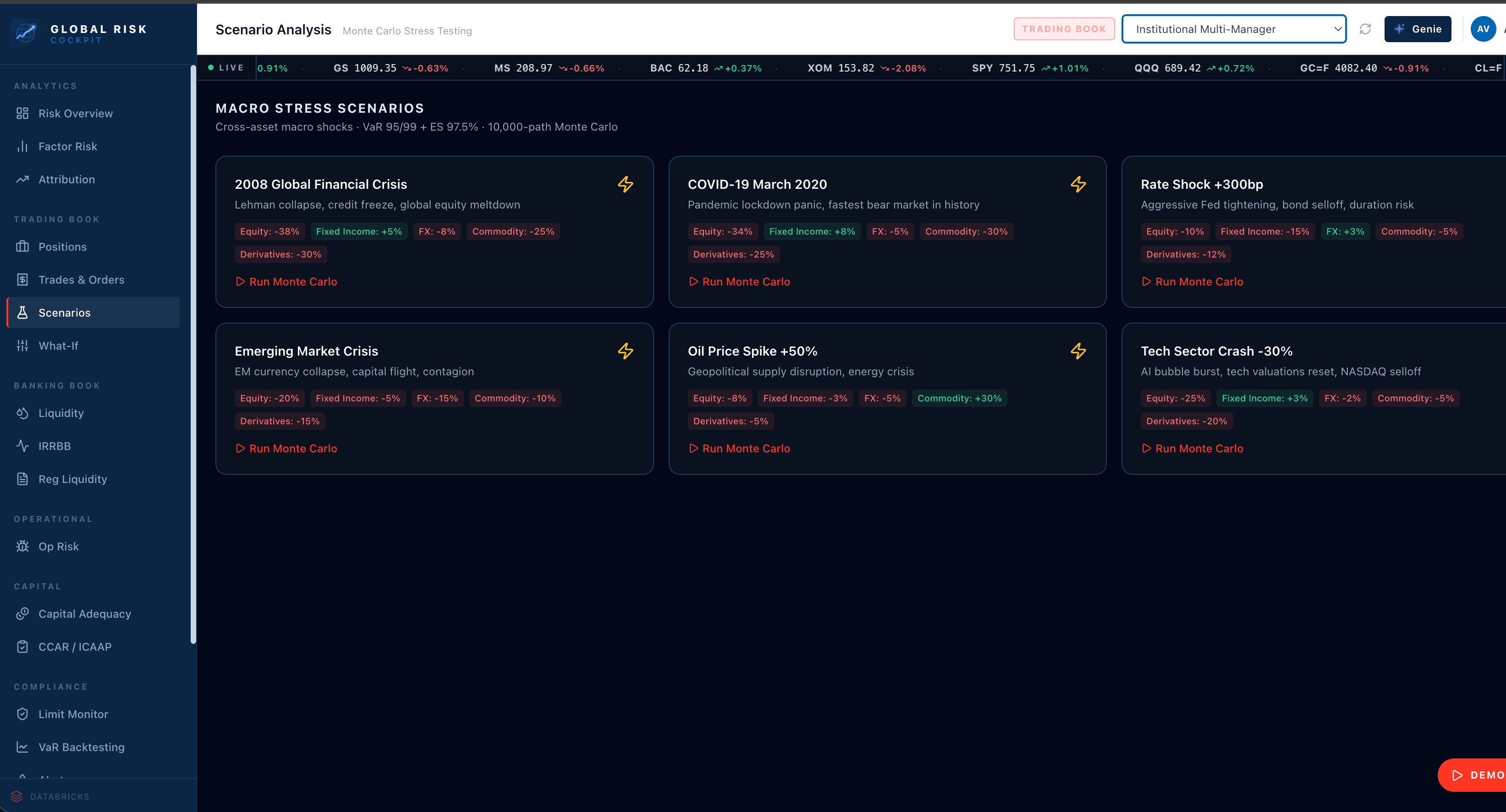
- The Data Architecture Gap: Standard, static historical risk models indicated that these portfolios were adequately hedged against conventional market movements. The underlying technology architecture failed to account for multi-variable, correlated feedback loops, specifically, how a rapid drop in asset value forced systemic liquidations of those exact same assets. Managing this risk requires high-performance, concurrent scenario simulations capable of processing complex macro shifts across interdependent asset classes simultaneously.
The Cost of Friction: Operational and Strategic Constraints
Analyzing modern operational failures reveals that structural vulnerabilities stem largely from fragmented data architecture and ‘vendor sprawl’ rather than flawed modeling. This creates structural friction that impacts three key areas:
- The Reconciliation Burden (Metric Impact: Operational Alpha & FTE Efficiency): Siloed data models and inconsistent controls force risk, finance, and operations teams into repeated validation exercises across spreadsheets, vendor systems, and bespoke extracts. Crucially, it degrades a key CRO metric: Time-to-Insight. Instead of focusing on proactive exposure management, risk teams consume their operational bandwidth validating line-item figures across spreadsheets and disconnected databases.
- Reporting Latency (Metric Impact: Value-at-Risk (VaR) Precision & Liquidity Coverage Ratio (LCR) Halflife): Stale data degrades decisions.Relying on overnight batch processing for complex calculations (like Expected Shortfall or macro stress tests) leaves risk committees operating on stale data. In high-velocity environments and volatile markets, this latency creates a blind spot in Intraday Liquidity Tracking and degrades the precision of VaR limits, forcing institutions to either take unhedged risks or hold sub-optimal, non-earning cash buffers.
-
Data Lineage Blind Spots (Metric Impact: Cost of Compliance & Model Risk Management – SR 11-7):
The weak lineage increases both the operational and regulatory burden. This exposes the firm to audit penalities (such as CCAR or FR 2052a) under BCBS 239 and SR 11-7 (Model Risk Management frameworks). Without automated lineage, tracing unexpected model outputs back to the source, distinguishing between structural market shifts and corrupted upstream data becomes a time-consuming, expensive bottleneck.
The Architecture Shift: Operationalizing the Strategic CRO
If the modern CRO is expected to operate as a strategic leader, the risk stack has to evolve from fragmented reporting infrastructure into a unified intelligence layer.
That is where the Databricks Data and AI Platform enters the picture. The platform’s value for risk organizations is not simply speed in isolation. It is the combination of unification, governance, and AI on one foundation:
- Real-Time Position Aggregation & Capital Optimization: By bringing positions, limits, stress outputs, and market data onto a unified, governed foundation in Unity Catalog, Databricks eliminates the reconciliation burden. Risk teams operate with a single, consistent permissions model and verified data lineage. This centralized visibility reduces Time-to-Aggregation from days to minutes, enabling the CRO to optimize Risk-Weighted Assets (RWA) and dynamically reallocate capital away from high-exposure sectors into higher-yielding assets.
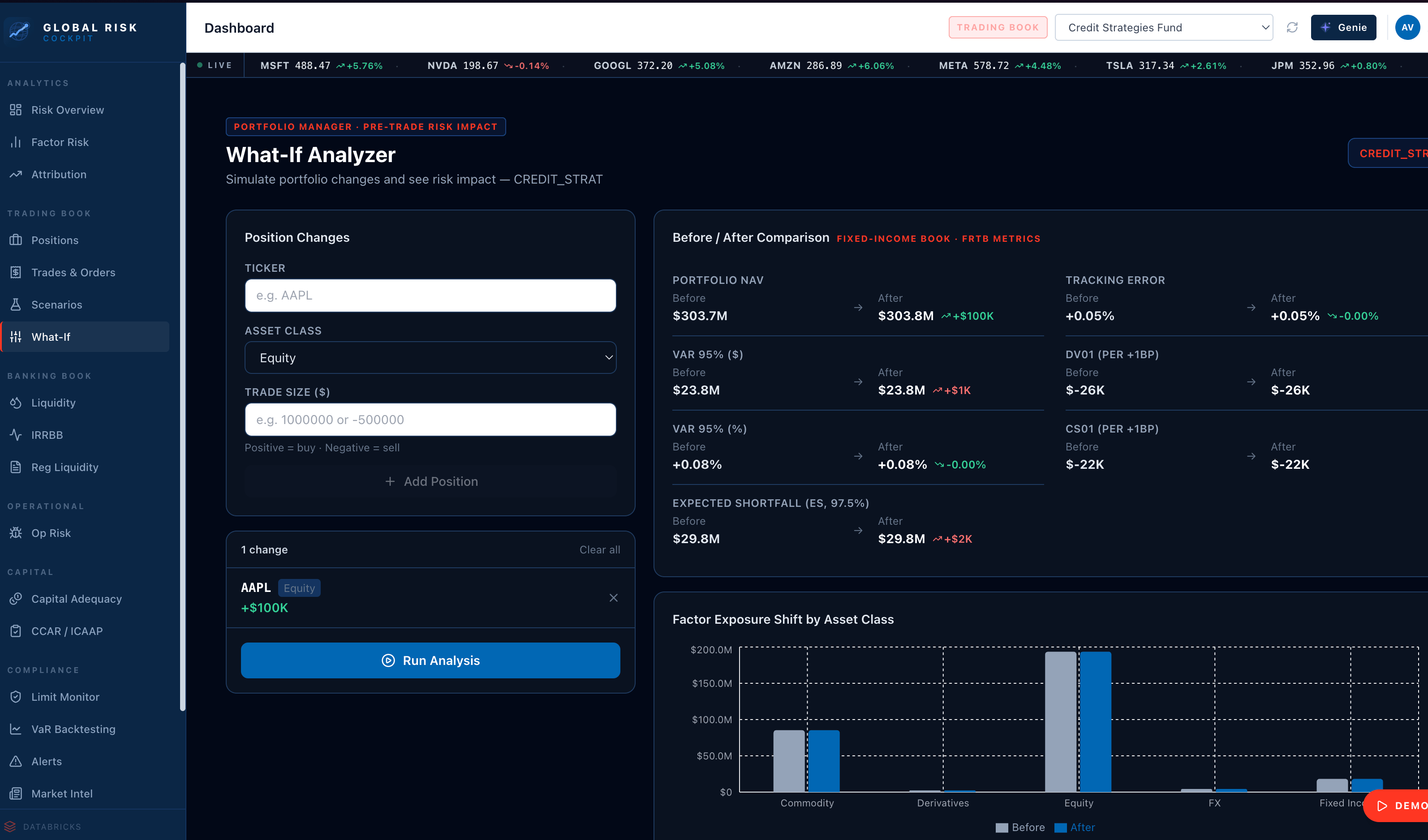
- Sub-Second “What-If” Simulations and Margin Defense: Moving from legacy overnight batch grids to high-performance, concurrent processing allows teams to transition from batch-mode blindness to real-time vigilance. Risk managers can execute complex, multi-variable “What-If” trade analysis and see VaR or Expected Shortfall deltas in seconds before a position is booked. This real-time capability protects net interest margins (NIM) and ensures that sudden shifts in macro variables do not trigger unhedged margin calls.
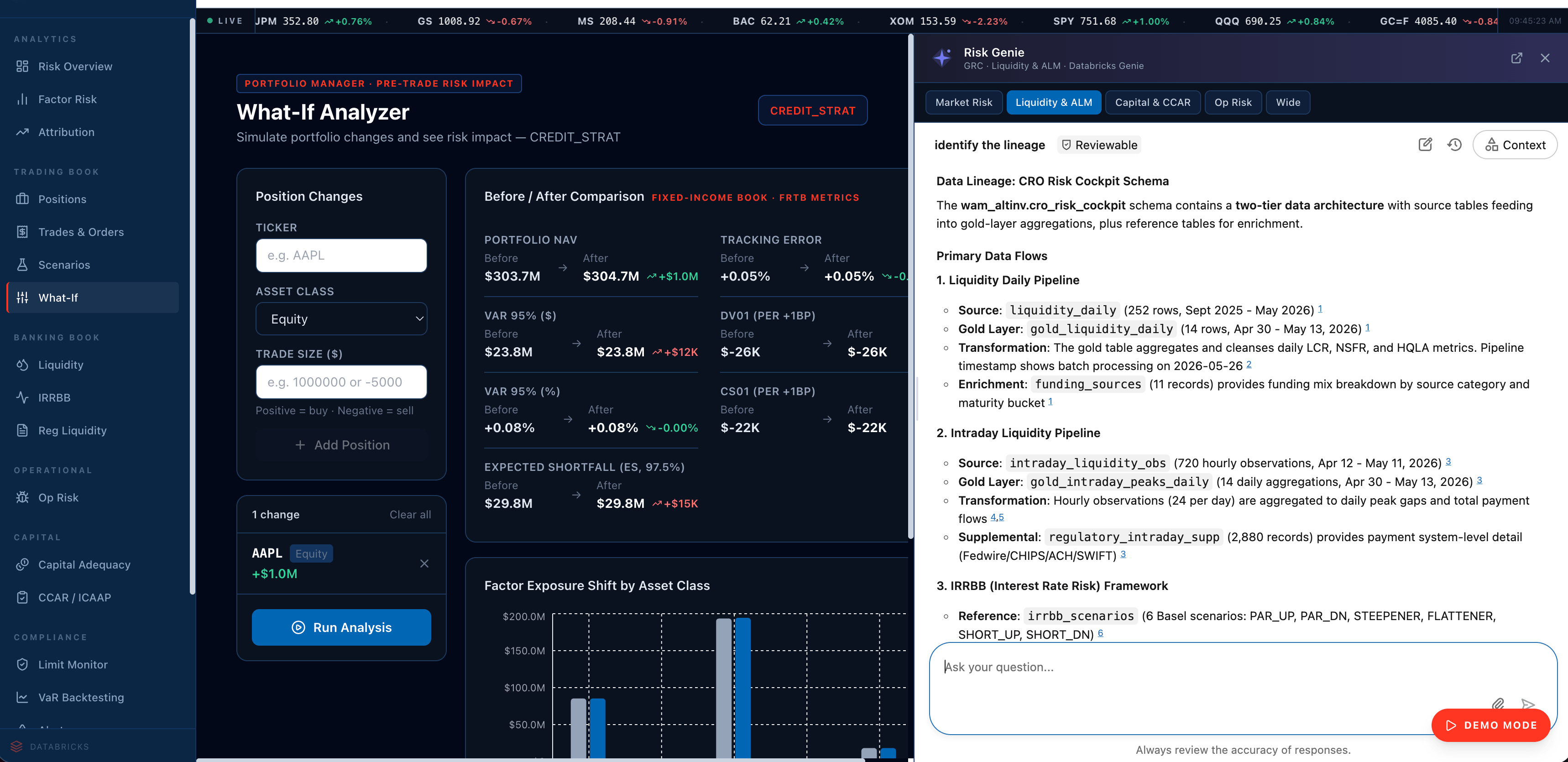
- Auditable AI Workflows & Streamlined Governance: As AI integrates into frontline credit decisioning and market risk signals, the Unity AI Gateway adds an enterprise-grade governance layer for LLM and ML traffic. It provides automated access management, rate limiting, usage tracking, payload logging, and guardrails. Combined with Databricks Genie, which enables risk analysts to access and query governed data using natural language while retaining full SQL audit trails and MLflow tracing,the platform slashes the Cost of Compliance and accelerates Model Validation timelines (SR 11-7). The result is a unified risk cockpit that supports a verifiable shift from delayed, manually stitched-together risk views toward more real-time aggregation, faster investigation, and absolute model reproducibility across all risk domains.
Databricks is powering the modern CRO across financial services
In Banking
The modern bank can no longer manage risk as a set of disconnected control functions. The CRO needs a single, governed risk and capital control plane – liquidity, capital, interest-rate, operational, and compliance signals aggregated from a single, governed foundation under Unity Catalog, rather than stitched together from a sprawl of point solutions after the overnight batch settles. On that foundation, four capabilities move the bank from retrospective reporting to proactive capital defense:
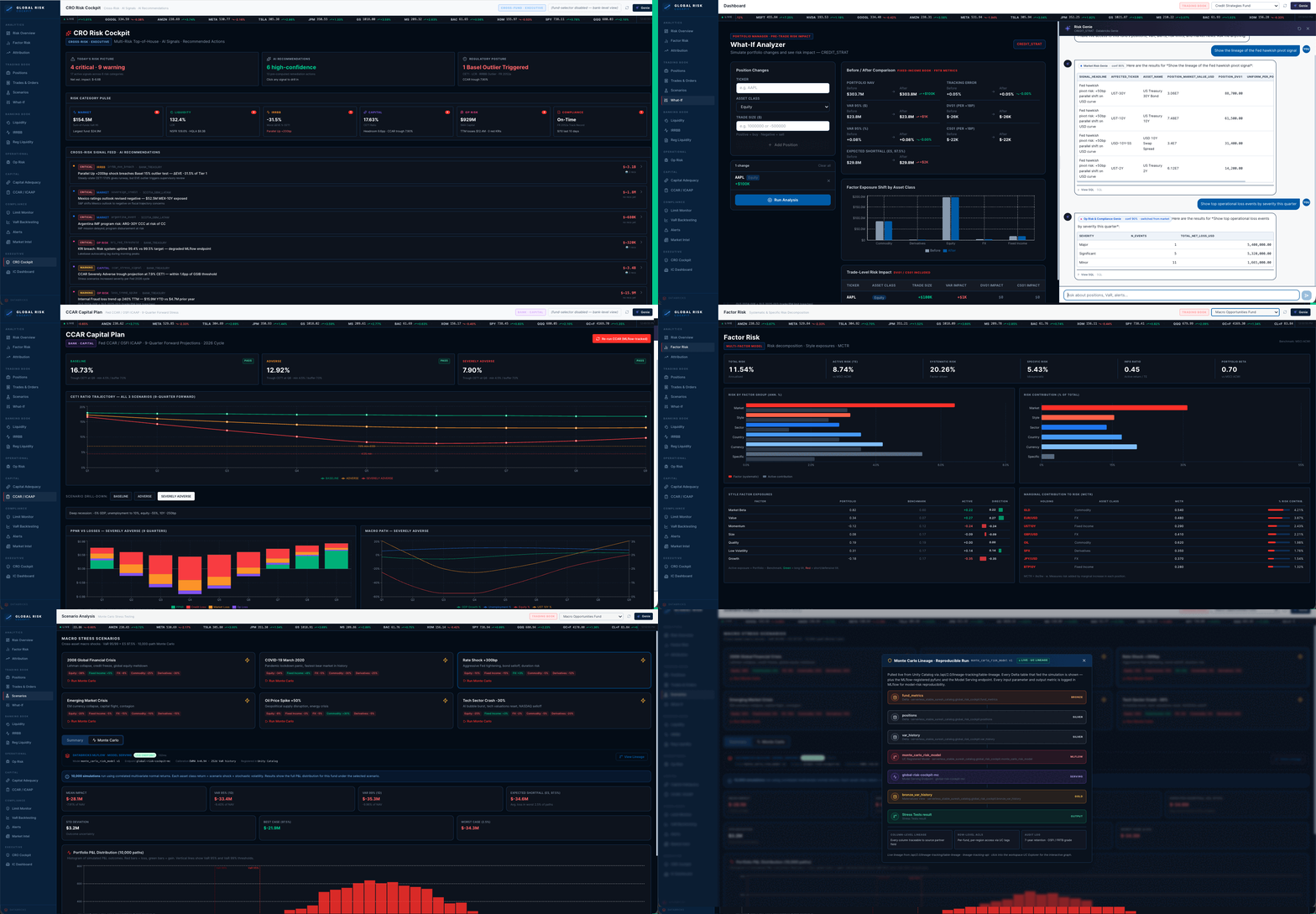
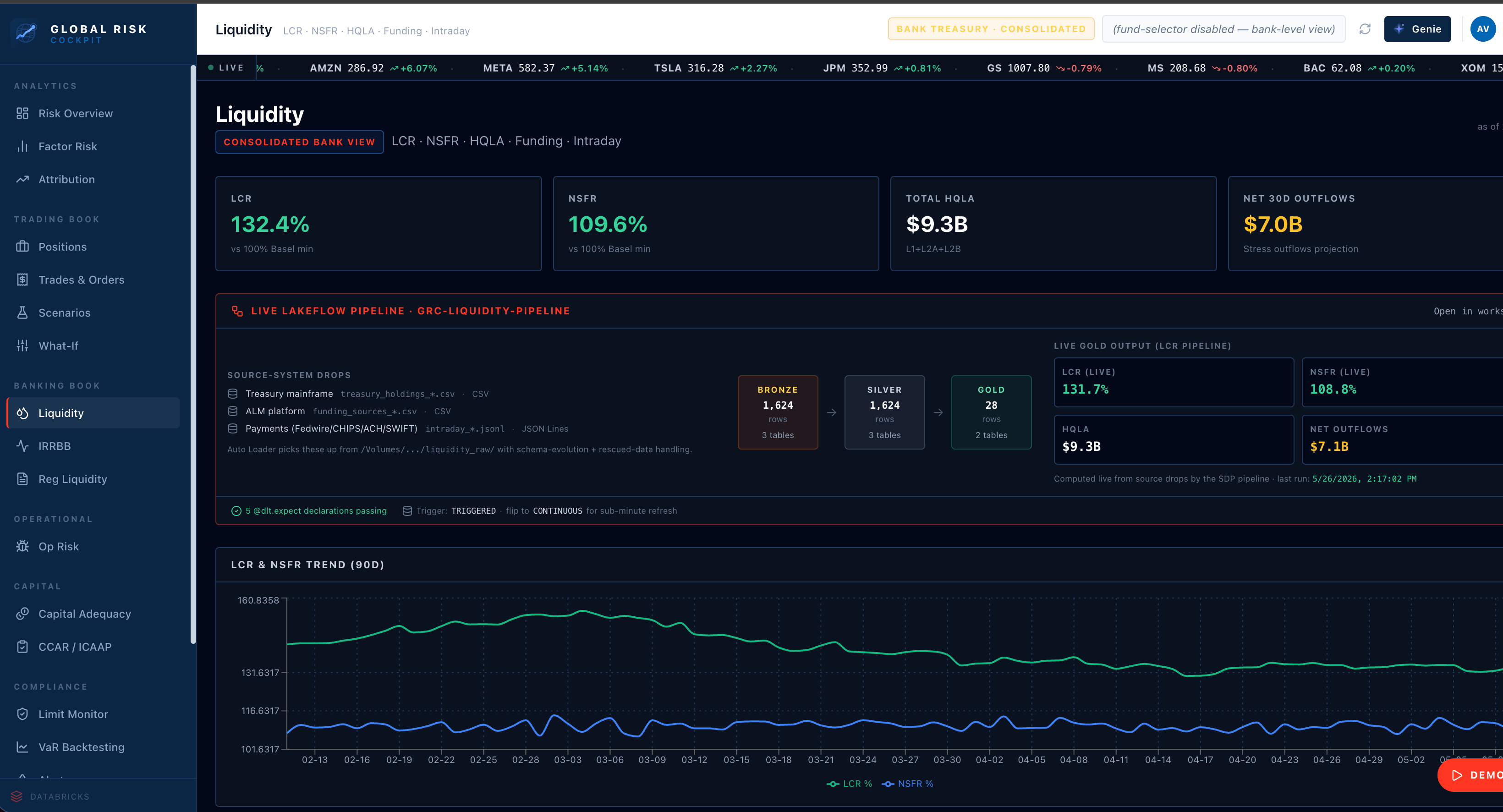
- Liquidity & ALM (LCR, NSFR, HQLA). Treasury moves from batch-mode blindness to intraday visibility – minute-by-minute monitoring of liquidity positions instead of a number that is always a day behind the balance sheet. As the risk cockpit shows, teams can track LCR, NSFR, and HQLA in real time, shrink non-earning cash buffers, and trace any published ratio back to its source without leaving the screen – precisely the visibility absent when a hyper-velocity deposit run outpaced a weekly-batch ALM framework.
- Interest-Rate Risk in the Banking Book (IRRBB). All the supervisory rate-shock scenarios live in governed tables the treasurer can read, override, and re-run in minutes rather than filing a vendor change request. Every scenario’s ΔEVE as a share of CET1 – and any Basel outlier-test breach – is queryable against the capital stack, so treasurer, CFO, and CRO see the same number at the same moment.
- Capital Planning & Adequacy (CCAR). Capital projection shifts from a notebook-and-spreadsheet project to a governed, reproducible workflow. MLflow-tracked CCAR re-runs capture every assumption, input, and output, turning an SR 11-7 model-validation conversation that took a week into one that takes a query – and moving capital planning from an annual exercise toward a continuous posture.
- Fit-for-purpose regulatory reporting. The same governed foundation that powers the liquidity view generates the regulator-bound output. Streamlined FR 2052a generation replaces, multi-handoff Excel-to-vendor chain, with the submission governed by the same lineage and access controls as the dashboard – eliminating duplicate reg-reporting stacks and the audit debt that comes with them.
The result is a risk organization that optimizes RWA and reallocates capital proactively, rather than spending its bandwidth validating line items across disconnected systems.
In Capital Markets
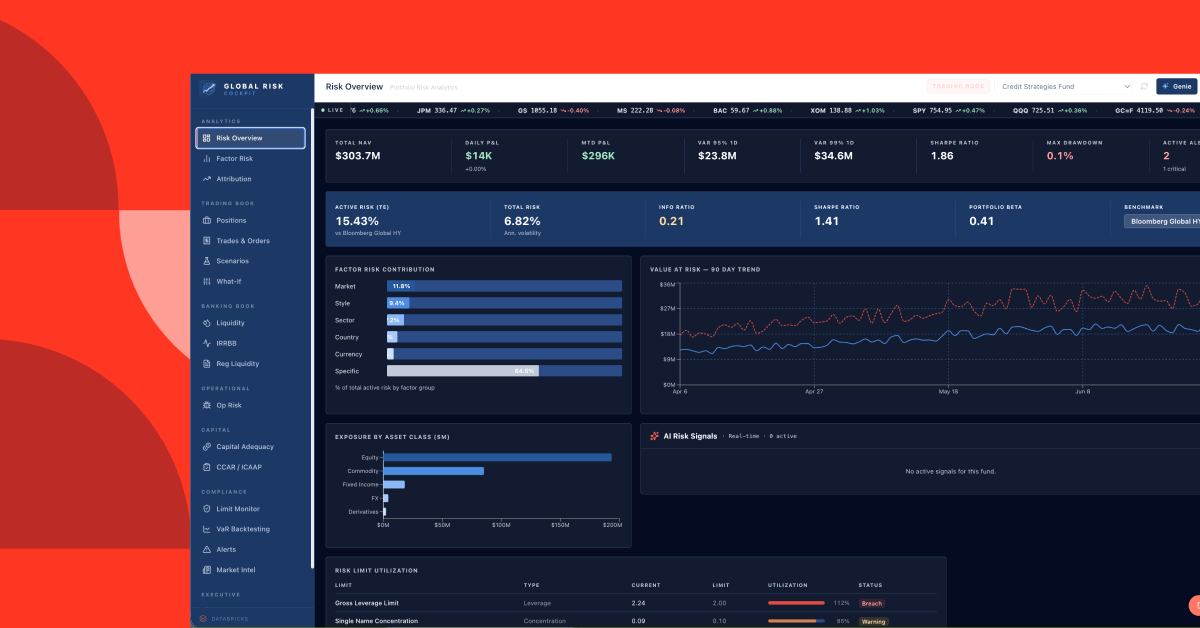
In capital markets, the constraint is sharper, because the cost of latency is measured in minutes. Risk teams still work across multiple systems, multiple versions of the truth, and multiple ages of data – OMS platforms, risk engines, analytics tools, spreadsheets, and email running in parallel. Databricks re-architects the workflow around a single governed market-risk foundation – proprietary positions, counterparty data, market data, limits, and partner feeds on one platform under Unity Catalog, surfaced through the risk cockpit and a natural-language Risk Genie. Four capabilities define the new operating model:
- Real-time exposure aggregation. VaR, Expected Shortfall, DV01, CS01, active limit breaches, and cross-fund exposures in one screen, with governed access and full lineage behind every metric – replacing the overnight batch grid where VaR arrives as yesterday’s number.
- Counterparty & cross-fund visibility. Total aggregated exposure to a single counterparty, across desks and prime brokers, becomes a self-service answer rather than a quarterly reconciliation project, closing the fragmentation gap that hid a family office’s true leverage until the losses had already landed.
- Sub-second what-if and stress testing. Risk managers run live, concurrent stress tests of correlated, multi-variable scenarios – the feedback-loop dynamics static historical models miss – and see a VaR or Expected Shortfall delta in seconds, before a trade is booked, protecting margins against sudden macro shifts rather than discovering breaches the next morning.
- AI-augmented investigation with auditable provenance. A natural-language Risk Genie lets the desk interrogate governed data in plain English while retaining a full SQL audit trail, and MLflow-backed model provenance gives validators and regulators a reproducible chain from scenario inputs to output metrics – answering novel risk questions at the speed of the market instead of routing each one to a quant queue.
This is what modern market risk looks like on Databricks: not another dashboard layered on legacy silos, but a live, governed, AI-augmented control surface for exposure management, model transparency, and faster decisions across the front, middle, and back office.
Proof in production
This is not aspirational. Tier-1 institutions are already running core risk and capital functions on the Databricks Data and AI Platform.
In banking, Raiffeisen Bank International’s example shows how a banking organization can consolidate a fragmented analytics environment into a more standardized, governed foundation while improving speed, cost efficiency, and auditability. For the modern bank, that means liquidity and capital discussions can move closer to real-time, with less manual reconciliation and stronger confidence in the numbers being presented.
In capital markets, Morgan Stanley scaled one of its most significant regulatory calculators, SACCR counterparty credit risk on Databricks, improving performance, calculation accuracy, and regulatory compliance, while consolidating onto a fully-managed Data and AI platform to meet its regulatory obligations with materially less effort. State Street is pioneering a new standard in financial-sector enterprise AI, unifying structured and unstructured data under Unity Catalog to balance rapid AI adoption with strict regulatory and security requirements. Across both worlds, the pattern is the same: one governed foundation, real-time aggregation, and auditable AI – the modern CRO’s mandate, in production.
The next crisis won’t wait for the overnight batch
SVB, Archegos, and the LDI unwind were not failures of mathematics. The models were sound. What failed was the architecture beneath them – data that aggregated too slowly, exposure that was fragmented across systems, and stress tests that could not see the feedback loops forming in real time. In each case, the risk was knowable. It simply wasn’t visible in time to act.
That is the gap that defines modern risk management. Markets now move at digital speed of a viral post and a same-day digital withdrawal; risk infrastructure built around weekly batch cycles and manual reconciliation cannot keep pace, and the cost of that mismatch is measured in billions and, increasingly, in institutional survival.
Closing the gap is no longer a technology upgrade; it is the precondition for the CRO’s evolving mandate.Real-time aggregation, sub-second scenario analysis, and auditable AI are what turn the risk function from a retrospective checkpoint into a forward-looking engine for capital allocation and growth.
The Databricks Data and AI Platform makes that shift achievable today. By unifying market, liquidity, capital, operational, and compliance risk on one governed foundation, with lineage on every metric and transparency on every model, it gives the CRO a single, real-time, defensible view of the enterprise. The institutions already running on it are not just reporting risk faster. They are seeing it sooner and acting on it before it compounds.
The question for every risk leader is no longer whether the model is right. It is whether the architecture will let them see clearly and move decisively when the next shock arrives. Modern risk demands a modern foundation. The legacy architecture has already shown us its limits.