

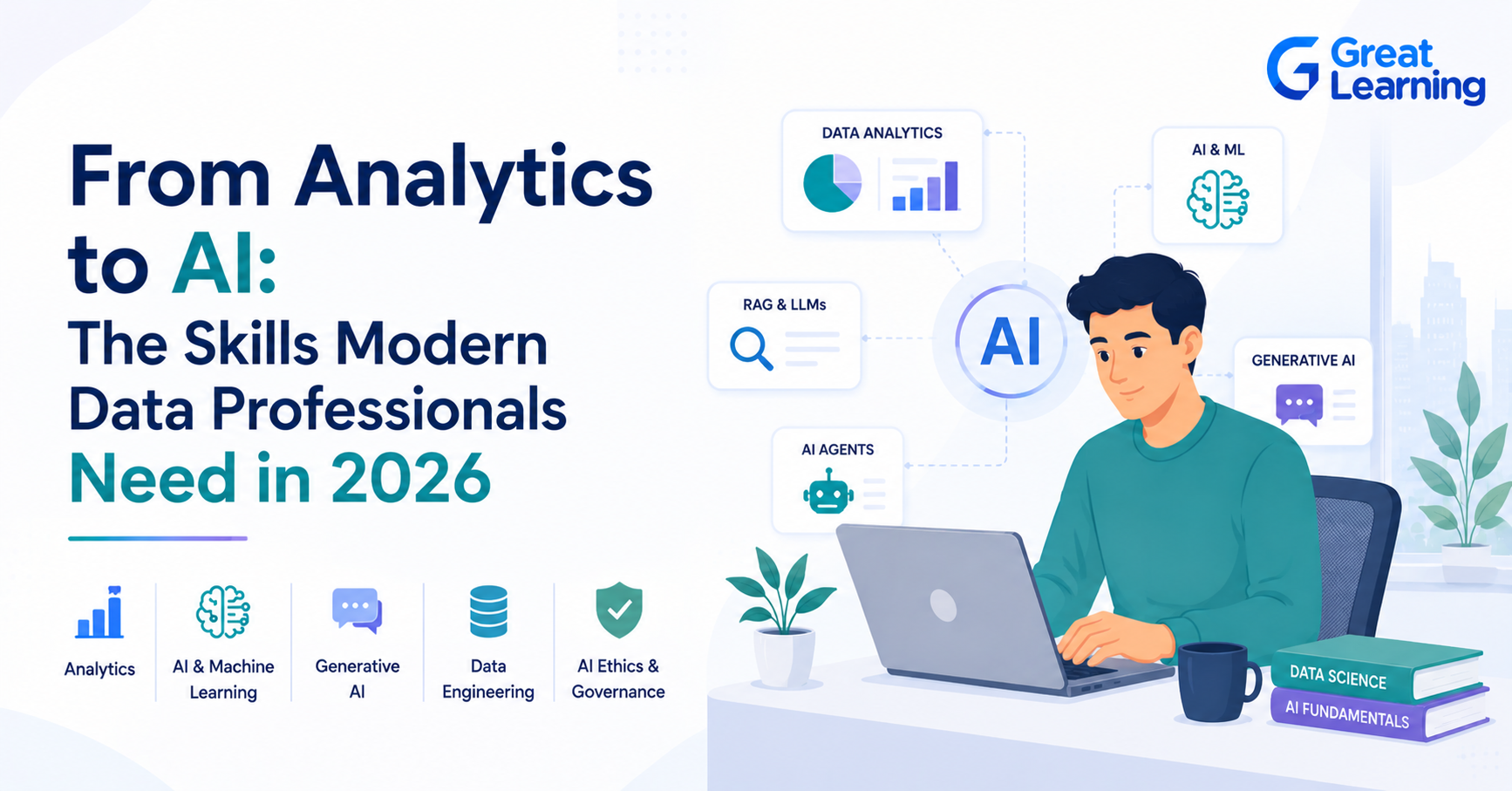
The expectations from data professionals have changed significantly. Beyond analyzing historical data and building dashboards, organizations now seek professionals who can leverage AI to generate insights, automate workflows, and solve complex business problems.
According to the World Economic Forum’s Future of Jobs Report 2025, AI and big data rank as the fastest-growing skills globally, while 86% of employers expect AI and information processing technologies to transform their business by 2030.
This shift is increasing demand for data professionals who can combine analytics with AI expertise.
This article explores the key AI skills for data professionals, how the role is evolving beyond traditional analytics, and the practical capabilities needed to build a successful career in AI and data science.
What Are AI Skills for Data Professionals?
AI skills for data professionals combine traditional data analysis with machine learning, generative AI, programming, and business problem-solving to deliver actionable insights and intelligent solutions.
Unlike traditional data roles that focused primarily on collecting, cleaning, and analyzing data, today’s professionals are expected to build intelligent systems, automate workflows, and help organizations make AI-driven decisions.
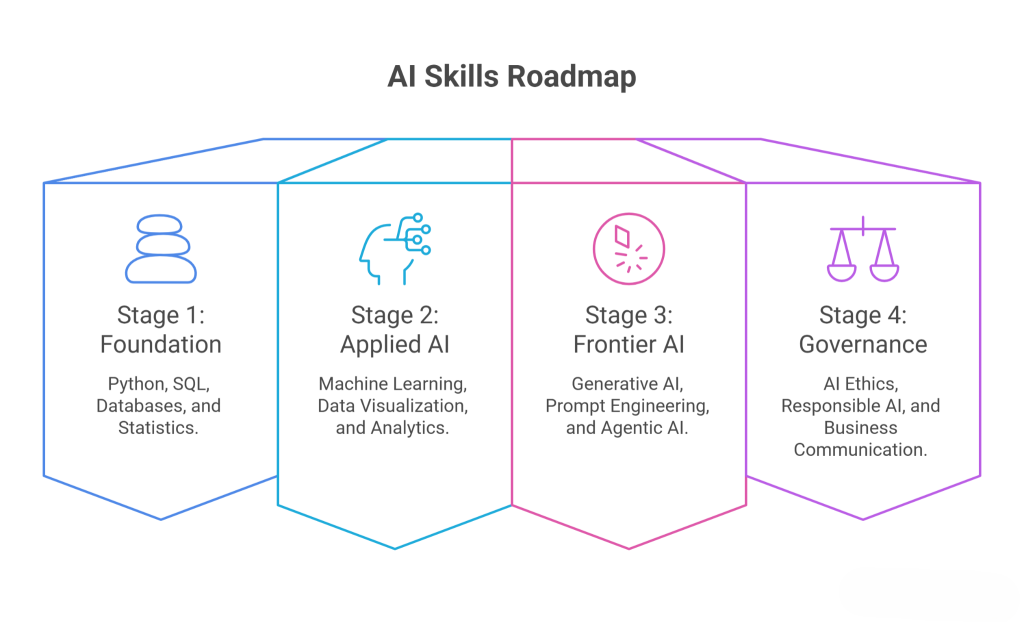
A practical learning journey looks like this:
| Learning Stage | Key Skills | Estimated Time* |
| Stage 1: Foundation | Python programming, SQL, Database Management, statistics, data manipulation | 4–8 weeks |
| Stage 2: Applied AI & Analytics | Machine Learning Fundamentals, Data Visualization, model evaluation, business analytics | 6–10 weeks |
| Stage 3: Frontier AI Skills | Generative AI, Prompt Engineering, AI agents, Agentic AI workflows, LLM applications | 4–8 weeks |
| Stage 4: AI Governance & Business Impact | AI ethics, governance, responsible AI, stakeholder communication, business problem-solving | 2–4 weeks |
*Estimated timelines assume part-time learning of approximately 8–10 hours per week.
For example, instead of spending hours preparing weekly reports, a modern data professional can use AI to automate data cleaning, generate summaries, build interactive dashboards, and focus on interpreting insights that drive business decisions.
Following this structured roadmap helps professionals develop both the technical and strategic capabilities needed for AI-powered roles.
Why Data Professionals Need AI Skills Beyond Traditional Analytics
Traditional analytics explains what happened. Modern AI enables data professionals to predict outcomes, automate decisions, and build intelligent applications using large language models (LLMs) and AI agents.
Organizations are rapidly moving beyond dashboards and descriptive reporting. Today’s data teams are expected to build AI-powered solutions that automate workflows, retrieve knowledge from enterprise data, and support business decisions in real time.
AI adoption continues to grow. According to McKinsey’s State of AI 2025, 88% of organizations now use AI in at least one business function, making AI, machine learning, and generative AI skills increasingly valuable for data professionals.
Today’s employers are looking for professionals who can work with modern AI frameworks and tools such as:
- LLMs like Claude and GPT models for analysis, summarization, and decision support
- Retrieval-Augmented Generation (RAG) to build AI applications using enterprise knowledge bases
- AI agent frameworks such as LangGraph for orchestrating multi-step reasoning and autonomous workflows
- Workflow automation platforms like n8n to connect AI with business systems and automate repetitive processes
- Machine learning and predictive analytics for forecasting, anomaly detection, and personalization
- Prompt engineering and AI evaluation to improve model accuracy, reliability, and business outcomes
Rather than simply analyzing historical data, modern AI systems can understand context, retrieve relevant information, generate insights, and take actions across connected applications.
| Traditional Analytics | Modern AI-Powered Analytics |
| Explains past performance | Predicts future outcomes |
| Manual reporting | AI-assisted insight generation |
| Static dashboards | Conversational AI interfaces |
| Descriptive analysis | Predictive and prescriptive intelligence |
| Isolated data analysis | RAG-powered enterprise knowledge retrieval |
| Standalone scripts | AI agents and automated workflows |
For example, a retail analyst can still identify last month’s best-selling products using traditional analytics.
With modern AI, the same professional can build a RAG-powered assistant that answers business questions using company data, use LangGraph to orchestrate inventory-optimization workflows, automate reporting with n8n, and leverage Claude or GPT models to generate executive-ready insights.
As AI becomes embedded across enterprise analytics, professionals who understand machine learning, generative AI, RAG, AI agents, workflow automation, and LLM application development will be better positioned to build intelligent data products rather than simply analyze data.
Core AI Skills Every Modern Data Professional Should Learn
Building a successful AI career requires more than learning machine learning algorithms. Modern data professionals need a combination of technical, analytical, and business skills.
Rather than mastering every new AI tool, professionals should focus on developing foundational skills that remain valuable across industries and technologies.
| Skill | Why It Matters |
| Python | Build AI, machine learning, and data science applications |
| SQL | Query, transform, and manage structured data |
| Machine Learning & Statistics | Develop predictive models and validate results |
| Data Visualization | Communicate insights through dashboards and reports |
| Generative AI (ChatGPT, Claude, Gemini) | Analyze data, generate insights, and automate everyday workflows |
| Prompt Engineering & AI Coding Assistants (GitHub Copilot, Cursor) | Improve LLM outputs and accelerate coding, debugging, and documentation |
| Agentic AI, RAG & Workflow Automation (LangGraph, CrewAI, n8n) | Build autonomous AI workflows and enterprise AI applications using business data |
| Cloud Platforms | Deploy and scale AI applications |
| Business Understanding | Translate business problems into AI-driven solutions |
For instance, a data scientist developing a customer churn model must not only build an accurate machine learning model but also explain its predictions to business stakeholders and recommend practical actions.
Developing this combination of technical and business capabilities helps professionals create AI solutions that deliver measurable impact rather than simply generating accurate predictions.
How Generative AI Is Changing Data Science Workflows
Generative AI is helping data professionals automate repetitive tasks, accelerate analysis, and focus more on solving business problems rather than manual data processing.
How Generative AI Is Transforming Data Science Workflows
Generative AI is transforming data science workflows by automating repetitive tasks, accelerating analysis, and enabling data professionals to focus on higher-value business decisions.
Traditional data science projects often require significant time to write SQL queries, clean datasets, document code, create reports, and interpret results.
Today, generative AI and AI agents can assist throughout the entire analytics lifecycle, helping professionals complete these tasks faster while maintaining human oversight.
Data professionals now use generative AI to:
- Generate SQL queries and Python code
- Summarize and explore datasets
- Explain analytical results in plain language
- Create reports, dashboards, and documentation
- Accelerate exploratory data analysis
- Automate repetitive analytics workflows
For example, a modern AI-assisted analytics workflow can automate much of the reporting process:
- Retrieve data from databases or cloud warehouses.
- Validate data quality by checking for missing values, anomalies, and inconsistencies.
- Analyze the data to identify trends, patterns, and key business insights.
- Draft a report with visualizations, summaries, and recommendations.
- Route the report to a manager or stakeholder for review and final approval before it is shared.
By automating routine tasks, generative AI enables data professionals to spend more time interpreting results, solving business problems, and making data-driven recommendations. However, human expertise remains essential for validating outputs, ensuring data quality, and applying business context before decisions are made.
Why Business and Communication Skills Matter in AI and Data Science
Technical expertise alone is no longer enough. Data professionals must also communicate insights clearly and connect AI solutions to business objectives.
This is why business communication is becoming as important as technical expertise. According to Gartner, at least 50% of generative AI projects were abandoned after the proof-of-concept stage due to unclear business value, poor data quality, inadequate risk controls, or rising costs.
Professionals who can translate AI insights into clear business outcomes are better positioned to drive successful AI adoption.
Important business skills include:
- Business problem-solving
- Data storytelling
- Communication
- Stakeholder management
- Critical thinking
- Decision-making
- Collaboration
Imagine a data scientist building a sales forecasting model. Delivering the model is only part of the job. They also need to explain why sales may change, what factors influence the predictions, and how business teams should act on those insights.
The ability to translate AI outputs into practical business recommendations is becoming one of the most valuable skills in modern data roles.
Common Skill Gaps Holding Data Professionals Back
Many data professionals have strong analytical foundations but struggle to keep pace with the rapid evolution of AI technologies.
Traditional analytics skills remain valuable, but organizations increasingly expect professionals to understand modern AI tools, automation frameworks, and production workflows.
Common skill gaps include:
- Limited machine learning knowledge
- Little experience with generative AI
- Weak software engineering practices
- Limited cloud platform experience
- Difficulty deploying AI models
- Lack of business communication skills
- Minimal exposure to real-world AI projects
For example, a professional may be highly skilled in SQL and dashboard development but have little experience integrating large language models into business applications or deploying machine learning solutions in production.
Addressing these gaps helps professionals transition from reporting historical insights to building intelligent, AI-driven solutions.
How Data Professionals Can Build AI Skills Effectively
Developing AI skills requires more than learning individual tools. It involves building a strong foundation in data science, machine learning, and real-world AI applications through consistent practice.
An effective learning path should include:
- Python programming
- Statistics and probability
- Machine learning
- Deep learning fundamentals
- Generative AI
- Data engineering basics
- Cloud platforms
- MLOps and deployment
- Real-world AI projects
Working on practical projects is equally important. Building recommendation systems, predictive models, AI-powered dashboards, and generative AI applications helps professionals understand how AI techniques are applied to real business challenges.
For professionals seeking structured learning, the AI and Data Science course from MIT Professional Education offers a comprehensive curriculum that covers AI, machine learning, deep learning, generative AI, data engineering, and hands-on industry projects.
By combining technical depth with practical application, the program helps learners build production-ready skills for modern AI and data science roles.
Career Opportunities for AI-Ready Data Professionals
Professionals who combine analytics with AI skills are well positioned for a growing range of roles across industries.
Organizations are looking for professionals who can transform data into intelligent business solutions rather than simply reporting historical trends.
Career opportunities include:
| Role | Primary Responsibility | Global Outlook |
| Data Scientist | Build predictive and AI-driven models | High demand across finance, healthcare, retail, and technology |
| AI Engineer | Develop intelligent AI applications | One of the fastest-growing AI roles worldwide |
| Machine Learning Engineer | Train and deploy ML models | Strong demand as organizations move AI models into production |
| Applied AI Engineer | Build production AI and GenAI solutions | Rapidly growing with enterprise GenAI adoption |
| Data Engineer | Develop scalable data pipelines | Essential for modern AI and analytics infrastructure |
| Analytics Consultant | Use AI to solve business problems | Increasing demand for AI transformation initiatives |
| AI Product Analyst | Support AI-enabled product development | Growing demand as AI-powered products become mainstream |
As AI adoption continues across industries, professionals with expertise in both analytics and AI will be better equipped to lead data-driven innovation and create long-term business value.
Final Thoughts
Modern data professionals need more than analytics skills to stay competitive. As AI becomes an integral part of data workflows, combining analytical expertise with machine learning, generative AI, and business problem-solving will be essential for delivering greater business value.
For professionals looking to build these in-demand capabilities, the AI and Data Science course by MIT Professional Education offers a structured 15-week learning path with hands-on projects, equipping learners with practical skills in AI, machine learning, and data science for the next generation of AI-driven careers.
Frequently Asked Questions
1. What AI skills should modern data professionals learn?
Modern data professionals should build a strong foundation in Python, SQL, statistics, and machine learning before expanding into generative AI, prompt engineering, AI agents, cloud platforms, and business communication. This combination enables professionals to develop AI-powered solutions that solve real business problems.
2. What’s the difference between Generative AI and Agentic AI?
Generative AI focuses on creating content, writing code, summarizing information, and answering questions based on user prompts. Agentic AI goes a step further by planning, reasoning, and executing multi-step tasks with minimal human intervention. For data professionals, Agentic AI can automate workflows such as retrieving data, validating results, generating reports, and routing outputs for approval.
3. How long does it take to become job-ready in AI and data science?
The timeline depends on your background and learning pace. Professionals with programming or analytics experience can often become job-ready within a few months through structured learning and hands-on projects, while beginners may require additional time to build foundational skills in Python, SQL, statistics, and machine learning.
4. Do I need a computer science degree to transition into an AI role?
No. Many professionals successfully transition into AI from backgrounds such as data analytics, engineering, mathematics, finance, and business. Employers typically value practical skills, real-world projects, and the ability to solve business problems more than a specific academic degree.
5. What tools should data professionals learn first?
Start with Python and SQL, as they form the foundation of most AI and data science workflows. Once you’re comfortable with these technologies, learn machine learning, data visualization, and generative AI tools such as ChatGPT or Claude before progressing to AI agents and enterprise AI frameworks.
6. Which industries are hiring AI-ready data professionals?
AI-ready data professionals are in demand across healthcare, finance, retail, manufacturing, technology, telecommunications, logistics, and consulting. Organizations across these industries are adopting AI to automate processes, improve decision-making, and build intelligent products and services.
7. Which AI and Data Science course is suitable for working professionals?
Working professionals should look for programs that combine AI fundamentals, machine learning, and generative AI with hands-on projects that apply to real-world business applications. The AI and Data Science course from MIT Professional Education provides a structured learning path to help professionals build practical, industry-relevant AI and data science skills.