

New research from Monash University scientists has revealed that microscopic life is actively breaking down decades-old mining waste in South Australia, turning stable radioactive and toxic metals into mobile nanoparticles that can easily travel through the environment.
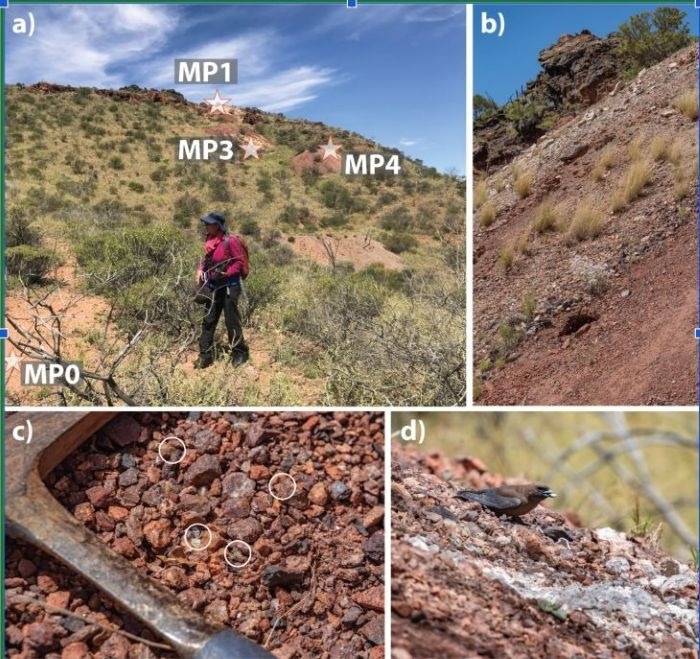
The study, published in the Journal of Hazardous Materials, investigated historic uranium and rare earth element mine waste in a cluster of historical, abandoned mine shafts located in the rugged Mount Painter area of the northern Flinders Ranges, South Australia.
Left largely undisturbed for more than 80 years and now part of the protected Arkaroola Wilderness Sanctuary, the site known as Mount Painter No. 6 Workings served as a natural laboratory for researchers to understand the long-term fate of these hazardous materials.
Previously, scientists believed that uranium and rare earth elements in these dry settings were immobile, safely locked away inside insoluble phosphate minerals. However, using advanced single-particle analysis, the Monash research team discovered high concentrations of polymetallic nanoparticles near the surface of the waste piles.
The researchers identified a direct link between the highest concentrations of these nanoparticles and the areas of greatest microbial diversity. This suggests that specialized microbial communities are effectively ‘mining’ the minerals, extracting the metals and transforming them into colloidal forms that can easily move through soil and water systems during rain events.
Professor of Synchrotron Geosciences, Joël Brugger from Monash University’s School of Earth, Atmosphere and Environment, said the discovery fundamentally changes how we view the stability of legacy mining sites.
“We have traditionally assumed that these toxic metals were securely locked away by nature in these arid environments, but these tiny organisms are proving us wrong,” Professor Brugger said.
“They are essentially acting as microscopic factories, breaking down stable minerals and mobilizing elements like uranium into the surrounding ecosystem. As we ramp up mining for the green energy transition, we must factor these invisible biological processes into our waste management strategies to prevent long-term environmental damage.”
As the global transition to green energy drives unprecedented demand for critical minerals, the volume of mining waste is predicted to rise significantly. The researchers warn that understanding how microbes interact with this waste is vital for preventing unseen environmental contamination.
As with any complex biological system, there is a flip side to the coin. The new mineral-microbe interaction pathways identified around Mt Painter could be harvested into new low impact extraction technologies or new methods for the remediation of contaminated sites.
Dr Santonu Sanyal from the Environment Research Unit at CSIRO, says the global push toward a green energy transition will inevitably lead to a significant surge in mining waste and a need for innovative and integrated approaches to mineral extraction and site remediation.
“As we rapidly scale up operations to meet the unprecedented demand for critical minerals, the volume of mining waste generated globally is going to rise significantly,” Dr Sanyal said.
“Understanding exactly how these native microbes interact with waste materials is absolutely vital if we want to prevent unseen, long-term environmental contamination, and develop the sustainable mine of the future.”
Professor Brugger and the CSIRO are part of the newly launched Monash Critical Minerals Initiative (MCMI), which brings together more than 40 researchers from Monash’s faculties of Business and Economics, Science, Engineering and Arts.
Its work spans the full minerals value chain, from resource discovery and extraction technologies to environmental stewardship, supply chain modelling, investment policy and social license outcomes.