

This year’s Kavli Prize in Nanoscience recognizes the field of twistronics and exemplifies how simple approaches can shape nanoscience research.
The 2026 Kavli Prize in Nanoscience recognizes Eva Y. Andrei, Allan H. MacDonald and Pablo Jarillo-Herrero for their pioneering work that established the field of twistronics. It is a fitting moment not only to celebrate these remarkable contributions, but also to reflect on how a simple idea changed nanoscience: rotate one atomically thin crystal with respect to another, and a new material is born.

Credit: Trond Loekke
Unlike several of previous years’ prizes that have recognized methodological advances, this year’s prize “wants to acknowledge a simple and universal nanoscale approach to achieve new materials properties”, says Mari-Ann Einarsrud, professor at Norwegian University of Science and Technology and chair of the selection committee.
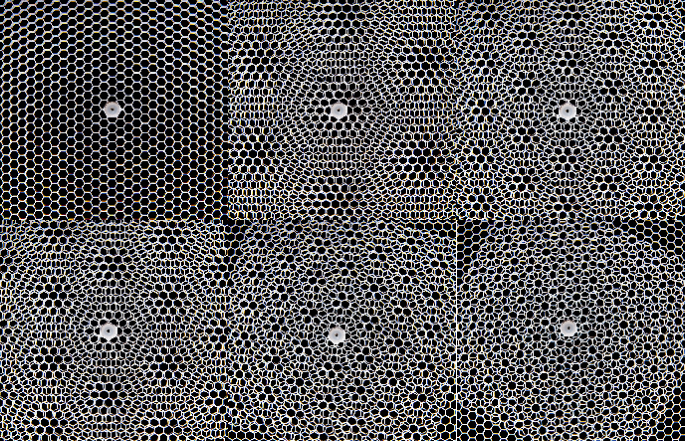
Twistronics has had a remarkably broad impact in nanomaterials science. In twisted bilayer graphene, a small change in angle can generate moiré patterns that reshape the electronic density of states and, at the magic angle (1.1°), produce nearly flat bands where electronic interactions dominate. The discovery of correlated insulating states and superconductivity in magic-angle graphene transformed twistronics from an elegant band-engineering concept into a highly tunable platform for quantum matter1,2. It changed the way researchers thought about the origin of complex quantum phenomena. Suddenly, strong correlations, topology and superconductivity were no longer tied to compositionally complicated materials; rather, these properties could be generated in a single-element material, stacking and twisting layers.
The field has since expanded far beyond its original bilayer graphene setting. Twisted transition-metal dichalcogenides, graphene–boron nitride heterostructures, moiré magnets and semiconducting van der Waals systems have produced correlated insulators, Chern bands, excitonic phases, ferroelectric responses and fractionalized electronic states. What makes these systems especially compelling is the combination of rich physics and nanoscale control. Twistronics introduced a general tuning knob to nanoscience: geometry, which has since extended to include the broader concept of topology. And moreover, that emergent properties that cannot always be predicted by studying the single constituents alone, such as superconductivity, can be so directly tuned.
Twistronics, or more generally moiré superlattices, is also beginning to shape functional electronic and opto-electronic devices. Gate-defined superconducting devices in magic-angle graphene have shown how Josephson-junction-like behaviour and superconducting circuit elements can be created within a single moiré material3,4,5. In parallel, magic-angle photonic superlattices have enabled lasing from twist-induced confined modes, illustrating that moiré geometry can manipulate photons too6. Extending this photonic direction, twisted bulk hBN can form interfacial quantum wells that localize excitons and enhance deep-ultraviolet emission for efficient UV light sources7.
The word twistronics smashes together ‘twist’ and ‘electronics’, but unlike the more famous ‘-onics’, it has not yet led to real-world applications. However, the next stage for the field will hinge on developing more precise nanofabrication protocols. The field has already shown that a small rotation can generate new material properties; the harder task now is to make that transformation more robust. Achieving this will require more precise control over twist angle, strain, lattice relaxation and interface cleanliness. Even slight variations can reshape the electronic structure, broaden phase boundaries or make it difficult to separate intrinsic physics from sample disorder. Encouragingly, new fabrication approaches are beginning to address this bottleneck, including polymer-free assembly using silicon nitride membranes, which has been used to produce cleaner twisted graphene heterostructures with improved moiré uniformity8.
More recently, efforts have been made to shift from top-down, layer-by-layer assembly toward bottom-up angle-controlled growth of moiré materials. The goal is no longer simply to find another phase with surprising properties, but to scale a known phase in designed architecture for novel devices.
The Kavli Prize celebrates more than the discovery of magic-angle graphene. It recognizes a broader shift in how nanoscience can be leveraged to access new nanomaterials. The twist was small, but the consequences were enormous.