

A fluidic memristor that heats itself to form and clear nanoscale salt blockages could bring ionic hardware closer to the dynamic learning and memory functions of biological neural systems.
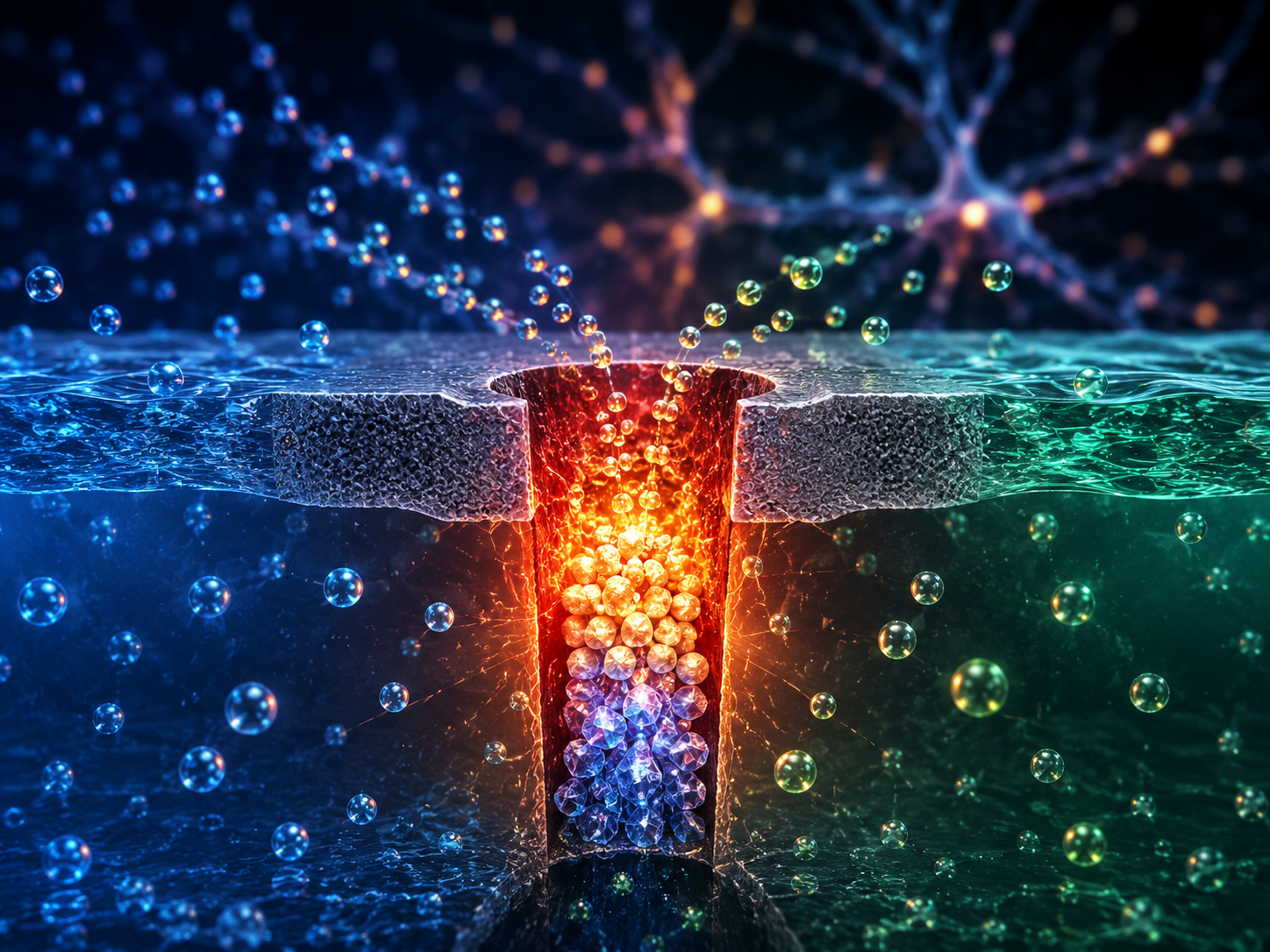
Paper: Self-heating-induced blocking in nanopores enables neuromorphic ionic computing. Image credit: AI-generated image created using ChatGPT/OpenAI
In a recent ‘article in press’ in the journal Nature Communications, researchers report the development of a self-heating-induced blocking memristor (SIBM) based on nanopores that enables neuromorphic ionic computing by leveraging thermally triggered precipitation and electric-field-driven precipitate clearance for resistive switching.
Ionic Neuromorphic Computing Rationale
Neuromorphic computing aims to emulate the brain’s efficient information processing using specialized hardware architectures. Memristors, as resistive switching devices, have emerged as promising candidates for neuromorphic systems due to their intrinsic memory functionality.
However, the majority of memristors are solid-state devices that use electrons or holes as charge carriers, differing fundamentally from biological neural systems that utilize ions and molecules. This discrepancy motivates exploration into fluidic memristors, which leverage ionic conduction within nanoscale channels to more closely mimic biological ionic dynamics. Existing fluidic memristors typically rely on mechanisms such as ion concentration polarization, mechanical deformation, or electrochemical reactions.
This work presents a nanopore-based fluidic memristor whose resistance switching arises from self-heating-induced precipitation blocking within nanoscale pores, offering a distinctive proof-of-concept approach to bioinspired neuromorphic hardware.
Nanopore Device Fabrication
The core device studied is a nanopore chip fabricated on a 20-nm-thick suspended silicon nitride membrane, with pores 300-400 nm in diameter created by focused ion beam technology. The chip separates two fluid reservoirs containing a mixed electrolyte solution of cerium sulfate (Ce2(SO4)3) and potassium chloride (KCl), along with Ag/AgCl electrodes inserted in each reservoir.
Key experimental tools include thermocouples positioned near the nanopores to measure localized heating, scanning electron microscopy (SEM) and atomic force microscopy (AFM) to observe morphological changes and precipitate formation upon switching, and energy-dispersive spectrometry (EDS) to identify precipitate compositions.
Finite element modeling was performed to simulate localized Joule heating and the resulting temperature distributions within the nanopores. Variation in device parameters explored the effects of voltage sweep range, electrolyte concentration and species, pore size, and pulse timing on memristor dynamics. Additionally, a 5 × 4 fluidic memristor array with patterned orthogonal PDMS microchannels was fabricated to demonstrate addressable write, erase, hold, read, and rewrite operations using nanopore-based device elements, sequentially storing and rewriting the letters “S,” “E,” and “U.”
Self-Heating Memristor Dynamics
The transport phenomena within the nanopores reveal a distinctive resistive switching (RS) mechanism fundamentally governed by self-generated Joule heating. When a voltage is applied, the large potential drop across the nanoscale pores produces localized Joule heating as ionic current passes through them.
This elevates the temperature within the pores, triggering the precipitation of cerium sulfate, a salt with retrograde solubility, inside the nanopores. The precipitates physically block ion transport channels, abruptly increasing resistance and switching the device to a high-resistance state (HRS). As voltage and temperature decrease, the precipitate is progressively removed, with conductance recovery potentially assisted by electroosmotic flow or electrophoretic transport, restoring ion conduction and returning to a low-resistance state (LRS).
I-V measurements under triangular voltage waves reveal a pronounced unipolar hysteresis loop with a sharp threshold voltage, indicating abrupt switching behavior resembling biological “all-or-nothing” neuronal responses. Thermocouple data and finite element thermal modeling support localized Joule heating as the trigger for switching.
Control experiments argue against nanobubble formation and electrode-surface electrochemical effects as the principal mechanisms of switching. Nanobubbles exhibited much faster dynamics than the observed resistance states. Separately, replacing the electrodes did not restore the low-resistance state. Morphological analysis provides direct evidence of crystalline Ce2(SO4)3 precipitates within the pores following resistive switching events.
Device performance is tunable via parameters that control Joule heating power, such as electrolyte conductivity, ion species, pore size, and applied voltage. Higher KCl concentrations and smaller pore diameters yield lower threshold voltages and more pronounced hysteresis due to enhanced local heating.
Importantly, the device exhibits negative differential resistance (NDR) regions during voltage sweeps, reflecting its nonlinear and dynamic thermal response. This characteristic is analogous to that of thermally driven Mott memristors. In other locally active devices, NDR has been linked to complex neuromorphic phenomena such as self-oscillation and action potential generation, although the researchers did not directly demonstrate these behaviors in SIBM.
Memristor response speed improves with device training, achieving response times around 12 ms in a well-trained device. SIBM also showed repeatable current-voltage switching across more than 60 consecutive scans and exhibited retention times of up to about 1500 seconds before relaxation.
The neuromorphic functionality demonstrated includes paired-pulse depression (PPD), in which the response to a second stimulus is attenuated as a function of inter-pulse interval, and spike-rate-dependent plasticity (SRDP), which shows frequency-dependent modulation of conductance analogous to synaptic behavior.
Memory and forgetting are emulated through supra-threshold pulses that induce blocking and lower-magnitude pulses that promote conductance recovery, with pulse magnitude rather than polarity primarily controlling the response. Bidirectional pulses above the switching threshold produced persistent inhibitory states analogous to mutual inhibition in biological synapses. Associative learning is emulated by conditioning a stimulus that initially elicits no response to eventually evoke a memory response after pairing with a second stimulus. Beyond these electrically driven learning and memory behaviors, the researchers also constructed a chemical synaptic device in which a brief acidic electrolyte stimulus dissolved the precipitate, converting a chemical input into a repeatable electrical response before precipitation reformed.
Prospects for Fluidic Memristors
In summary, this research presents a novel nanoscale fluidic memristor whose unique resistive switching arises from localized self-heating-induced salt precipitation blocking nanopores and electrically assisted precipitate clearance. This thermal-chemical switching mechanism represents a distinctive proof-of-concept approach in ionic neuromorphic devices, providing nonlinear conductance dynamics with negative differential resistance and enabling diverse synaptic-like plasticity behaviors.
Future optimization avenues include precise nanopore structural control, surface engineering, and electrolyte tailoring toward stable, reversible precipitate cycles that minimize energy consumption. Furthermore, the intrinsic chemical tunability offers opportunities for multifunctional platforms that combine thermal, ionic, and chemical signal processing. However, the system remains an early proof of concept, with a 20-element array, limited endurance testing, and no system-level energy or practical computing benchmark.