

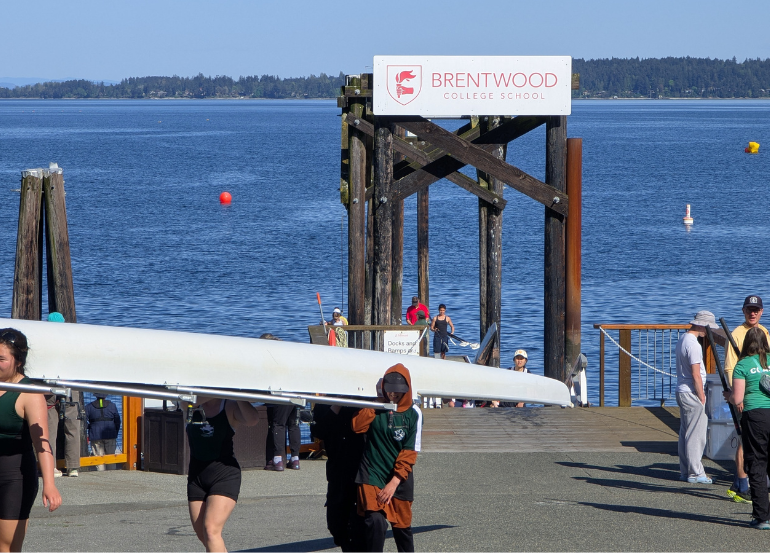
Three kilometers of open water. A bobbing, floating dock. Family and friends waiting for a live feed from across the globe.
This was the scene at the 54th annual Brentwood International Regatta. For the broadcasting students, it was a high-stakes classroom. For the IT team, it was a puzzle. They had cameras, they had passion, but they lacked the one thing needed for the livestream: reliable wireless connectivity.
Cellular coverage was limited. Starlink created synchronization issues for real-time livestream from different cameras.
So, we joined forces with Brentwood College to understand the environment and their application requirements. Our team—Monica Alfonso Bernal (Account Executive), Nishant Hooda (Solutions Designer), and Ian Procyk (Wireless Solutions Designer)—worked closely with the school to validate a technical solution tailored to their unique marine environment.
We brought in Cisco Ultra-Reliable Wireless Backhaul (URWB). Think of it as a fiber-optic cable, but without the actual cable. We set up an industrial wireless link between the school’s rooftop and that floating start dock.
The setup was simple, but the engineering was precise. We used a patch antenna on the dock that didn’t mind the constant movement of the water. On the roof, we aimed a high-gain antenna to lock in the signal. We configured URWB to ignore the reflections bouncing off the ocean surface. Watch the video below for details:
The result? Camera feeds with 60 frames per second, and not a single dropped frame. The broadcast was flawless.
“For me, this is a great example of what partnership is all about,” says Monica Alfonso Bernal. “It’s about understanding our customer’s challenges, bringing the right people together, and helping create a better experience for their students, families, and community.”
But this isn’t just about rowing.
The struggle to get a stable connection can happen in many scenarios. They hit whenever fiber is too pricey or simply impossible to install. Think about a busy manufacturing floor where equipment is constantly on the move. Or consider airport shuttles and city transit systems that need a steady stream of data while in motion. Even something as simple as providing public Wi-Fi in a sprawling park or linking two separate campus buildings can become a pricey or too long if cabling is needed.
When you can’t run a wire, you need a wireless backbone that acts like one. URWB is that backbone. Whether it’s connecting remote cameras for security, managing automated equipment in a warehouse, or keeping public Wi-Fi running in a park, the logic stays the same. You need speed, you need low latency, and you need it to work when the environment is fighting you.
Brentwood College proved that you don’t need to be tied to a wall to do professional-grade work. They’re already planning to add drones and boat-mounted cameras for next year. Their imagination has no limits now.
Sometimes, the best way to connect the world is to stop relying on the things that keep us grounded. If you’ve got a spot that’s too far, too remote, or just too difficult to reach with fiber, maybe it’s time to cut the cord.
The ocean is big. The signal is strong. Let’s see what you can build.
Subscribe to the Industrial IoT Newsletter