

Support CleanTechnica’s work through a Substack subscription or on Stripe.
Cement decarbonization attracts miracle stories. One company has a new binder. Another has a carbon-negative aggregate. Someone else has an electrochemical process, a hydrogen kiln, a low-carbon limestone route, a supplementary cementitious material, a recycled cement process or a carbon-capture retrofit. Some of these ideas are useful. Some will become real niches. A few may become meaningful industrial wedges. But the sector will not be decarbonized by one magic cement.
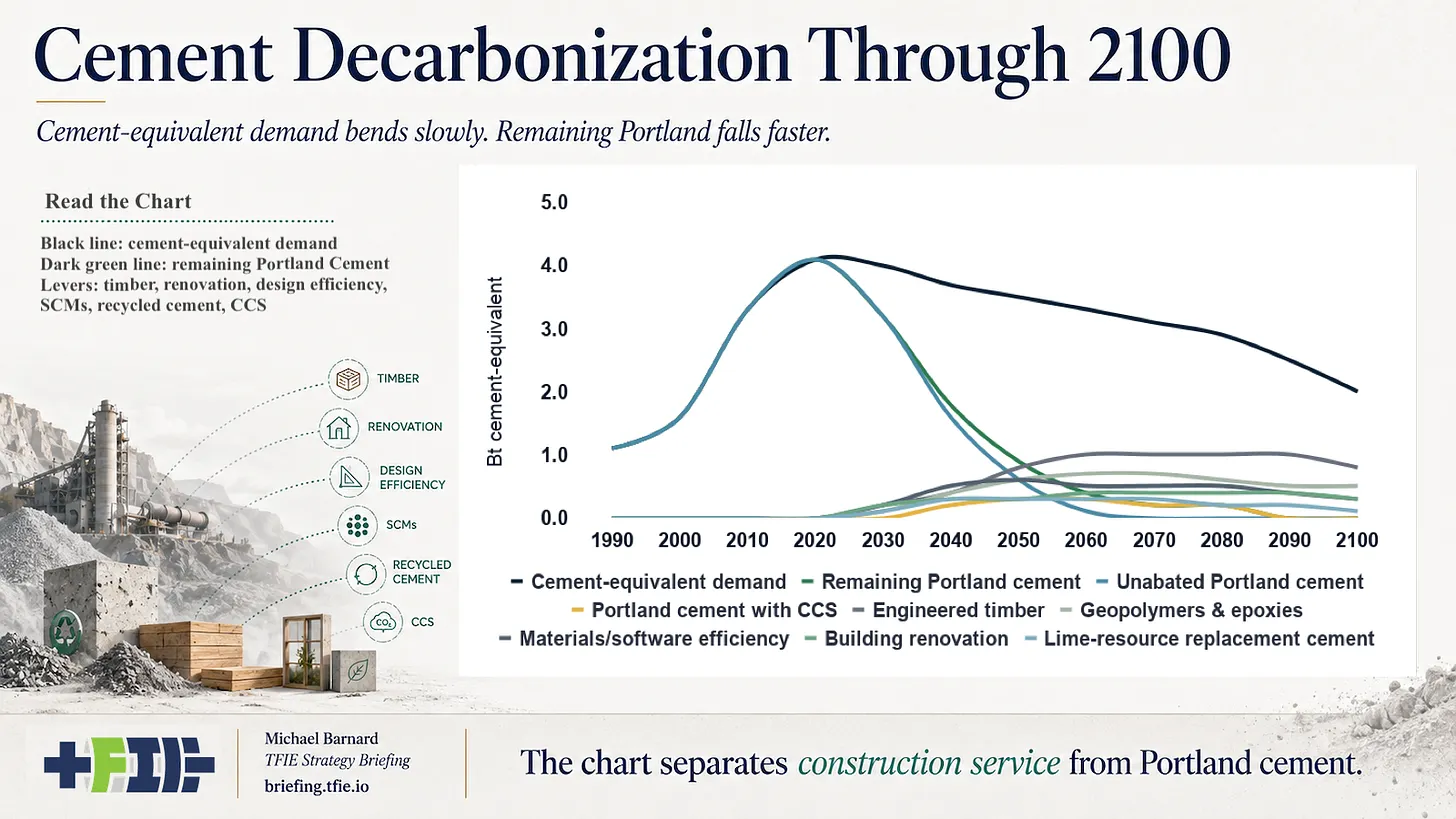
The first mistake is treating cement demand as fixed. Cement is not an end use. It is an input into buildings, roads, bridges, ports, tunnels, foundations, dams, industrial sites and other infrastructure. The useful question is not simply how to make today’s cement with lower emissions. It is how much cementitious material the world needs after design efficiency, renovation, material substitution, urban form, infrastructure maturity and better construction practice are counted.
That denominator changes over time. China’s massive first-build of infrastructure and property is already past its peak. Other regions will still build, but they are unlikely to repeat China’s material intensity at the same scale. Mature economies will shift more of their built-environment spending toward renovation, repair, adaptive reuse and replacement rather than endless first-build expansion. Growing economies still need concrete, but better design, higher-quality standards and less waste can reduce tonnes per unit of service.
Portland cement remains central because it is cheap, standardized, familiar, strong, durable and deeply embedded in codes, procurement and supply chains. That is why it cannot just be waved away. But Portland cement is also carbon-intensive because emissions come from two places at once. Kilns need heat, and limestone releases CO₂ when it is converted into clinker. Electrifying or changing kiln heat helps, but it does not eliminate the process emissions from limestone chemistry.
That is why clinker is the real target. Ordinary Portland cement is not used as pure clinker. It is a blend. The lower the clinker share, the lower the process emissions per tonne of cement, provided performance is maintained. Supplementary cementitious materials such as fly ash, slag, calcined clays, natural pozzolans and limestone blends can reduce clinker demand. The limits are not only technical. They are also regional supply, standards, performance requirements, construction habits, procurement rules and conservative engineering practice.
Some traditional supplementary materials are also constrained. Fly ash availability falls as coal power declines. Blast-furnace slag is tied to a steel route that also changes as steelmaking shifts toward scrap and electric arc furnaces. That does not make low-clinker cement impossible, but it does mean the easy historical substitutes are not infinite. Calcined clays and limestone-calcined clay cements become more important in that context, as do regional material assessments rather than global averages.
Alternative binders matter, but they should be treated as bounded. Some can perform well in specific applications. Some can reduce process emissions. Some may use industrial residues or different mineral chemistries. But cement is not a software market where a better product can simply scale through a download. It is a heavy, local, standards-bound, liability-sensitive construction material. It has to pass codes, engineering conservatism, supply-chain reliability, cost, contractor familiarity and long-term durability requirements.
Mass timber is another wedge, not a replacement for all concrete. It can reduce cement demand in buildings where wood performs real structural work and where forestry, manufacturing, codes, insurance and construction capability line up. It is not a substitute for all foundations, tunnels, bridges, marine works, high-load industrial floors or much civil infrastructure. The useful role for mass timber is to reduce building-related concrete demand where it is structurally and economically sensible.
Recycled cement and concrete reuse are also useful but bounded. Existing concrete can be crushed and reused as aggregate. Some processes aim to recover cementitious value from demolished concrete. These are worth tracking, especially as mature economies renovate and rebuild more than they expand. But demolition flows, contamination, collection logistics, processing cost and performance standards will determine how much recycled material can actually displace new Portland cement.
Carbon capture is the last major lever, not the first. It may be necessary for remaining clinker process emissions in large, long-lived plants with suitable CO₂ transport and storage. But it is not a license to ignore denominator reduction, clinker substitution and material efficiency. Cement plants are numerous, markets are local, margins can be thin and CO₂ infrastructure is not universally available. CCS is more plausible for selected residual emissions than as a blanket answer for every kiln.
The practical pathway is therefore layered. Use less unnecessary concrete. Design structures more efficiently. Renovate where possible instead of rebuilding. Substitute mass timber where it performs real building work. Reduce clinker content where materials and standards allow. Use calcined clays, pozzolans, limestone blends and other substitutes regionally. Develop alternative binders where they pass performance and supply-chain tests. Recycle concrete and cementitious materials where logistics and quality work. Apply CCS selectively to the residual Portland cement that remains difficult to eliminate.
This is less dramatic than the magic-cement story, but it is more credible. Cement decarbonization is not a single breakthrough waiting to displace a lazy incumbent. It is a materials, standards, construction, infrastructure and capital-stock problem. The sector changes when many smaller wedges compound through design, demand, chemistry, codes, procurement and plant turnover.
For the full pathway review, read the TFIE Strategy Briefing version:
Subscribe for the professional layer behind the projection: denominator tests, material wedges, pathway logic, update triggers and the distinction between useful cement technologies and claims that pretend the whole sector is one product substitution away from decarbonization.
Sign up for CleanTechnica’s Weekly Substack for Zach and Scott’s in-depth analyses and high level summaries, sign up for our daily newsletter, and follow us on Google News!
Have a tip for CleanTechnica? Want to advertise? Want to suggest a guest for our CleanTech Talk podcast? Contact us here.
Sign up for our daily newsletter for 15 new cleantech stories a day. Or sign up for our weekly one on top stories of the week if daily is too frequent.


CleanTechnica uses affiliate links. See our policy here.
CleanTechnica’s Comment Policy