

Key Takeaways
- Incomplete data causes AI hallucinations. Most enterprise AI lacks location context, so it fabricates answers to fill the gaps. A (Model Context Protocol) MCP server gives it verified, real-world data to reason with instead.
- You don’t need code or GIS expertise to query spatial data. The Precisely MCP server enables you to geocode addresses, assess property risk, pull demographics, and generate site selection reports through plain natural language prompts.
- The Precisely MCP server is free, built on Anthropic’s open-source MCP, and works across LLMs. It connects to Claude, ChatGPT, and other leading LLMs.
Enterprise AI is only as useful as the context it has to work with. Give a model incomplete data and it will do what LLMs always do when they hit a gap: fill it in.
Sometimes that’s fine. But when you’re making decisions that have a significant impact on your business, like about where to open a new location, how to assess property risk, or which customer segments to prioritize in a specific market, a hallucinated output becomes a liability.
That’s the challenge I unpacked in a recent live demo for Data Science Connect’s AI Demo Day.
Most organizations have substantial first-party data. What they often lack is the location-specific context that ties that data to the real world: drive times, neighborhood demographics, nearby businesses, consumer behavior, flood zones, wildfire exposure, parcel details. Without that location intelligence layer, AI is essentially reasoning blind.
The harder part? Even organizations that know they need this data struggle to use it. Spatial data doesn’t natively integrate with most AI tools and interfaces, presenting another obstacle to overcome before location AI workflows can make use of location. Working with it traditionally means GIS tools, spatial queries, custom integrations – it’s a lot of time, effort, and friction before you get any value.
The Precisely MCP Server was built to remove that friction entirely.
What Is an MCP Server, and Why Does It Matter for Enterprise AI?
If you’re new to Model Context Protocol, the short version is this: MCP is an open standard developed by Anthropic that gives AI systems a standardized way to access external data sources and tools. Instead of writing bespoke integration code for every API you want an AI to use, you connect to an MCP-compliant interface and let the model do the rest.
The key point for enterprise teams: MCP is a meaningful shift in how AI can interact with the data your business actually depends on, securely and at scale, through natural language.
The Precisely MCP Server takes this a step further by connecting to hundreds of location intelligence tools and data enrichment datasets — addresses, parcels, buildings, demographics, places, risk factors, consumer spend, and more — and making all of it queryable through plain language in whatever LLM interface you already use.
Precisely MCP Demo: From a Single Address to a Full Site Selection Report
During the live session, I walked through two scenarios that illustrate just how quickly the MCP server can move from simple query to complex output.
- Geocoding with context, not just coordinates. The first example was intentionally minimal. I typed an incomplete New York address into Claude Desktop (no borough or ZIP) and asked for a geocode.
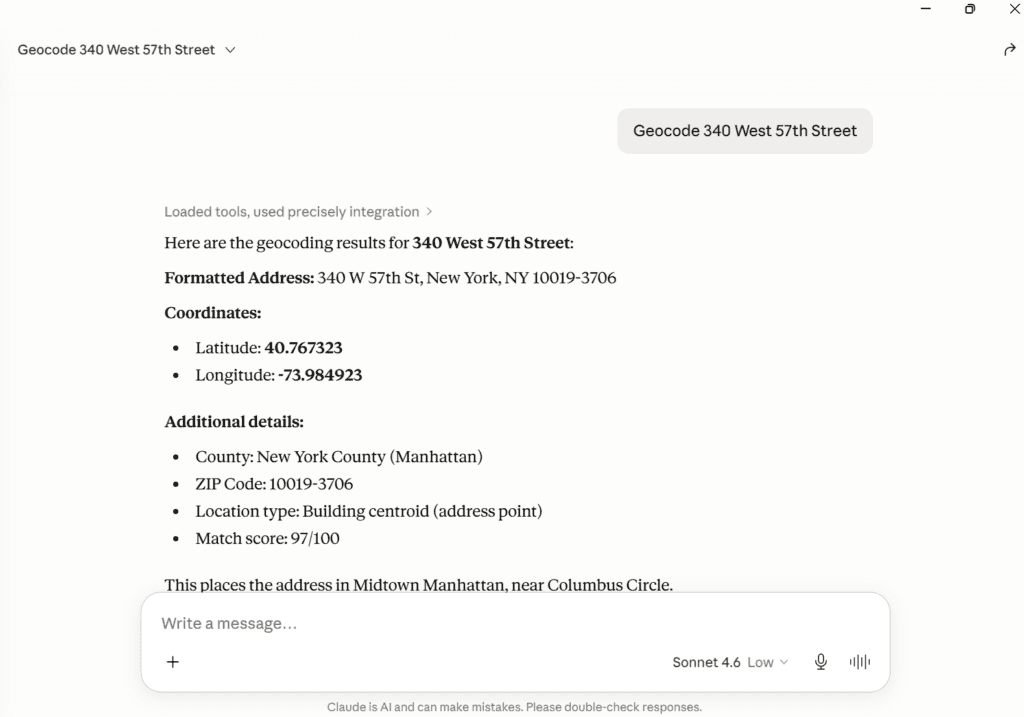
The MCP server handled address autocomplete, returned latitude and longitude, and surfaced a PreciselyID: a unique, persistent identifier that Precisely appends to every addressable location – you can see this as the PBKEY in the image below.
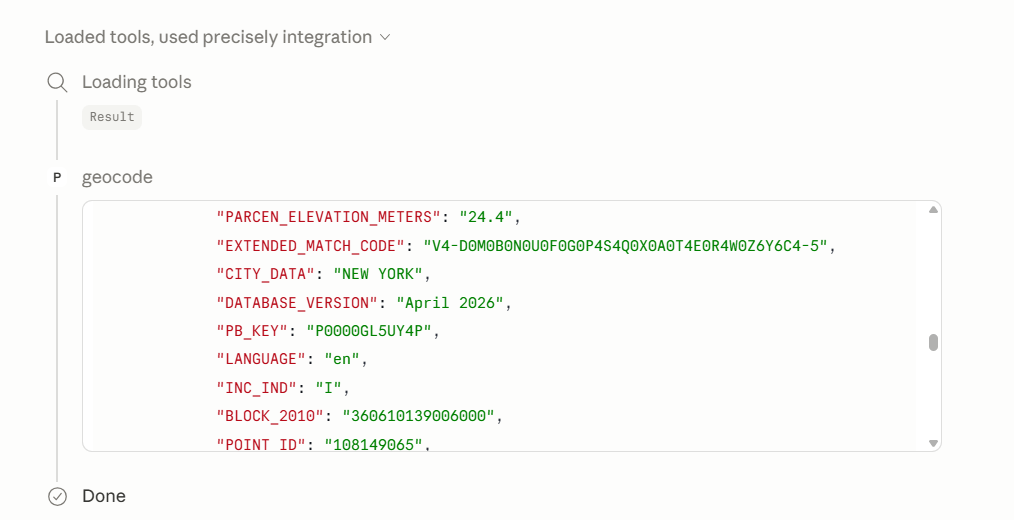
That PreciselyID is worth pausing on. It’s what allows a raw address in your internal systems to connect seamlessly to our entire network of enrichment data — including demographics, parcel attributes, building details, risk scores — without any manual matching or data engineering. One identifier, everything linked.
- A site selection report, generated in minutes. The second example used a project prompt to set Claude up as a lead audience and site strategist. I gave it a system prompt defining the analysis objective, specified the data I wanted pulled through, and appended a consumer spend CSV representing first-party organizational data. Then I simply asked it to generate a site selection report for the same address.
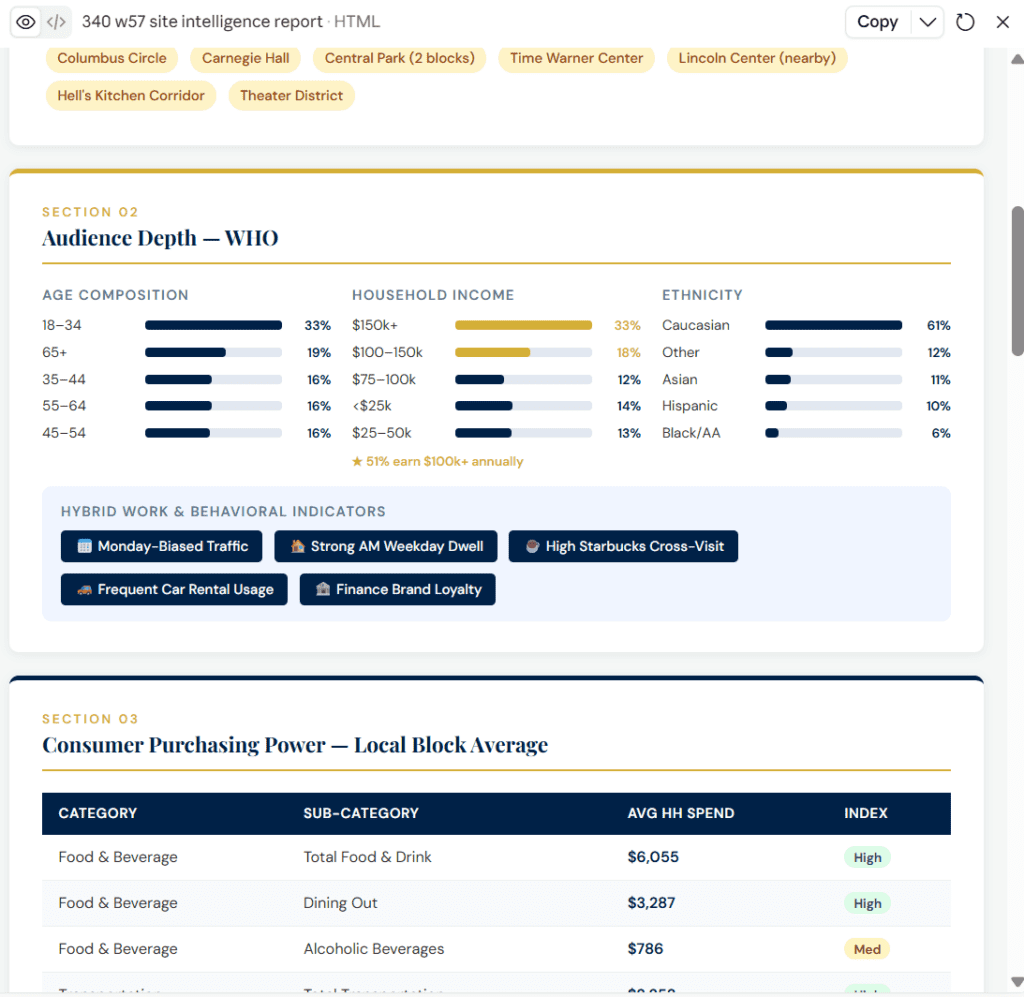
What came back would have previously taken hours or even days to assemble: audience profile, traffic analysis, retail spend nearby, and advertiser fit assessment, all formatted, readable, and ready to share. I could export it as a PDF or stand it up as a lightweight web app. The entire thing ran through natural language in Claude.
How Does The Precisely MCP Server Help You Prevent AI Hallucinations?
This is the question that matters most for teams scaling AI in enterprise environments. The answer comes down to data completeness.
When an AI model encounters a question it can’t answer from its training data or available context, it doesn’t say “I don’t know.” It generates something plausible. For general knowledge, that’s often acceptable. For questions tied to specific places, properties, or real-world conditions, it’s a significant risk.
The Precisely MCP server gives AI the grounding it needs. By making live, verified location intelligence available on demand within the same interface where the model is already working, you’re both improving output quality and replacing fabricated context with accurate, current, authoritative data.
That changes the reliability profile of AI entirely for location-dependent use cases.
DEVELOPER PORTALData Integrity Suite Developer Portal
Accelerate your developer journey. Our best-of-breed APIs empower developers to deliver unique experiences and groundbreaking applications on time, every time! With comprehensive documentation and expert support at your fingertips, you’ll have all the tools to bring your vision to life.
Which Industries and Use Cases Does Precisely MCP Server Support?
The site selection example I demonstrated is one application, but the underlying capability maps across a wide range of industries and workflows. Here are a few worth calling out:
- Insurance and financial services teams can build risk assessment workflows that pull wildfire exposure, flood zone classification, crime rates, and proximity to emergency services for any address on demand, through a conversational interface.
- Retail and real estate teams can analyze market expansion opportunities using service gap analysis, population migration data, and consumer sentiment without standing up a separate geospatial analytics stack.
- Telecommunications operators doing network planning can bring in infrastructure data, demographic density, and coverage boundary information to inform AI-assisted site decisions.
In each case, the MCP server handles the heavy lifting: identifying which APIs to call, retrieving the right data, and returning it in a format the AI can reason with directly.
Getting Started: Free, Open-Source, and Model-Agnostic MCP Server
The MCP server is available at no cost. It’s available through the Precisely GitHub repository, and designed to work with Claude Desktop and other leading LLM interfaces.
The design is model-agnostic by design, so you’re not locked into a specific tool or vendor, and teams can use whatever AI interface fits their workflow.
The Precisely Developer Portal is the best place to start. You’ll find full API documentation, a quick start guide, authentication setup, and example prompts that show exactly what’s possible.
The post How the Precisely MCP Server Brings Location Intelligence Directly Into Your AI Workflows appeared first on Precisely.