

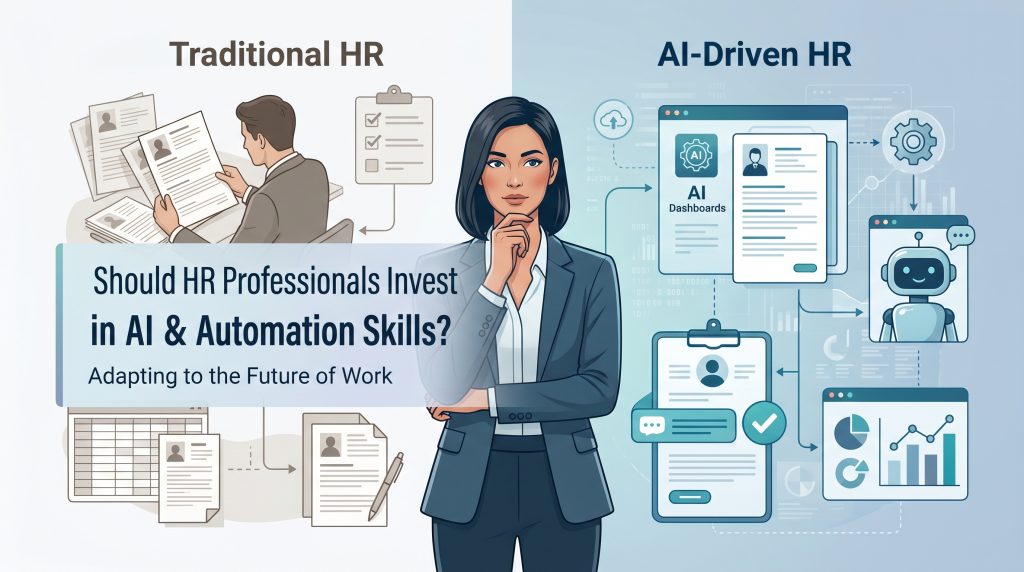
AI isn’t coming for HR. It’s already here. Payroll engines are auto-processing tax compliance.
Natural language processing (NLP) tools are scanning thousands of resumes in seconds.
Conversational AI bots are fielding first-level employee queries around the clock.
As HR shifts toward a more data-driven, technology-enabled function, investing in AI and automation skills is becoming essential for long-term career growth and strategic relevance.
The HR professionals who treat this as a spectator sport are already falling behind. Those who are actively building AI fluency are earning bigger tables and bigger decisions.
This isn’t about replacing human judgment in HR. It’s about deciding whether you’ll be the person directing the AI, or the one being directed by its outputs. Let’s explore this in more detail.
Where AI Is Already Replacing vs Augmenting HR Work
Understanding the difference between automation and augmentation is the first step in positioning yourself strategically.
Tasks Being Automated (High Risk of Full Displacement)
These are transactional, rules-based HR functions where AI handles the entire workflow end-to-end with minimal human involvement:
- Resume screening and candidate shortlisting:
AI-powered applicant tracking systems (ATS) score and rank candidates against role-specific criteria for their ATS-optimized resume, reducing initial screening time by up to 75%. Robotic process automation (RPA) filters applicants based on skill tags, qualifications, and keyword matching without any recruiter input.
- Interview scheduling and coordination:
Automated scheduling tools integrated with calendar APIs eliminate back-and-forth emails between HR and candidates. These tools handle time zone logic, conflict resolution, and candidate notifications automatically.
- Payroll processing and compliance workflows:
AI handles gross-to-net calculations, tax deductions, and statutory compliance checks. RPA bots pull data across multiple HRMS systems and reconcile discrepancies before payroll runs, reducing human error rates significantly.
- Basic employee query handling via chatbots:
AI assistants powered by large language models (LLMs) resolve Tier-1 queries, leave balances, policy FAQs, and benefits information without HR intervention. IBM’s internal AskHR tool automates more than 80 common HR processes, saving one department 12,000 hours in a single quarter.
Tasks Being Augmented (High Value, Hard to Automate)
These are judgment-intensive HR functions where AI acts as a force multiplier, not a replacement:
- Strategic hiring decisions using predictive models:
Machine learning algorithms analyze historical performance data, assessment scores, and attrition patterns to generate quality-of-hire predictions. HR uses these outputs to make sharper hiring calls, not cede them.
- Workforce planning using scenario simulations:
AI-powered workforce planning tools, simulations, and headcount forecasting models. HR professionals use these to stress-test hiring plans against revenue projections and skills gap analyses.
- DEI insights via pattern recognition:
Algorithmic auditing tools surface gender pay gaps, promotion rate disparities, and sourcing bias by cross-referencing workforce data, insights that would take months to surface manually.
- Employee sentiment analysis using NLP:
Pulse survey tools and passive listening platforms analyze text at scale to detect morale shifts, burnout signals, and disengagement risk. HR acts on these signals before they become turnover statistics. To understand how AI is reshaping the entire world of work, read more on how AI will reshape our workplaces.
Routine HR is shrinking. Strategic HR is expanding.
The distinction between automation and augmentation creates a clear career divide. HR professionals who spend most of their time on process execution will increasingly see those responsibilities automated. Those who learn to design workflows, interpret AI-generated insights, and build systems that improve organizational decision-making will become more valuable.
For professionals looking to make this shift, the AI-Native Program: Workflows & Agents for Productivity offers hands-on training in building AI-powered workflows, no-code agents, and automation systems using tools like ChatGPT, Claude, Gemini, and Perplexity. As routine HR tasks become increasingly automated, the ability to orchestrate AI systems and apply human judgment to strategic decisions will become a defining advantage.
The professionals who stay relevant are the ones who understand which bucket they’re operating in and actively move toward the second.
AI & Automation Skills HR Professionals Should Learn
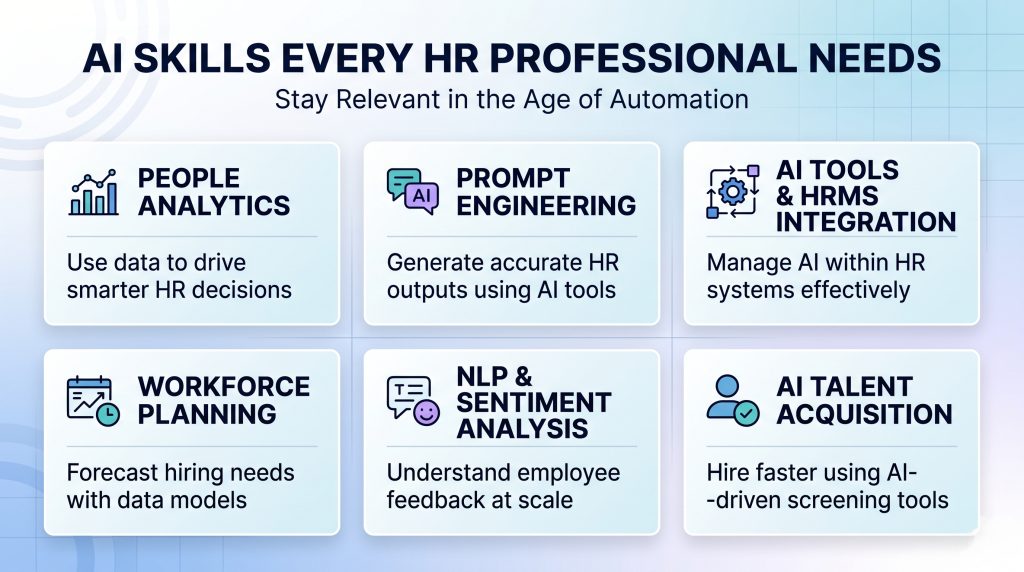
1. People Analytics and Data Interpretation
People analytics involves collecting, structuring, and analyzing workforce data to generate actionable HR insights.
Why is it needed?
HR decisions driven by gut feel are getting replaced by evidence-based models. Executives increasingly expect HR to present attrition risk scores, engagement indices, and productivity metrics, not anecdotal observations.
How does it help?
An HR professional with people analytics skills can build predictive modeling, track diversity KPIs over time, and influence talent strategy using regression analysis and cohort tracking. This is one of the most direct paths to earning a seat in C-suite conversations. Explore a deeper breakdown of the field in this guide on HR analytics.
If you want to get started without a long-term commitment, Great Learning’s free HR Analytics course is a practical starting point covering data-driven decision-making frameworks specifically mapped to HR use cases.
2. Prompt Engineering for HR Applications
Prompt engineering is the skill of structuring inputs to generative AI tools (like ChatGPT or Claude) to produce accurate, role-specific outputs.
Why is it needed?
HR professionals are already using generative AI for drafting job descriptions, performance review summaries, and policy documentation. But poorly structured prompts produce generic, unreliable outputs. Good prompt design produces work-ready content.
How does it help?
A well-engineered prompt can generate a structured competency-based interview guide, a localized compensation benchmarking brief, or a personalized learning path recommendation in minutes. The efficiency gains are direct and measurable.
Watch this full course on Prompt Engineering to get hands-on from the ground up.
3. AI Tool Literacy and HRMS Integration
Understanding how AI layers integrate with core HRMS platforms (SAP SuccessFactors, Workday, BambooHR) and standalone tools.
Why is it needed?
HR teams are adding AI modules to existing systems. Professionals who can’t configure, audit, or troubleshoot these integrations become dependent on IT, which slows down HR’s decision velocity.
How does it help?
HR professionals who understand API logic, data pipelines, and AI model configurations can own the roadmap for HR technology adoption rather than simply reacting to it. Curious about how AI agents are changing employee workflows? This piece on adopting AI agents for employee workflow breaks it down well.
4. Workforce Planning and Scenario Modeling
Using AI-based forecasting tools to model headcount needs, skills gaps, and future talent supply under different business conditions.
Why is it needed?
Post-pandemic volatility, hybrid work norms, and accelerating automation are compressing planning cycles. Annual workforce plans are becoming obsolete. HR needs rolling, data-backed scenario models.
How does it help?
Mastering workforce planning tools lets HR professionals simulate the impact of business growth, layoffs, or geographic expansion on talent needs months before the business feels the gap. For a comprehensive view of this domain, refer to this resource on workforce management.
5. NLP-Based Employee Listening and Sentiment Analysis
Using NLP-powered tools to extract meaning from open-ended survey responses, exit interview transcripts, and internal communications.
Why is it needed?
Quantitative engagement surveys only capture part of the picture. Unstructured text contains richer signals of frustration, confusion, and disengagement that traditional HR metrics miss.
How does it help?
HR professionals trained in sentiment analysis can detect early-warning signals of attrition, team dysfunction, or leadership failure, and act before it becomes a business problem.
6. AI-Augmented Talent Acquisition
Using AI sourcing tools, predictive hiring models, and automated screening platforms to improve recruitment quality and speed.
Why is it needed?
Talent acquisition is the function under the most immediate AI pressure. Professionals who don’t understand AI-driven sourcing, bias-resistant screening, or predictive quality-of-hire scoring are already operating at a disadvantage.
How does it help?
HR professionals who combine ATS optimization, talent intelligence platforms, and structured interviewing protocols with AI tooling consistently deliver lower cost-per-hire and higher offer acceptance rates.
Want to see how HR teams are using ChatGPT specifically?
Watch this: How HR Teams can use ChatGPT.
Not sure which AI skills are actually worth building versus those that are overhyped?
This breakdown on what to learn vs what’s hype as AI goes mainstream is worth reading before you invest time.
Why AI Skills Are a Career Investment, Not a Trend?
The business case for HR AI skills isn’t abstract. It shows up in measurable outcomes that CFOs and CHROs care about.
Measurable impact areas:
- Reduction in cost-per-hire: AI-driven sourcing and screening tools cut average cost-per-hire by 20–40% by reducing recruiter hours spent on high-volume top-of-funnel work.
- Increase in quality-of-hire: Predictive hiring models using machine learning improve quality-of-hire metrics by matching candidates against performance data from comparable role holders, reducing mis-hires.
- Improved retention through predictive analytics: Organizations using attrition prediction models intervene on at-risk employees 60–90 days earlier than those relying on exit surveys. Early intervention directly reduces voluntary turnover costs.
HR professionals with AI skills:
- Move closer to business KPIs like revenue per employee, workforce productivity indices, and skill coverage ratios.
- Gain influence in leadership conversations previously dominated by finance and operations.
- Build the ability to translate workforce data into board-level strategic narratives.
AI literacy is becoming the new business acumen for HR. It’s what earns HR the seat at the decision-making table, not just the chair in the room.
For HR professionals who want to build this influence intentionally, check out Great Learning’s guide on effective leadership skills in the age of AI.
If you’re ready to build serious depth, the PG Program in Artificial Intelligence and Machine Learning from Great Learning, offered in collaboration with a leading global university, covers machine learning, NLP, and predictive analytics with business applications directly relevant to HR functions. It’s designed for working professionals and includes mentor-guided projects that you can map to real HR use cases.
The Risk of Not Upskilling
The cost of inaction isn’t staying still, it’s falling behind:
- Credibility gaps in leadership forums: HR professionals who can’t speak the language of predictive models, workforce analytics, or AI governance lose ground in budget conversations and strategic planning sessions to their data-literate peers in finance and operations.
- Technology-led decision-making without HR oversight: When HR professionals don’t understand the AI systems their organizations deploy, the oversight responsibility shifts to IT or external vendors, removing HR from its core accountability for workforce fairness, compliance, and culture.
- Talent obsolescence cycles are accelerating: The half-life of HR skills is shortening. Professionals who upskilled for HRMS implementation 5 years ago are now behind on AI governance, generative AI literacy, and workforce intelligence platforms.
- Widening peer gap: Across organizations, a bifurcation is already forming between HR professionals who are building AI fluency and those who aren’t. The former group is being elevated into workforce strategy roles; the latter is being consolidated into administrative functions.
Real-World Use Cases
- Predictive attrition models preventing talent loss
Organizations using machine learning to score flight risk across their workforce, by combining tenure data, compensation benchmarking, engagement scores, and manager feedback, are intervening with high-value employees before resignation notices arrive. Some have reported 15–25% reductions in voluntary attrition within 12 months of deployment.
- Personalized learning paths using AI recommendations
AI-powered LMS platforms analyze individual employee skills gaps, cross-reference career trajectory data, and deliver role-specific learning modules. The result is L&D budgets that are allocated based on actual skill deficits, not assumed needs.
These use cases don’t run themselves. They require HR professionals who understand the models, can question the outputs, and know when human judgment should override algorithmic recommendations. That’s the skill set the market is paying for.
How HR Professionals Should Approach Upskilling?
The question isn’t whether to invest in AI skills. It’s how to sequence that investment.
1. Learn: Build foundational literacy first
Start with certifications and structured courses that give you a conceptual framework, HR analytics, AI fundamentals, and data-driven decision-making. Don’t wait until you need these skills to start building them.
For those starting from scratch, Great Learning’s free Human Resource Management course covers core HRM principles, while the premium HR Management: Strategy to Execution program bridges classical HR frameworks with modern, AI-augmented practice, giving you a structured path from operational execution to strategic positioning.
For HR leaders specifically, the Strategic Leadership for the AI-Driven Future program equips you to lead organizational AI adoption, manage change at scale, and communicate the value of AI-augmented HR to board-level stakeholders. It’s built for people who don’t just want to understand AI but want to drive decisions around it.
2. Adopt: Hands-on experimentation over passive learning
Build fluency by actually using tools to run a real recruiting pipeline through an AI-assisted ATS, set up a pulse survey with NLP analysis, and build a simple attrition prediction model using Excel or Python. Contextual practice compounds faster than coursework alone.
Not sure where to begin?
Watch 6 steps to get started with AI for Beginners for a structured entry point.
3. Partner: Cross-functional collaboration as a learning accelerator
The HR professionals gaining the most AI capability fastest aren’t doing it alone. They’re embedding themselves in cross-functional projects with data science, IT, and finance teams. Collaborative exposure to technical problem-solving frameworks accelerates HR’s AI learning curve faster than solo study.
For reference on what makes HR professionals successful in this kind of cross-functional environment, this piece on the qualities of a successful HR professional is a useful framing tool.
Conclusion
The HR function is at an inflection point. The professionals who build AI and automation skills now aren’t chasing a trend; they’re positioning themselves to do the work that actually matters, interpreting what the models can’t, advocating for what the data misses, and shaping workforce strategy in organizations that will increasingly be run by AI-augmented decision systems.
The tools exist. The learning pathways exist. What’s left is the decision to act.
If you’re ready to build the skills that make you indispensable in an AI-led HR function, start with Great Learning’s free resources and explore the programs linked throughout this article.