


The simple story about wireless is a price war: multi-year price locks, free lines, cable carriers underselling the mobile network operators and fixed wireless exceeding everyone’s expectations. A more complex story is revealed by the MNOs’ detailed earnings results. The core price of connectivity has been flat for nearly four years while household income has increased. Net net? The carriers turned themselves into discount storefronts for the services they sell.
Reported wireless revenue per line looks like it climbed. Blended across AT&T, T-Mobile and Verizon, postpaid phone ARPU rose from $53.22 in the second half of 2022 to $56.37 in early 2026, a roughly 6% rise. But Verizon, the carrier driving most of the 6% increase, books streaming and cloud perks inside its reported ARPU. Its former consumer chief revenue officer stated publicly in March 2025 that 15% of wireless service revenue now comes from non-connectivity services, a figure that was zero when myPlan launched in May 2023 and is closer to 17% today. Strip the perks out on the same ramp, and the picture inverts. Blended core connectivity ARPU went from $53.22 to $52.76, flat to slightly down in nominal dollars across three and a half years.
Meanwhile, nominal disposable income per household climbed about 19% in the last four years according to the US government’s Bureau of Economic Analysis. Flat price, rising income, and the math is easy to understand.
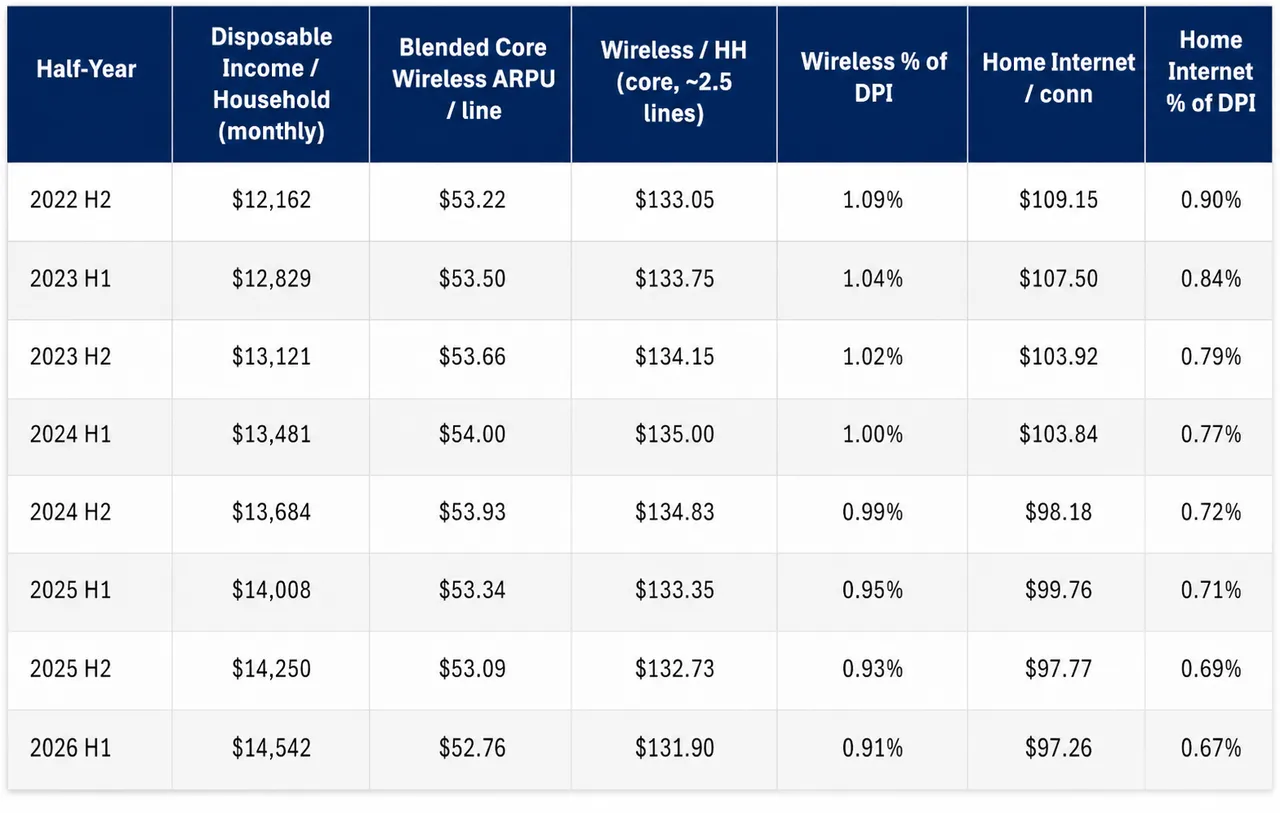
Wireless is carrier-reported core ARPU (Verizon perk-adjusted). BEA NIPA per-capita nominal disposable personal income (series A229RC), scaled to household; real-terms adjustment uses the BEA DPI deflator (A229RC/A229RX); October 2025 onward extrapolated.
Wireless fell from 1.09% of household disposable income to 0.91%, a 17% reduction in the relative burden, while the core price per line did not rise at all. That is the paradox in one line: ARPU went up, the price of connectivity did not and telecom claimed less of the wallet driving real world savings for American families.
In real terms the gap is starker. Over the period the disposable-income price level rose about 9%, so a household’s real purchasing power grew roughly 9% rather than the full 19% nominal, while the core price of wireless, flat in nominal dollars, fell about 10% after inflation. The device is the one place inflation barely matters: the climb in smartphone selling prices is mostly premiumization, real buyers choosing more expensive phones, not the dollar losing value, with carriers footing for most Americans. Inflation-adjusted, connectivity got cheaper, incomes got larger and only the hardware the consumer chose to upgrade got pricier.
While prices remained steady in the last several years, the value consumers are taking from their wireless providers has dramatically increased. Let’s look at Verizon by way of example.
Verizon is the lone nationwide carrier that books its perks into reported service revenue, about $10.50 per line by 2026, which is why Verizon alone takes the perk adjustment in the numbers above. The perks represent significant savings: Netflix and Max for $10 against roughly $18 bought separately, Apple One and Google One at about half of their near-$20 retail.
T-Mobile and AT&T deliver streaming without increasing their ARPU at all. T-Mobile folds Netflix into the plan and gives it away, and the Apple TV+ that shows up at $3 on a T-Mobile bill is passed straight through to Apple, not booked as T-Mobile service revenue. So two of the three nationwide carriers were already at clean core connectivity pricing, and only Verizon’s apparent climb was perks. The industry turned itself into a half-price, often free, storefront for streaming and cloud while holding the price of the pipe flat.
The value consumers are getting on the device side has increased as well. Consider the following. Recon Analytics Device Intelligence shows the sellout-weighted average selling price of a US smartphone reached $738 across 2025 and peaked at $868 in the fourth quarter, the iPhone 17 launch window, up from roughly $615 a year earlier. Forty percent of phones sold in 2025 cost $800 or more, and nearly one in five was a $999-and-up flagship. The market has finished its move to 5G: 93% of phones bought in 2025 were 5G-capable, so the network the carriers spent years building now sits in nearly every new device. Apple accounts for 57% of US units sold at an $884 average, Google’s Pixel tops the range at $992, Samsung holds a quarter of the market at $652 and Motorola anchors the value end at $285. Consumers have access to better devices while the carrier absorbs the cost.
Nearly one in five phones sold still costs under $300, so the household that wants to spend less can, while carrier trade-in credits and multi-year interest-free financing put the $884 Apple within monthly reach for the household that wants the best.
For the American consumer, all of this adds up to one of the best deals in the household budget.
Wireless service runs about $130 a month for a typical multi-line household and has been flat in nominal terms since 2022, under 1% of disposable income and falling about 10% in real terms. For that, plus a device financed at zero interest with the carrier generally crediting back the financing cost, the household carries a premium 5G phone whose $700-plus sticker it never felt, multi-year price certainty and a stack of streaming and cloud services worth $25 to $45 a month at retail for a fraction of that or nothing. A family that would pay $40 to $50 assembling Netflix, a second streamer and cloud storage on the open market gets the same through the carrier for $10 to $20, or free on T-Mobile. Connectivity is cheaper as a share of income than at almost any point in the smartphone age, the rising cost of the device is absorbed by the carrier and the services that ride the network arrive at half price or no price.
The competitive read inverts the conventional wisdom. This was not a race to the bottom on price. Carriers held core connectivity prices flat for four years and grew revenue by selling discounted services the customer wanted, while the affordability cushion underneath quietly widened. Wireless now sits below 1% of household disposable income. At that level, a price increase is closer to noise in the family budget than the switching trigger it was when wireless approached 1.4%. The pricing power is real and underused, and the next dollar of revenue is far more likely to come from perks, premium tiers and device economics than from the base plan. The strategic question is no longer how low the bill must go. It is how much value carriers can stack on a bill that already claims less of the paycheck than at almost any point in the smartphone age.
About Recon Analytics
Recon Analytics, a Light Reading contributor, delivers near-real-time market intelligence for the telecom and artificial intelligence sectors through its Recon Analytics Pulse platform. Each year, Recon reaches more than half a million consumers, empowering clients to understand and respond to major industry developments faster than ever before.
Recon uses AI assistance to write its commentaries and compile insights based on its proprietary data.