


User experience (UX) strategy is frequently misunderstood as a tactical exercise, a deliverable achieved through better wireframes or cleaner interfaces. In reality, it operates at a higher level of intent, setting the foundation for effective design.
My perspective on UX strategy is shaped by more than 15 years leading design initiatives at global organizations, including five years at Booking.com, and partnering with major companies like Unilever, Amazon, and Deloitte. I specialize in UX strategy and product design, and my focus is helping cross-functional teams define what problems truly matter and what success looks like before we build a solution.
How UX Strategy Strengthens Business Outcomes
Where the UX process governs how teams execute, UX strategy determines what they’re solving for and why those solutions matter. It provides the decision-making framework that links user insights to business outcomes, long before pixels or prototypes come into play.
In this deep dive, I’ll outline the:
- Structure and intent of a successful UX strategy.
- Common pitfalls that limit strategic impact.
- Consequences of operating without a defined UX strategy.
Core Concepts: What Is UX Strategy?
UX design strategy defines how an organization turns its understanding of users into a business advantage. It connects what customers need with how the company delivers value through its products and services. UX strategy is not a goal itself; it’s more of a directional framework. It identifies the:
- User experience a team aims to create.
- Principles that will guide the experience.
- Outcomes that signal success.
A mature strategy outlines a shared vision of the desired experience and establishes priorities for achieving it. It ties user needs and pain points to metrics such as retention, engagement, and lifetime value. Instead of reacting to usability issues or feature requests, teams can operate with a clear understanding of who they serve and how the choices they make advance user outcomes and organizational objectives.
When I create a UX strategy, I focus on more than just making interfaces look nice. I want to help companies make better decisions, set clearer priorities, and see real results in their business outcomes. That means more conversions, fewer errors, and better customer retention.
A strong strategy also helps teams work faster by reducing design inconsistencies and cutting down on rework caused by unclear requirements. If our design choices consistently improve these important metrics, then the strategy is doing its job.
History and Evolution of UX Strategy
UX strategy emerged as digital products became too complex for interface design alone to ensure meaningful user experiences. Early influences came from fields like human-computer interaction and cognitive psychology, which study how people perceive and act on information. Industrial and product design contributed principles of usability and ergonomics, showing that form and function must coexist.
As digital ecosystems evolved, designers began applying behavioral insights and iterative testing to create more intuitive systems. With time, UX shifted from simple usability research to a competitive differentiator, where the quality of every customer interaction impacts overall brand perception.
UX strategy now focuses on guiding product vision and organizational priorities. It draws from Agile, Lean, and Design Thinking frameworks, connecting long-term vision with short-term feedback loops so that a product’s experience remains adaptable.
Common Misconceptions About UX Strategy
Many product professionals confuse UX strategy with other design functions, and even expert designers are sometimes guilty of oversimplifying it. This can dilute its impact and keep teams focused on surface-level improvements rather than systemic alignment. Common misconceptions about UX strategy include:
- UX strategy is essentially UI: Strategy isn’t about visual polish. It’s about shaping the entire end-to-end experience, including how products solve problems and deliver value over time.
- Strategy and process are interchangeable: While UX process defines how design is carried out, UX strategy determines what the work is trying to achieve. Process provides consistency. Strategy provides clarity of purpose.
- Only designers own UX strategy: True strategy is cross-functional. It requires input from product, engineering, marketing, and leadership to align design with broader business goals.
- Strategy is a one-time deliverable: UX strategy should evolve continuously as user needs, market conditions, and organizational objectives shift.
The Cost of Getting UX Strategy Wrong
When UX strategy is neglected or poorly defined, the consequences ripple across the organization. Design decisions become reactive and teams waste time solving the wrong problems. Product usability suffers, as does brand credibility, design efficiency, and product growth. Here’s an overview of the potential impact:
- User dissatisfaction and churn: Products that overlook user needs or accessibility standards create frustration and abandonment, eroding trust and driving customers toward competitors.
- Misaligned priorities: Without a guiding strategy, UX teams may chase incremental improvements that fail to support business goals. This can lead to repeated redesigns and wasted time and money.
- Reputational and compliance risks: Ignoring user feedback or ethical design principles can result in public backlash or legal exposure in regulated industries.
- Stalled innovation: Teams without a strategic foundation struggle to scale or adapt as markets evolve. Design becomes maintenance rather than a driver of differentiation.
Developing a Strong UX Strategy
Effective UX strategy comprises several key elements that give design work coherence and integrity. These elements:
- Translate research into direction.
- Align teams around a shared vision.
- Establish criteria for success.
Ultimately, the strength of a UX strategy depends on how well these parts work together.
Core UX Strategy Components
Each component of UX strategy plays a distinct role in aligning user experience with organizational goals. Here’s how they contribute:
UX Vision
The vision defines what the product aspires to deliver for users: its purpose and promise. A clear vision anchors design decisions and keeps teams aligned.
Goals
Strategic goals translate that vision into measurable outcomes tied to business performance. They connect UX efforts to tangible results such as improved retention, higher conversion rates, and greater customer satisfaction.
Prioritization Frameworks
Frameworks for prioritization help teams identify which initiatives have the greatest impact. They balance user needs with technical feasibility and business value and ensure that attention is directed where it matters most.
Guidelines
Design principles, standards, and patterns provide consistency across products and teams. These guardrails support scalability and help preserve a unified experience as organizations grow or product lines expand.
Feedback Loops
Continuous feedback closes the gap between strategy and real-world use. Regular validation through research, testing, and analytics allows teams to refine assumptions and adapt strategy over time.
Research-backed Foundations
Evidence, not assumptions, forms the foundation of a robust UX strategy. Research reveals how users think, act, and make decisions. By combining the following methods, teams can pinpoint real opportunities and validate them with confidence.
- User research: Usability testing, interviews, and ethnographic studies uncover qualitative insights into user needs and pain points.
- Market research: Competitive and market analyses help position the product effectively and identify unmet user or business needs.
- Analytics and behavioral data: Quantitative data connects what users say with what they actually do, highlighting friction points and validating hypotheses.
UX Maturity-model Considerations
Maturity models show how organizations evolve from doing sporadic, ad hoc design (focused on aesthetics and quick fixes) to making UX a core strategy. In mature organizations, UX is embedded into major decisions across leadership, product, and engineering.
Recognizing their organization’s maturity stage helps teams set achievable goals and allocate resources, whether that means hiring researchers, purchasing tools, or investing in research. As a company develops, its UX strategy should expand from isolated improvements to enterprise-wide transformation.
How to Build and Implement UX Strategy Effectively
A UX strategy can only deliver results when it’s put into action, which requires structure and accountability across teams. Here we dive into a practical framework and cover how to:
- Set measurable goals.
- Embed UX into governance and decision-making.
- Sustain strategic alignment as organizations scale.
UX Strategy Playbook: A Step-by-Step Guide
The following steps outline a practical approach to building, testing, and evolving a high-performing UX strategy.
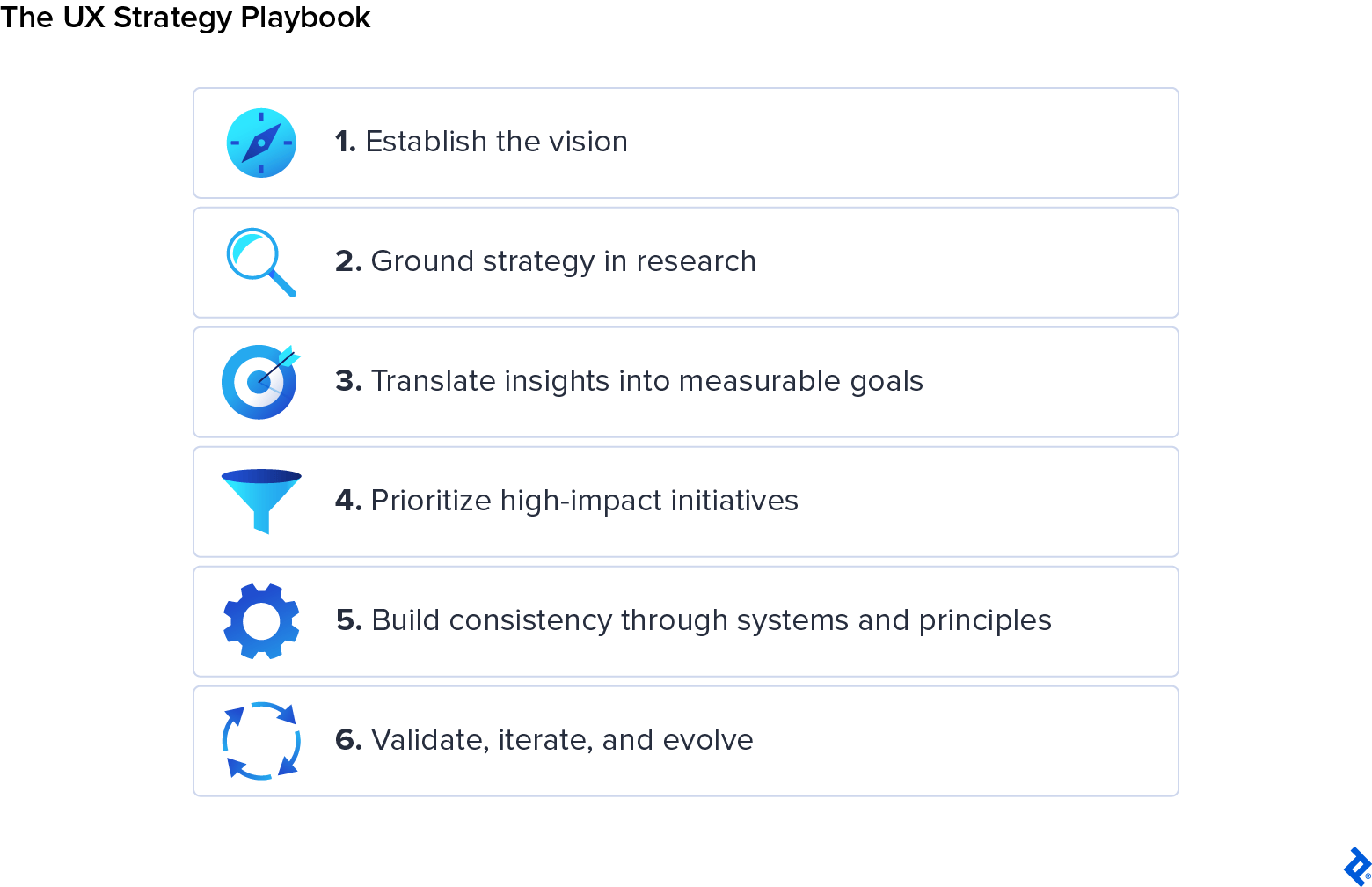
1. Establish the Vision
Articulate how UX supports the organization’s broader objectives while addressing user needs. This vision anchors every design and product decision that follows.
Example: A travel-booking app sets a vision to make planning multicity trips “as simple as booking a single flight,” reducing friction and increasing repeat bookings.
2. Ground Strategy in Research
Combine user, market, and competitive research to reveal opportunities, validate assumptions, and shape priorities.
Example: User interviews reveal that travelers often juggle multiple tabs and external notes to compare routes, accommodations, and timing. Competitive analysis shows limited tools for side-by-side planning, highlighting a clear opportunity.
3. Translate Insights Into Measurable Goals
Convert findings into specific objectives and key results (OKRs) that tie UX outcomes, such as engagement, retention, or satisfaction, to business performance.
Example: The team sets goals to increase trip-planning completion rates by 20% and reduce time-to-itinerary creation by 30%. These OKRs tie directly to increasing conversion and revenue.
4. Prioritize High-impact Initiatives
Use prioritization frameworks to focus resources on opportunities that create the most value for both users and the business.
Example: Using an impact/effort matrix, the team prioritizes a guided itinerary builder ahead of secondary improvements like aesthetic map enhancements.
5. Build Consistency Through Systems and Principles
Develop design systems, experience guidelines, and principles that maintain coherence and scalability across teams and products.
Example: The team expands the design system with standardized patterns for navigation, trip summaries, and booking flows. They also create guidelines for displaying information so every team follows the same principles.
6. Validate, Iterate, and Evolve
Continuously test and refine strategy through user feedback and performance data, adapting to new insights and changing conditions.
Example: Early usability tests show confusion around editing individual trip segments, leading to a redesigned timeline. Post-launch analytics reveal strong uptake but drop-off during route comparison, prompting further iteration.
Setting UX Goals and Metrics
Turning strategy into measurable outcomes is essential: By linking user experience to quantifiable metrics, teams can demonstrate value and guide continuous improvement. Setting intentional goals and metrics shifts UX from a support function to a driver of business growth. Key principles here include:
- Aligning outcomes with business performance: Anchor goals in terms of retention, engagement, and revenue to show how UX contributes to organizational success.
- Tracking user-centered indicators: Use task completion rates, satisfaction scores, and net promoter scores to assess usability and response.
- Building accountability: Use metrics as evidence for decision-making and to secure stakeholder confidence in UX investments.
- Measuring impact over time: Consistently track analytics to turn UX into a feedback mechanism that ensures designs change with user needs and market conditions.
Aligning UX Strategy With Business Strategy
To reach its full potential, UX strategy needs to align with the overall business strategy. It should support the company’s vision and help meet growth goals. When UX leaders connect customer insights to business objectives, they create a link between user satisfaction and profitability.
This strategic alignment keeps UX from being isolated in design functions and positions user experience as a shared responsibility across departments. The result is a unified direction where design decisions strengthen both the customer journey and the company’s competitive position.
Governance and Scaling UX Strategy Across Organizations
As organizations grow, maintaining coherence across multiple teams and products can be challenging. Governance provides the structure needed to scale UX without diluting its intent.
Design councils, review boards, and experience frameworks can establish clear decision-making processes, ensuring that quality and vision remain consistent. Design systems extend this governance by creating a common language of components, principles, and interaction patterns. At the operational level, they reduce redundancy and accelerate delivery.
Effective governance is about balance rather than control. It creates enough order to maintain standards while allowing teams the flexibility to adapt.
The Role of UX Leaders and Cross-functional Teams
For UX strategy to be truly effective, leadership must be able to articulate vision and align diverse teams around it. The influence of UX leaders goes beyond design execution: They play a pivotal role in defining direction, securing buy-in, and translating high-level objectives into actionable frameworks.
Effective UX strategy is built on cross-functional collaboration. By giving product managers, engineers, and marketers shared ownership, the strategy becomes a joint responsibility, not solely a design task, which ensures UX thinking is embedded organizationally.
Real-world Applications of UX Strategy
The real measure of a UX strategy lies in its application, where abstract principles are tested in real conditions. The following examples illustrate how organizations can turn theory into practice and how UX strategy can guide decisions, improve performance, and create sustained competitive advantage.
UX Strategy in Action: Case Studies
While the foundations of UX strategy are universal, their implementation varies widely. These case studies highlight how two well-known companies yielded tangible results by grounding design decisions in strategic principles.
Aviva
Aviva needed to unify digital experiences across three complex products. By applying style guides to all design elements, the company created greater cohesion, reduced inconsistency, and streamlined user flows, all while aligning with current framework standards. The result was a measurable improvement in user satisfaction, demonstrating how consistency and systemization can benefit the user experience at scale.
Nike
Nike used UX strategy to encourage customers to buy directly from its app and website instead of third-party retailers. The company focused on improving its digital experience, using customer behavior data to tailor product suggestions and deliver exclusive releases, and designing features that rewarded engagement. This led to higher repeat purchases and stronger long-term customer relationships.
Industry-specific UX Strategy
A strategic approach to UX must account for the pressures, risks, and expectations unique to each sector.
In financial services, long-term trust is a key lever: Experience decisions must reinforce credibility, communicate stability, and integrate compliance requirements without undermining usability.
Healthcare environments introduce different priorities, where the strategy hinges on safeguarding sensitive data, supporting high-stakes decision-making, and ensuring accessibility for users with varied physical and cognitive needs.
Retail ecosystems rely on strategies that strengthen loyalty through relevance and continuity across digital and physical touchpoints.
By grounding UX strategy in the realities of the industry, teams can ensure their plans remain operationally viable and aligned with the outcomes that matter most in the organization’s domain.
Ethics and Accessibility in UX Strategy
Ethics and accessibility are foundational elements of a responsible UX strategy. Treating accessibility as a requirement means that people with diverse abilities can navigate and use a product without barriers. In addition to reducing legal risk, accessibility broadens market reach by expanding who can meaningfully engage with the product.
Ethical considerations should be embedded in a similar way. Instead of being a reactive response to regulation or public scrutiny, ethics should guide how data is collected and how choices are presented. This helps prevent the drift toward coercive or misleading patterns that undermine user autonomy.
By integrating ethics and accessibility at the strategic level, companies build products that are resilient, inclusive, and trustworthy.
The Future of UX Strategy and Long-term Impact
Emerging technologies, shifting user expectations, and new regulatory pressures are informing how organizations define and deliver value. To stay relevant, UX strategy must be an ongoing discipline: one that integrates research more deeply, anticipates long-term consequences, and supports sustainable product ecosystems.
Continuous UX Strategy
Viewing UX strategy as a single milestone often leads to drifting priorities, as decisions made early on quickly lose relevance when user behavior and product goals shift. A continuous approach keeps teams close to real indicators through research, testing, and iterative improvements that surface issues before they become costly.
This rhythm of learning helps ground decisions in current user needs while giving organizations the flexibility to respond to new trends, technologies, and competitive pressures. In treating strategy as something that matures over time, teams build products that stay relevant longer.
UX Research and Strategy Integration
Strategy loses traction when it isn’t connected to ongoing insight. Initial discovery provides direction, but true value comes from letting research evolve alongside the product. When teams fold fresh user feedback into decision-making, they spot shifting expectations early and avoid leaning on outdated assumptions.
Regular moments of inquiry, created through interviews, data, and testing, maintain a steady signal that lets teams adjust course and keeps strategy aligned with what users actually do.
Future Trends in UX Strategy
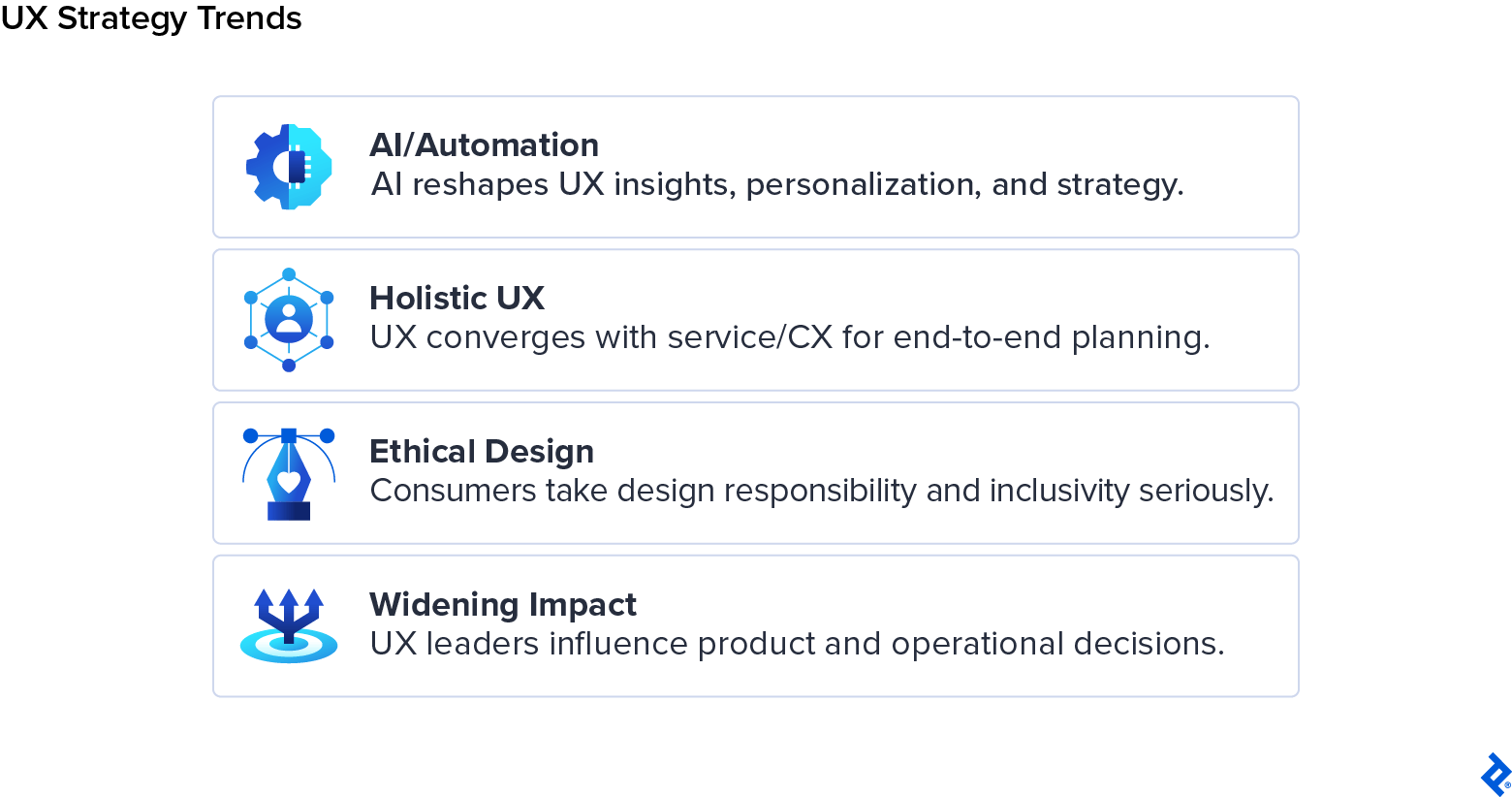
As companies adapt to changing user expectations, the field of UX strategy is becoming more interconnected and influential at the organizational level. The trends below highlight how UX strategy is evolving:
- AI, automation, and adaptive systems are reshaping how teams gather insights, personalize experiences, and set strategic priorities.
- Blended disciplines, including service design and customer experience strategy, are converging with UX, creating more holistic, end-to-end planning.
- Ethical design and inclusivity are moving from best practices to requirements, as users and regulators demand responsible digital behavior.
- Strategic influence is widening, with UX leaders having an increasing impact on product direction and operational decisions.
Elevating UX Strategy for Lasting Success
A well-crafted UX strategy serves as a stabilizing force, guiding how products evolve, teams prioritize work, and value is communicated. When strategy is rooted in evidence and tied to business goals, it reduces uncertainty and empowers teams to act.
Scaling UX strategy successfully requires a cross-team commitment to embedding design as a core capability. This means viewing UX principles as shared standards and supporting them with the right systems and governance.
Ongoing investment in research, refinement, and alignment ensures that products remain relevant. It also fosters trust and enables companies to create experiences that adapt to evolving demands. The organizations that thrive will be those that view UX strategy as a dynamic discipline.