

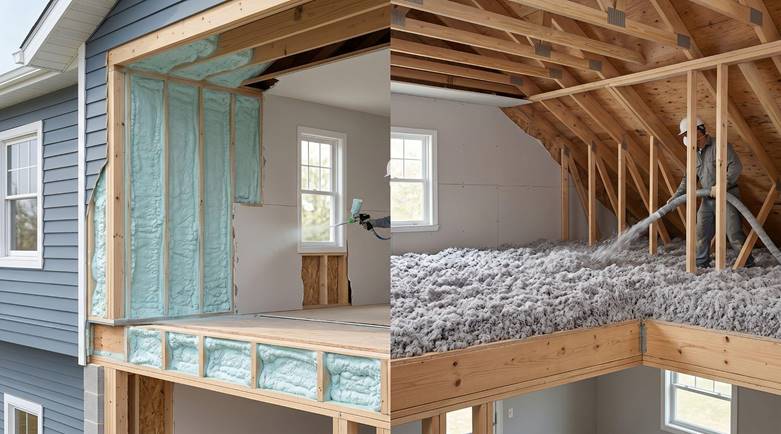
Retrofitting insulation in an existing home is rarely a one-product decision. Walls, attics, and rim joists each have their own constraints, and the right answer changes from one part of the house to the next. Hiring a professional spray foam insulation crew for the whole job sometimes makes sense, and sometimes a mix of products is the cheaper, smarter path.
This article is a practical decision tree, not a sales pitch for one side. Both products work. They just work in different places.
When Spray Foam Wins
Spray foam earns its price tag in three situations: air sealing, irregular cavities, and assemblies where you cannot afford to lose depth to a vapor retarder or air barrier. In a balloon-framed wall full of penetrations and gaps, foam seals as it insulates. In a rim joist or knee wall, foam handles the geometry that loose-fill insulation cannot. Calling out blow-in insulation contractors for those same spots can leave you with thermal bypasses that show up later as drafts or ice dams.
Closed cell foam also adds structural racking strength to a wall assembly, which matters more in commercial retrofits than residential, but it is a real benefit.
When Blown-In Wins
Blown-in cellulose or fiberglass is the right call for flat, accessible attics where code wants R-49 or R-60 and you have unlimited depth above the ceiling. There is no cheaper way per square foot to hit those numbers.
It also wins when the budget is tight and the assembly is forgiving. A vented attic floor with no moisture concerns, no air-sealing problems, and good baffles at the eaves is a textbook blown-in job.
Cost Per Square Foot
Rough national ranges for retrofit work:
| Product | Installed cost per sq ft | Typical R-value at code depth |
| Blown-in fiberglass (attic) | $1.00 to $1.80 | R-49 at 14 to 17 inches |
| Blown-in cellulose (attic) | $1.20 to $2.00 | R-49 at 13 to 14 inches |
| Open cell spray foam | $1.50 to $3.00 | R-13 to R-21 per cavity |
| Closed-cell spray foam | $2.00 to $5.00 | R-13 to R-21 per cavity, plus air and vapor control |
| Dense-pack cellulose (walls) | $1.80 to $3.00 | R-13 in a 2×4, R-21 in a 2×6 |
Prices vary by region, access, and minimum job size. A small spray foam job carries a setup cost that disappears on larger jobs. Always ask whether the quote includes a setup or trip charge.
Install Time
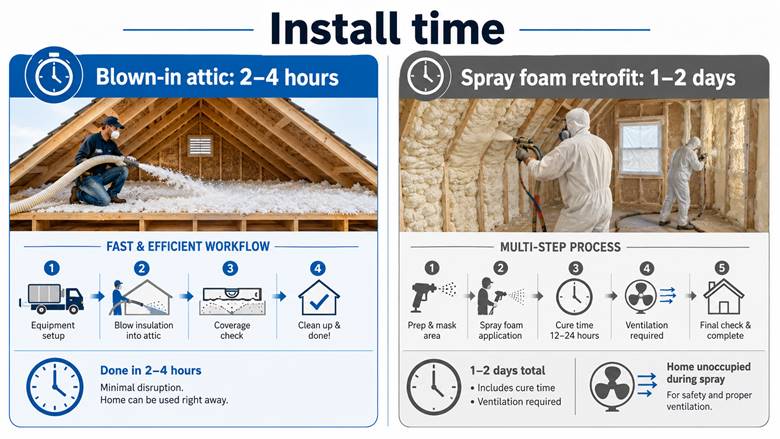
Blown-in attic work moves fast. A crew can blow a 1,500 sq ft attic in two to four hours once setup is done. Wall dense-pack is slower because each cavity needs a tube run and a fill check.
Spray foam is slower per square foot and has curing and ventilation requirements. A whole-house foam retrofit usually takes one to two full days with the home unoccupied during spray and for several hours after.
Mess Factor
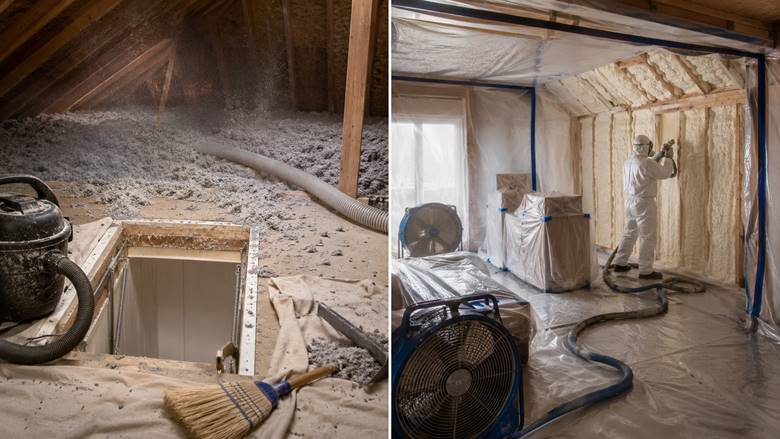
Blown-in is dusty during install. Cellulose creates a fine dust that drifts. Crews tarp off the work zone, but expect to vacuum afterward and to find some fibers around the attic hatch for a few days.
Spray foam is contained but has a strong chemical odor during installation and for several hours of cure. The home should be vented and unoccupied. Overspray on stored items is a real risk in attics, so anything in the work zone needs to come out or be wrapped.
Decision Tree for Retrofits
Walk through the questions in order. Stop at the first one that gives you an answer.
- Is this an open, flat attic with unlimited depth, no moisture issues, and a code R-49 or R-60 target? Use blown-in.
- Is this a rim joist, band joist, knee wall, or cathedral ceiling? Use closed-cell foam.
- Are you converting a vented attic to unvented, or insulating the roof deck? Use spray foam, usually closed cell.
- Are the walls closed, plaster or drywall already in place, and you do not want to open them up? Use dense-pack cellulose or injection foam through small drilled holes.
- Are the walls open during a renovation? Either product works. Pick a budget and on whether you need air sealing or vapor control built in.
- Do you have a chronic air-leak or ice-dam problem? Air-seal first with foam at the leak points, then top up with blown-in if depth allows.
Before You Get Quotes
Two prep steps save money. First, decide what you are actually trying to fix: heating bills, comfort in a specific room, ice dams, sound, or all of the above. The goal changes the product. Second, get a blower-door reading if you can. Air-sealing problems are cheaper to fix when they are diagnosed instead of being guessed at.
Then collect at least two quotes for the same scope, and make sure both contractors are pricing the same R-value target and the same prep work.
If a retrofit project in the Denver area calls for both products in different parts of the house, USA Spray Me runs spray foam and blown-in crews under one roof and can scope the whole job from one walkthrough.