

Close Menu
geekfence.comgeekfence.com
    What's Hot

    Wilkie refers gambling concerns to anti-corruption commission

    August 13, 2026

    Lumen ready for AI traffic rush – with programmable fabric and “more fiber than anyone”

    August 13, 2026

    With a feel for physics, AI models simulate a wider range of real-world scenarios | MIT News

    August 13, 2026
    Facebook X (Twitter) Instagram
    • About Us
    • Contact Us
    Facebook Instagram
    geekfence.comgeekfence.com
    • Home
    • UK Tech News
    • AI
    • Big Data
    • Cyber Security
      • Cloud Computing
      • iOS Development
    • IoT
    • Mobile
    • Software
      • Software Development
      • Software Engineering
    • Technology
      • Green Technology
      • Nanotechnology
    • Telecom
    geekfence.comgeekfence.com
    Home»Green Technology»Seabirds reveal global mercury distribution in oceans
    Green Technology

    Seabirds reveal global mercury distribution in oceans

    AdminBy AdminApril 15, 2026No Comments4 Mins Read11 Views
    Facebook Twitter Pinterest LinkedIn Telegram Tumblr Email
    Seabirds reveal global mercury distribution in oceans
    Share
    Facebook Twitter LinkedIn Pinterest Email


    Seabirds reveal global mercury distribution in oceans

    Mercury released into the oceans affects marine environments worldwide. Traditionally, its distribution and quantity have been estimated using marine biogeochemical simulation models.

    A recent international study led by Japanese researchers analyzed blood mercury concentrations in more than 11,215 seabirds from 108 species, of which 659 were newly collected samples and over 10,556 were from previous studies. This is the first biologically based estimate of oceanic mercury distribution, say the researchers.

    The study found that mercury levels in seabirds vary according to prey trophic level, bird body weight, and foraging depth. The findings were published in Science and the Total Environment.

    Mercury emissions into the ocean have risen since the Industrial Revolution, primarily due to increased atmospheric mercury from coal combustion. Mercury travels long distances by wind and enters the ocean through rainfall.

    In the ocean, some mercury becomes highly toxic and bioaccumulates in the food chain, ultimately concentrating in the tissues of seabirds that consume fish and zooplankton.

    Professor Akiko Shoji and Researcher Jumpei Okado of Nagoya University Graduate School of Environmental Studies, along with Senior Researcher Bungo Nishizawa of the Japan Fisheries Research and Education Agency, led an international study with 12 institutions from four countries.

    Why were seabird blood samples used?
    Blood samples from seabirds are efficiently collected when they come ashore for breeding. Mercury concentrations in adult birds’ blood at breeding sites reflect their dietary mercury intake from specific ocean areas within the two months prior to sampling.

    This method enables a more accurate correlation of mercury levels with specific times and locations than other sample types. Additionally, blood collection causes minimal harm to the birds.

    Analysis of seabird blood data
    Between 2017 and 2024, researchers collected blood samples from 659 individuals representing 10 seabird species at breeding sites in Japan, Alaska, and New Zealand. They dried and homogenized the samples, then measured total mercury concentrations using atomic absorption spectrometry. Results were standardized to total mercury per gram of dry weight in whole blood for comparison.

    Researchers also conducted a systematic review of 106 publications from 1980 to 2025, with over 80% published after 2010, and analyzed data on more than 10,556 adults representing 105 seabird species.

    In total, the team analyzed blood mercury concentrations in over 11,215 individuals from 108 seabird species worldwide, covering diverse diets and geographic regions.

    The analysis found that seabirds at higher trophic levels, with larger body mass, and those feeding on prey from depths between 200 and 1,000 meters have higher mercury levels.
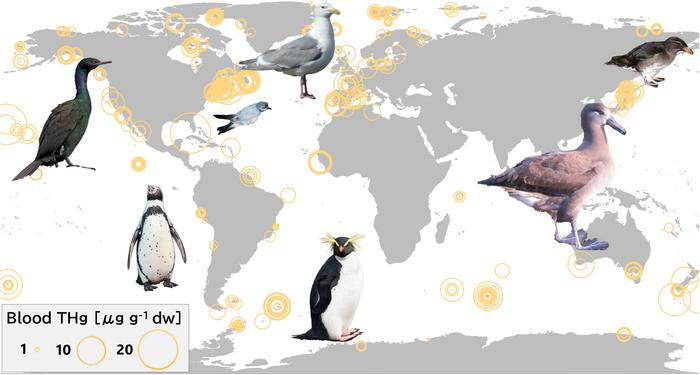
    World map with differently-sized seagull icons denoting oceanic regions with higher or lower mercury levels
    Findings include the first biologically based estimate of oceanic mercury distribution, analyzing blood mercury levels in more than 11,215 seabirds from 108 species. (THg: total mercury). (Image credit: Jumpei Okado (modified from Okado et al. 2026, licensed under CC BY 4.0)

    Statistical analysis showed distinct regional patterns in oceanic mercury contamination. Mercury levels were higher in the North Atlantic, North Pacific, South Pacific below 40 degrees south, and in areas with low productivity, as indicated by reduced chlorophyll a levels. In contrast, mercury levels were much lower in the South Atlantic and Southern Oceans.

    The study also found that albatrosses and shearwaters are more exposed to mercury than other seabird species.

    Significance and future perspectives
    The researchers found that predictions from the seabird-based model and the marine biogeochemical simulation models were only weakly correlated.

    “The seabird model is based on empirical measurements from organisms and is therefore considered more reliable than values from marine simulation models,” said Shoji. “Seabirds live in diverse environments, from coastal and tropical zones to polar regions. Their varied feeding patterns make them effective indicators of global ocean health.”

    This approach offers a promising method to monitor and verify the effectiveness of international mercury emission regulations, such as the Minamata Convention, and to support stronger global efforts to reduce mercury contamination in marine ecosystems.



    Source link

    Share. Facebook Twitter Pinterest LinkedIn Tumblr Email

    Related Posts

    New EU packaging rules target waste and resource use

    August 13, 2026

    Why Fixture Supply Lines Matter More Than Homeowners Think

    August 12, 2026

    The impact of clean energy on household bills

    August 11, 2026

    Simplifying the sustainability certification ecosystem

    August 10, 2026

    Power Systems Have More Flexibility Plans Than Flexible Grids

    August 9, 2026

    Imperfect sorting of plastic types undermines mechanical recycling, explains Manchester study

    August 7, 2026
    Top Posts

    Understanding U-Net Architecture in Deep Learning

    November 25, 202576 Views

    The Next Paradigm in Efficient Inference Scaling – The Berkeley Artificial Intelligence Research Blog

    May 16, 202642 Views

    Is it too late to start learning AI and machine learning in my 30s or 40s?

    April 9, 202638 Views
    Don't Miss

    Wilkie refers gambling concerns to anti-corruption commission

    August 13, 2026

    Independent MP Andrew Wilkie has taken the fight over gambling reform to the National Anti-Corruption…

    Lumen ready for AI traffic rush – with programmable fabric and “more fiber than anyone”

    August 13, 2026

    With a feel for physics, AI models simulate a wider range of real-world scenarios | MIT News

    August 13, 2026

    Monitoring beyond SNMP: Turning your network into a sensor

    August 13, 2026
    Stay In Touch
    • Facebook
    • Instagram
    About Us

    At GeekFence, we are a team of tech-enthusiasts, industry watchers and content creators who believe that technology isn’t just about gadgets—it’s about how innovation transforms our lives, work and society. We’ve come together to build a place where readers, thinkers and industry insiders can converge to explore what’s next in tech.

    Our Picks

    Wilkie refers gambling concerns to anti-corruption commission

    August 13, 2026

    Lumen ready for AI traffic rush – with programmable fabric and “more fiber than anyone”

    August 13, 2026

    Subscribe to Updates

    Please enable JavaScript in your browser to complete this form.
    Loading
    • About Us
    • Contact Us
    • Disclaimer
    • Privacy Policy
    • Terms and Conditions
    © 2026 Geekfence.All Rigt Reserved.

    Type above and press Enter to search. Press Esc to cancel.