

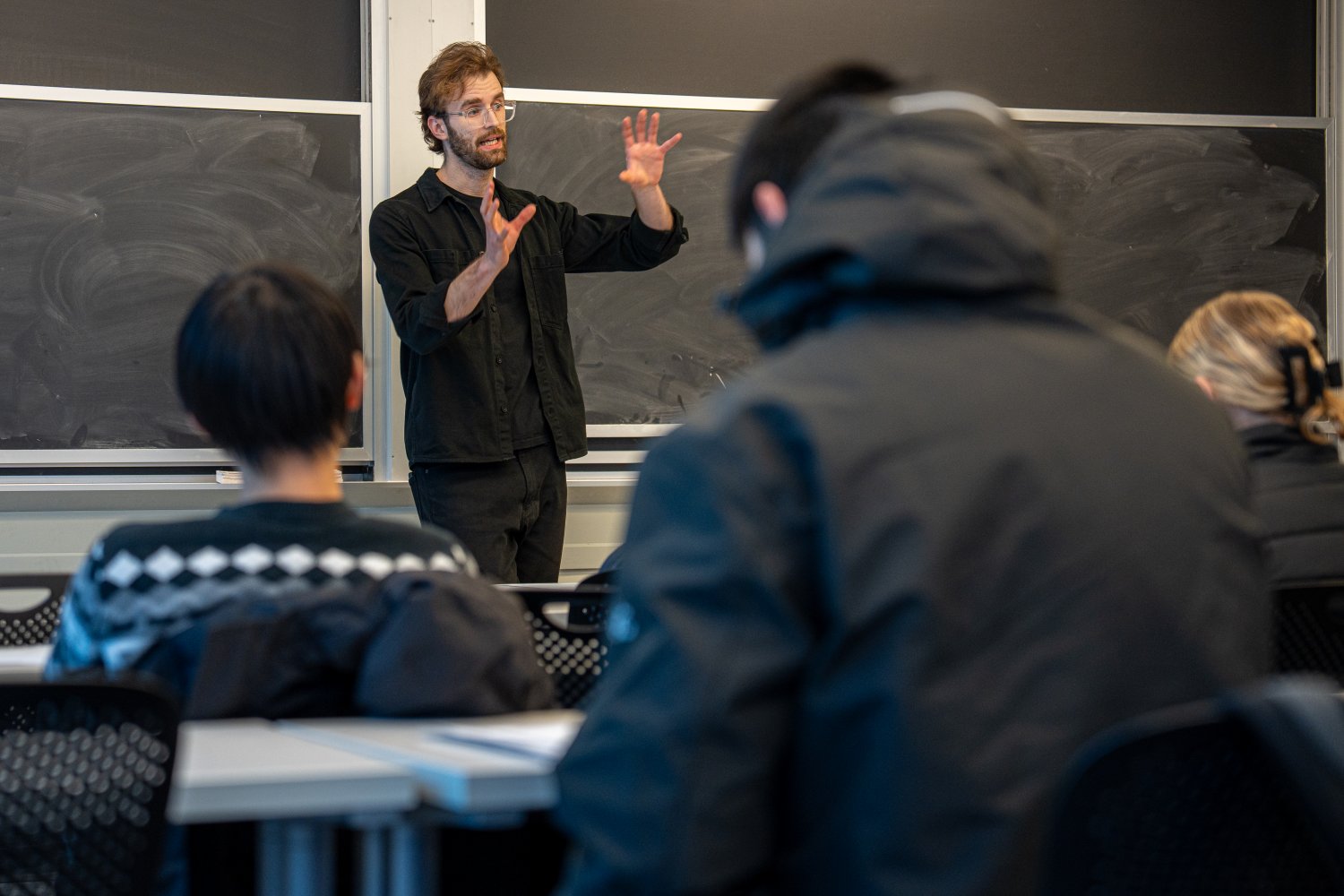
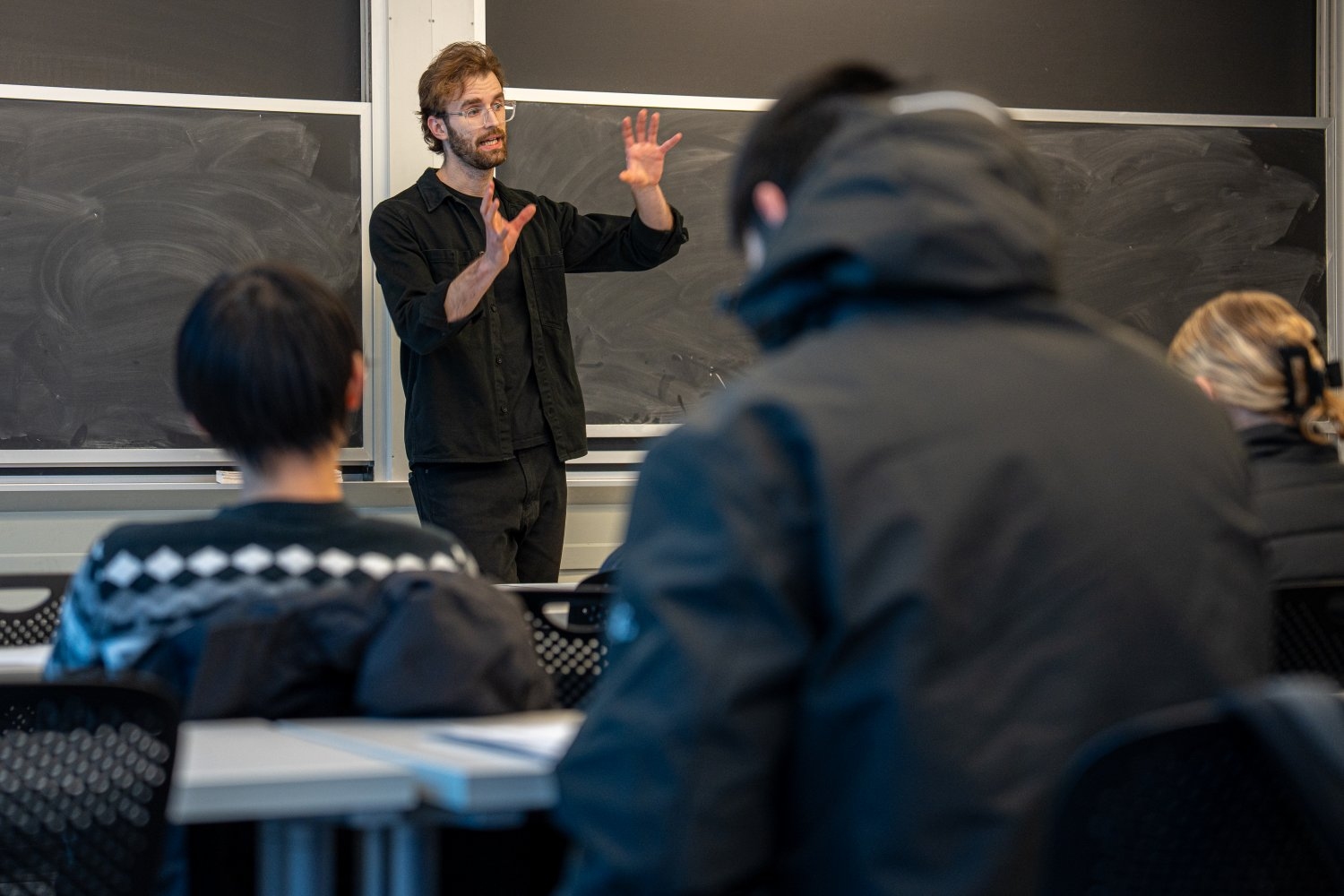
What makes work valuable? Michal Masny, the NC Ethics of Technology Postdoctoral Fellow in the MIT Department of Philosophy, investigates the role work plays in our lives and its impact on our well-being.
Masny sees numerous benefits to work, beyond a paycheck. It’s a space for people to develop excellence at something, make a social contribution, gain social recognition, and create and sustain community.
“Consider a future in which we shorten the work week, or one in which we eliminate work altogether,” Masny says. “I don’t believe either of these scenarios would be unambiguously good for everyone.”
“Work is both necessary and positively valuable,” he argues, further suggesting that our lives might be worsened if we were to eliminate work completely. “There can be optimal combinations of work and leisure time.”
Masny is completing his two-year term in the NC Ethics of Technology Fellowship at the end of the spring semester. In addition to advancing his research, Masny has been working to foster dialogue and educate students on issues at the intersection of philosophy and computing. This semester, Masny is teaching an undergraduate course, 24.131 (Ethics of Technology).
Masny advocates for an updated approach to educating complete, socially aware students. “I want to create scientists who think about their projects and potential outcomes as lawyers and philosophers might, and vice versa,” he says. Masny argues for the importance of eliminating the “wisdom gap” between these groups, citing scientist Carl Sagan’s warning about the dangers of becoming “powerful without becoming commensurately wise” as scientific and technological advances continue.
“The traditional division of labor is that scientists and engineers invent new technologies, and then philosophers and lawyers evaluate and regulate them,” he continues. “But the pace at which new technologies are invented and deployed has made this division of labor untenable.”
Established in 2021 with support from the NC Cultural Foundation, the fellowship was created with the goal of advancing critical discourse and research in the ethics of technology and AI at MIT, and by making important research and information available to the global community.
Venture capitalist Songyee Yoon, founder and managing partner of AI-focused investment firm Principal Venture Partners and a supporter of the NC Ethics of Technology Fellowship, believes technology and scientific discovery are among humanity’s most valuable public goods, and artificial intelligence represents the most consequential technology of our time.
“If we want the fabric of our society to be built responsibly, we must train our builders upstream, at the very moment they begin learning to design and scale technology. There is no better place to begin this work than MIT,” she says. “Supporting the Ethics of Technology Fellows Program was born from that conviction, and I am deeply encouraged to see it embraced at MIT.”
“In philosophy, you’re supposed to question everything”
Masny arrived at MIT in fall 2024, following a year as a postdoc at the Kavli Center for Ethics, Science, and the Public at the University of California at Berkeley. Originally from Poland, Masny received his PhD in philosophy from Princeton University after completing studies at Oxford University and the University of Warwick in the United Kingdom.
He works mainly in value theory, ethics of technology, and social and political philosophy. His current research interests include the nature of human and animal well-being, our obligations to future generations, the risk of human extinction, the future of work, and anti-aging technology.
During his tenure in the fellowship, Masny has published several research articles on ethical issues concerning the future of humanity — a topic closely relevant to thinking about the existential risks of AI development and deployment.
“In philosophy, you’re supposed to question everything,” he says.
Masny’s work in the fellowship continues a tradition of collaborative investigation and exploration that MIT encourages and celebrates. In fall 2024, Masny co-taught an introductory undergraduate course, STS.006J/24.06J (Bioethics), with Robin Scheffler, an associate professor in the Program in Science, Technology, and Society.
During the 2024-25 academic year, Masny led a student research group, “Deepfakes: Ethical, Political, and Epistemological Issues,” as a part of the Social and Ethical Responsibilities of Computing (SERC) Scholars Program. The group explored the ethical, political, and epistemological dimensions of concerns over misleading deepfakes, and how they can be mitigated.
Students in Masny’s cohort spent spring 2025 working in small groups on a number of projects and presented their findings in a poster session during the MIT Ethics of Computing Research Symposium at the MIT Schwarzman College of Computing.
In summer 2025, Masny assisted with a summer course in philosophy, 24.133/134 (Experiential Ethics), in which students subject their computer science and engineering projects to ethical scrutiny with the help of trained philosophers.
He’s encouraged by the opportunities to test his ideas and share them with people who can help refine and improve them.
Communities of practice and engagement
When considering the value of his experience at MIT, Masny lauds the philosophy department and the opportunities to collaborate with so many different kinds of scholars. To answer the kinds of questions his research uncovers, he says, you must range further afield. He values the space MIT creates for broad inquiry while also seeking connections between his findings on work, its value, and the human impact of technology on our social lives.
“Typically, undergraduate philosophy courses include two hour-long lectures followed by discussion; a lecture is like an audiobook,” he says. Instead, he believes, they should more like listening to a podcast or watching a talk show.
“I want the class to be an event in a student’s schedule,” he continues.
Masny is also considering how to integrate valuable philosophical tools into life outside the classroom. Philosophy and research can support other kinds of inquiry. Developing philosophers’ mindsets is a net positive, by his reckoning. Designing better questions, for example, can lead to better, more insightful, more accurate answers. It can also improve students’ abilities to identify challenges.
Masny will begin teaching at the University of Colorado at Boulder in fall 2026, and wants to test new ideas while continuing his research into the value of work.
Kieran Setiya, the Peter de Florez Professor in Philosophy and head of the Department of Linguistics and Philosophy, says the NC Ethics of Technology Postdoctoral Fellowship has allowed MIT to bring in a series of exceptional young philosophers working at the intersection of ethics and AI, studying the systemic effects of new computing technologies and the moral, social, and political challenges they pose.
“This is just the kind of applied interdisciplinary thinking we need to support and sustain at MIT,” he adds.