

Close Menu
geekfence.comgeekfence.com
    What's Hot

    Wilkie refers gambling concerns to anti-corruption commission

    August 13, 2026

    Lumen ready for AI traffic rush – with programmable fabric and “more fiber than anyone”

    August 13, 2026

    With a feel for physics, AI models simulate a wider range of real-world scenarios | MIT News

    August 13, 2026
    Facebook X (Twitter) Instagram
    • About Us
    • Contact Us
    Facebook Instagram
    geekfence.comgeekfence.com
    • Home
    • UK Tech News
    • AI
    • Big Data
    • Cyber Security
      • Cloud Computing
      • iOS Development
    • IoT
    • Mobile
    • Software
      • Software Development
      • Software Engineering
    • Technology
      • Green Technology
      • Nanotechnology
    • Telecom
    geekfence.comgeekfence.com
    Home»Nanotechnology»A new explanation for negative thermal expansion – Physics World
    Nanotechnology

    A new explanation for negative thermal expansion – Physics World

    AdminBy AdminApril 9, 2026No Comments3 Mins Read17 Views
    Facebook Twitter Pinterest LinkedIn Telegram Tumblr Email
    A new explanation for negative thermal expansion – Physics World
    Share
    Facebook Twitter LinkedIn Pinterest Email


    Revealing how copper atoms shift under heat offers a blueprint for engineering materials with precisely controlled expansion

    Wavy layers

    Wavy layers (Courtesy: Shutterstock/Long Quattro)

    Most materials expand when heated because increased atomic vibrations push atoms slightly farther apart. However, some unusual materials, such as α‑Cu₂V₂O₇, instead shrink when heated, a phenomenon known as negative thermal expansion. Although this behaviour had been observed before, its underlying mechanism was not well understood. In this study, the researchers examined α‑Cu₂V₂O₇ from 5 K to 800 K using neutron diffraction, synchrotron X‑ray diffraction, Raman spectroscopy, and first‑principles calculations. They found that the material exhibits three distinct thermal‑expansion regimes: almost no expansion below 35 K, strong negative thermal expansion between 35 K and 550 K, and normal positive expansion above 550 K.

    The origin of this behaviour lies in how copper atoms move within distorted CuO₆ like octahedra. At the lowest temperatures, a quantum effect called the second‑order Jahn-Teller effect pushes the copper atoms off‑centre, but this motion is partly suppressed by the onset of antiferromagnetic ordering, which stabilises the structure and produces near‑zero thermal expansion. As the temperature increases, the second‑order Jahn-Teller effect weakens, allowing the copper atoms to shift back toward the centre of their octahedra, but in opposite directions along different structural chains. This anti‑off‑centering motion compresses the Cu-Cu zigzag chains and also reduces the spacing between neighbouring chains, pulling the structure inward and producing the observed negative thermal expansion.
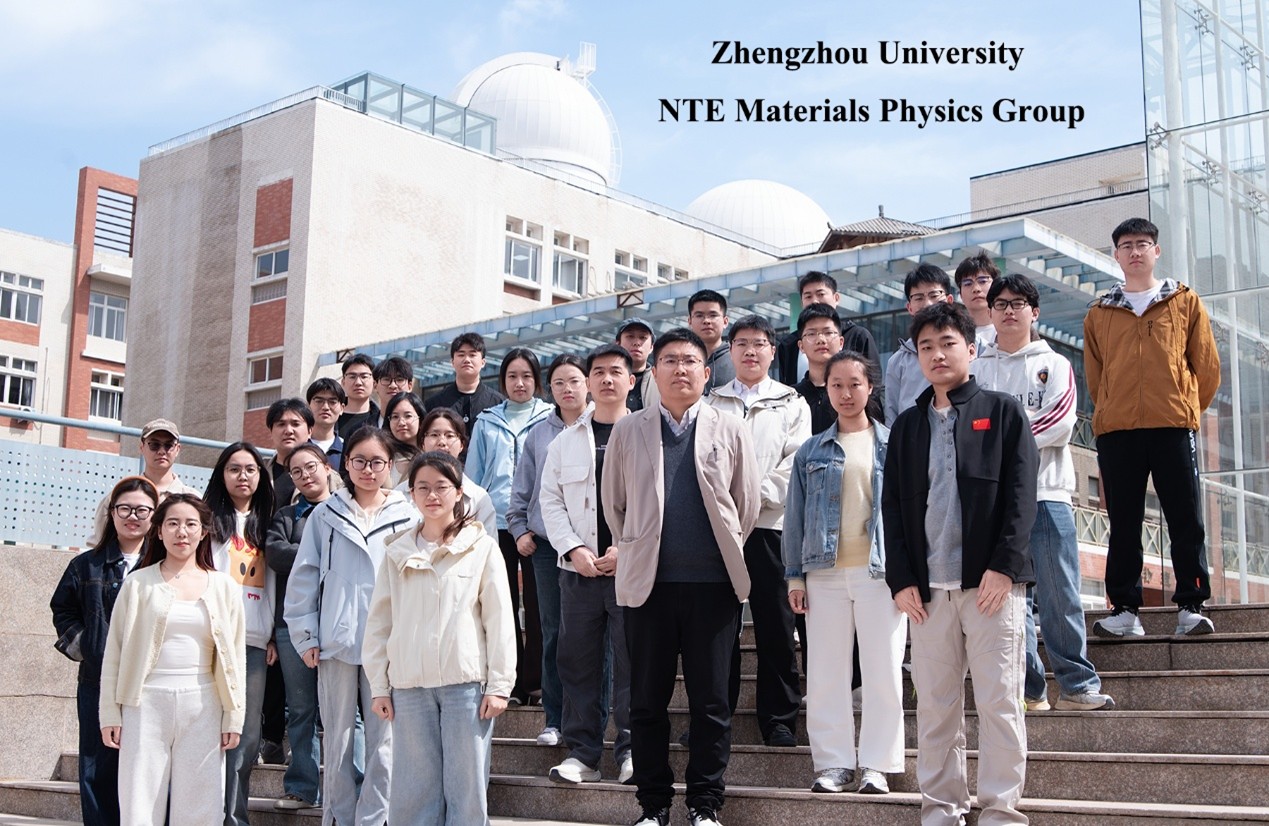
    The Negative Thermal Expansion Materials Physics Group at Zhengzhou University
    The Negative Thermal Expansion Materials Physics Group at Zhengzhou University was established by Professor Qilong Gao in 2023. The team conducts in-depth characterization and mechanistic investigations by leveraging major large-scale scientific facilities, including SPring-8, ESRF APS, SSRF, ELETTRA, and CSNS. (Courtesy: Gao/Zhengzhou University)

    The researchers also found that the copper atoms have unusually large vibrational freedom along one axis, which helps enable this motion. Raman spectroscopy revealed an anomalous broadening of a low‑frequency vibrational mode, providing evidence for electron-phonon coupling that further supports the proposed mechanism. Together, these effects explain the unusual thermal behaviour of α‑Cu₂V₂O₇ and offer valuable insight for designing materials with controlled thermal expansion, which is important for precision engineering, electronics, and composite materials that must remain dimensionally stable across temperature changes. Meanwhile, this mechanism, centered on the Jahn–Teller effect, can be extended to a wide range of transition metal oxide systems, providing a universal theoretical foundation for systematically explaining the anomalous thermal expansion behavior of such materials.

    Do you want to learn more about this topic?

    Negative thermal expansion and associated anomalous physical properties: review of the lattice dynamics theoretical foundation by Martin T Dove and Hong Fang (2016)


    Source link

    Share. Facebook Twitter Pinterest LinkedIn Tumblr Email

    Related Posts

    A programmable DNA origami nanosyringe for directed membrane translocation

    August 12, 2026

    Magnetic molecules explain a puzzling material – Physics World

    August 11, 2026

    Pomegranate Peel Nanomaterials Give TiO₂ New Control Over CO₂ Reduction

    August 10, 2026

    New fuel cell breakthrough could help power energy-hungry data centers

    August 9, 2026

    Spectral biophysical cytometry with nanosensors reveals remodelling of immune cells in atherosclerosis

    August 7, 2026

    Kristian Dominek Barajas – ‘I’m able to take a really complicated problem and give it my best guess’ – Physics World

    August 6, 2026
    Top Posts

    Understanding U-Net Architecture in Deep Learning

    November 25, 202577 Views

    The Next Paradigm in Efficient Inference Scaling – The Berkeley Artificial Intelligence Research Blog

    May 16, 202642 Views

    Is it too late to start learning AI and machine learning in my 30s or 40s?

    April 9, 202640 Views
    Don't Miss

    Wilkie refers gambling concerns to anti-corruption commission

    August 13, 2026

    Independent MP Andrew Wilkie has taken the fight over gambling reform to the National Anti-Corruption…

    Lumen ready for AI traffic rush – with programmable fabric and “more fiber than anyone”

    August 13, 2026

    With a feel for physics, AI models simulate a wider range of real-world scenarios | MIT News

    August 13, 2026

    Monitoring beyond SNMP: Turning your network into a sensor

    August 13, 2026
    Stay In Touch
    • Facebook
    • Instagram
    About Us

    At GeekFence, we are a team of tech-enthusiasts, industry watchers and content creators who believe that technology isn’t just about gadgets—it’s about how innovation transforms our lives, work and society. We’ve come together to build a place where readers, thinkers and industry insiders can converge to explore what’s next in tech.

    Our Picks

    Wilkie refers gambling concerns to anti-corruption commission

    August 13, 2026

    Lumen ready for AI traffic rush – with programmable fabric and “more fiber than anyone”

    August 13, 2026

    Subscribe to Updates

    Please enable JavaScript in your browser to complete this form.
    Loading
    • About Us
    • Contact Us
    • Disclaimer
    • Privacy Policy
    • Terms and Conditions
    © 2026 Geekfence.All Rigt Reserved.

    Type above and press Enter to search. Press Esc to cancel.