

Rinsing off a cleanser takes two seconds and disappears from thought. Where it actually goes – what happens after the drain – is a question most people never ask, and the skincare industry has been quietly fine with that arrangement.
The sector does more than $155 billion annually. It also has a documented chemical trail, one that researchers have spent years following from bathroom drains into river sediment, coastal waters, marine mammal tissue. Polar bear livers. Dolphin fat. These aren’t activist talking points or edge cases. Peer-reviewed studies – some from as recently as 2025 – keep finding the same compounds in places they have no business being.
The Gap Between US and EU Regulation Is Bigger Than Most People Realise
The U.S. historically banned 11 chemicals from cosmetics. Eleven. The EU has banned or restricted over 2,500.
That’s not a rounding error – it reflects a genuinely different philosophy about risk. Europe works on the precautionary principle, which means restricting a chemical when there’s reasonable cause for concern. The U.S. approach has historically required proof of harm first. When you’re dealing with compounds that accumulate slowly in fatty tissue over years or decades, waiting for proof is a standard that takes an extremely long time to meet.
The Modernization of Cosmetics Regulation Act – signed December 2022 and the first major update to FDA authority over cosmetics since 1938 – moved the U.S. figure to around 33. California added 24 more to its own restricted list when the Toxic-Free Cosmetics Act kicked in that January. Progress, technically. But certain parabens, dibutyl phthalate, formaldehyde-releasing preservatives – all banned in Europe – remain perfectly legal in U.S. products as you read this.
The 40% Problem
Around 80% of ingredients in mass-market skincare are derived from petrochemicals. Most products are designed to be rinsed off. They go down the drain, into wastewater systems, and through treatment facilities that were designed long before this volume and variety of synthetic chemistry existed in consumer products.
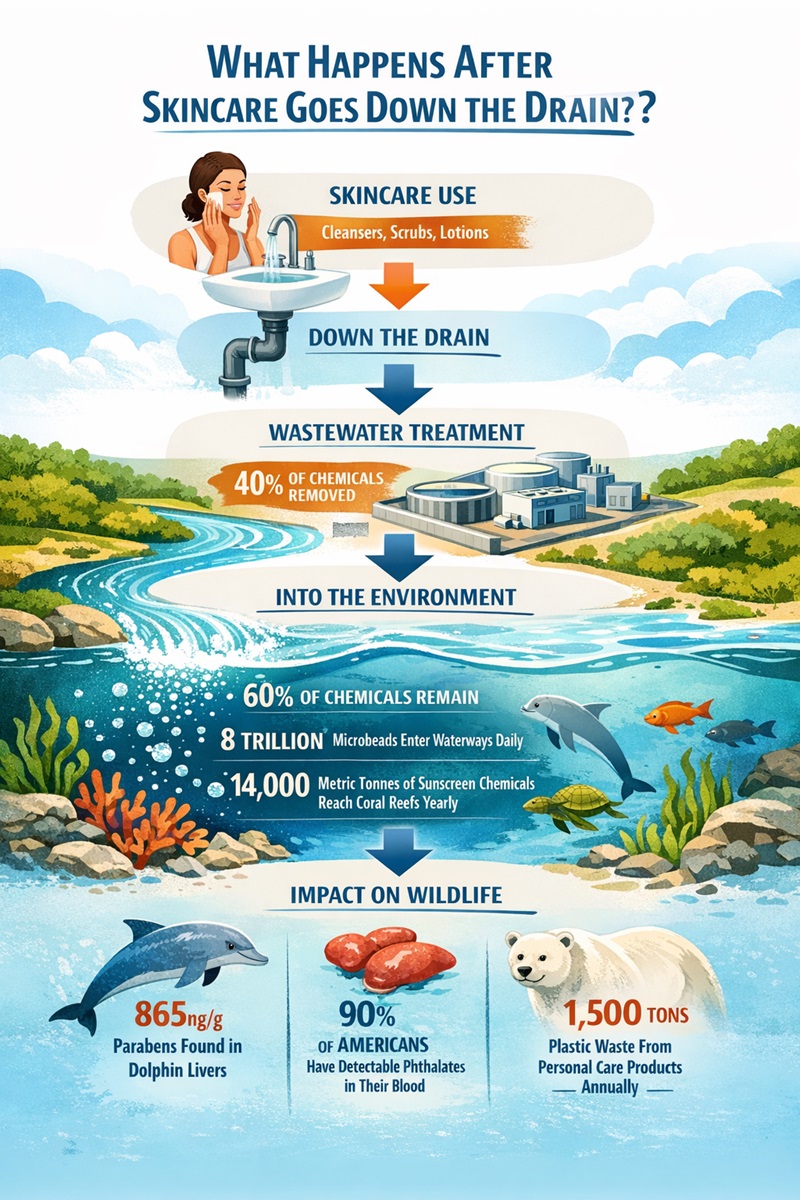
Conventional wastewater treatment removes around 40% of many synthetic chemicals. The rest passes through.
Parabens turn up in surface water at concentrations up to 170.9 μg/L. About 8,000 metric tonnes are manufactured and used globally every year, and treatment plant effluent is now formally identified as a primary pathway for aquatic contamination. For people already shifting away from conventional products, opting for 100% natural, clean skincare removes many of these synthetic preservatives before they ever see a drain – which matters because the infrastructure downstream isn’t catching them.
Where that contamination ends up is the part that’s hardest to dismiss. Methylparaben at 865 ng/g wet weight in bottlenose dolphin livers in Sarasota Bay, Florida. Among the highest concentrations ever recorded in marine mammals. Parabens in polar bear livers from the Chukchi and Beaufort Seas. A 2025 study found them in humpback dolphins in the South China Sea – with evidence of maternal transfer, meaning calves are born already carrying the load.
Phthalates move through the same pathways. The CDC reports nearly 90% of Americans carry measurable phthalate levels in their blood. Diethyl phthalate – used as a fragrance fixative, common in skincare – has been found in fin whales, blue whales, and bowhead whales in the Norwegian Arctic, where certain compounds interfered with thyroid hormone receptors. These aren’t animals anywhere near cities or outflows.
PFAS are a different category of problem. An FDA analysis of over 430,000 cosmetic products found more than 50 PFAS ingredients intentionally used in nearly 1,700 of them. A 2021 Notre Dame study found PFAS indicators in 50–60% of tested cosmetics. They appeared on ingredient labels in 8% of those products. Present in most, disclosed in almost none.
And fragrance. The word “fragrance” on a label legally covers dozens of individual compounds without naming them – phthalates are commonly included. A 2018 study in Science found VOC emissions from consumer products now rival motor vehicle emissions in industrialised cities.
300,000 Microbeads. Per Tube.
That’s the estimate for a single tube of facial scrub. A 2015 estimate put it at 8 trillion microbeads a day reaching U.S. aquatic habitats – that’s not a typo – with another 800 trillion settling into sewage sludge before getting spread on agricultural land. The global figure for microplastics escaping treatment from personal care: around 1,500 tonnes a year.
The U.S. Microbead-Free Waters Act covered rinse-off products; the EU followed with its own ban in October 2023. A 2025 study then tested eight scrub products in regions fully covered by those bans. Six of the eight still contained microbeads – a few at over 6,000 beads per gram.
The bans exist. Enforcement is another matter.
Leave-on products aren’t covered at all. Polyethylene, polypropylene, acrylates copolymer – microplastics, just listed under their chemistry names – remain in moisturisers and foundations. The Plastic Soup Foundation tested leading cosmetics brands and found microplastics in 87% of products.
What Oxybenzone Does to Coral
Between 6,000 and 14,000 metric tonnes of UV-filtering chemicals enter reef coastal waters every year. Oxybenzone causes bleaching at 62 parts per trillion – a concentration so low it barely registers on a human scale. The documented effects on coral go beyond surface-level bleaching: DNA damage, skeletal endocrine disruption, larvae that develop deformities before they’ve had a chance to settle.
The mechanism was established in a 2022 Science paper. Corals take up oxybenzone and metabolise it into a compound that absorbs light but releases it as reactive oxygen species rather than heat. In other words – inside coral tissue, sunscreen becomes a phototoxin. It converts light into damage.
Hawaii banned both oxybenzone and octinoxate starting January 2021; Palau went further and restricted ten reef-damaging chemicals from January 2020. By early 2025, 84% of the world’s coral reefs had gone through bleaching-level heat stress. Warming oceans are driving most of it – chemical pollution compounds the damage in tourist-heavy coastal areas, but it isn’t the lead cause.
Mineral sunscreens with non-nano zinc oxide or titanium dioxide work differently – they stay on the surface and scatter UV rather than absorbing it, which means no metabolic conversion happens in coral tissue. Worth knowing: ‘reef safe’ is a marketing phrase with no legal standing anywhere. The active ingredients list is the only thing that tells you what you’re actually putting in the water.
120 Billion Packaging Units
Per year. About 95% discarded after single use. In practice, roughly 9% of cosmetic plastic packaging is actually recycled.
Packaging accounts for up to 35% of a product’s total environmental footprint. The carbon picture extends beyond packaging – Scope 3 emissions from supply chains and raw material production represent up to 90% of total carbon footprint for many cosmetics companies. Petroleum-derived butylene glycol, a solvent used routinely in skincare, has 103% greater global warming potential than its bio-based equivalent. The petrochemical version is still the industry standard.
What’s Moving
The clean beauty market sat at around $10.5 billion in 2025 and analysts project it reaching $35.3 billion by 2033. PwC’s 2024 Voice of the Consumer survey – 20,000 people across 31 countries – found 80% willing to pay more for sustainable products. New skincare launches carrying clean claims hit 45% in 2024, up 21% from 2022. Whether that reflects genuine formulation change or smarter labelling is a different question.
The words ‘natural,’ ‘clean,’ and ‘non-toxic’ carry no legal weight in most markets – they mean whatever a brand decides they mean. Third-party certification is the only way around that: COSMOS, ECOCERT, and the Soil Association involve actual auditing rather than self-declaration. For checking specific ingredients before you buy, EWG Skin Deep and Beat the Microbead are both worth bookmarking.
On labels: “fluoro” or “perfluoro” anywhere in an ingredient name indicates PFAS. “Fragrance” or “parfum” may conceal phthalates and dozens of other compounds. Polyethylene, polypropylene, and acrylates copolymer are microplastics labelled as chemistry.
To keep the scale honest: tyre and textile microplastics dwarf what personal care contributes. Climate change drives most coral bleaching. The scale of these problems is industrial. Individual purchasing choices don’t fix industrial-scale problems on their own.
But personal care sends thousands of tonnes of microplastics into waterways every year regardless. Shows up in cetacean tissue across the globe. Contains chemicals restricted elsewhere because the evidence against them was judged sufficient. A market generating $155 billion annually is large enough that where consumer demand shifts, product development follows – eventually. The shift is already happening. How far and how fast depends partly on how many people actually look at the label rather than the packaging.