

Every chemical reaction must overcome an energy hurdle before it can occur. Substances need an initial input of energy to start reacting. Sometimes this barrier is small, like lighting a match. In many industrial processes, however, the required energy is much higher, which increases costs.
To make reactions easier and more efficient, chemists rely on substances called catalysts. These “reaction helpers” reduce the energy needed. The most effective catalysts often contain metals, including rare and expensive ones.
Breakthrough Catalyst Turns CO2 Into Methanol
Researchers at ETH Zurich have now made a major advance in catalyst design. Their new system significantly lowers the energy needed to produce methanol (an alcohol) from carbon dioxide and hydrogen.
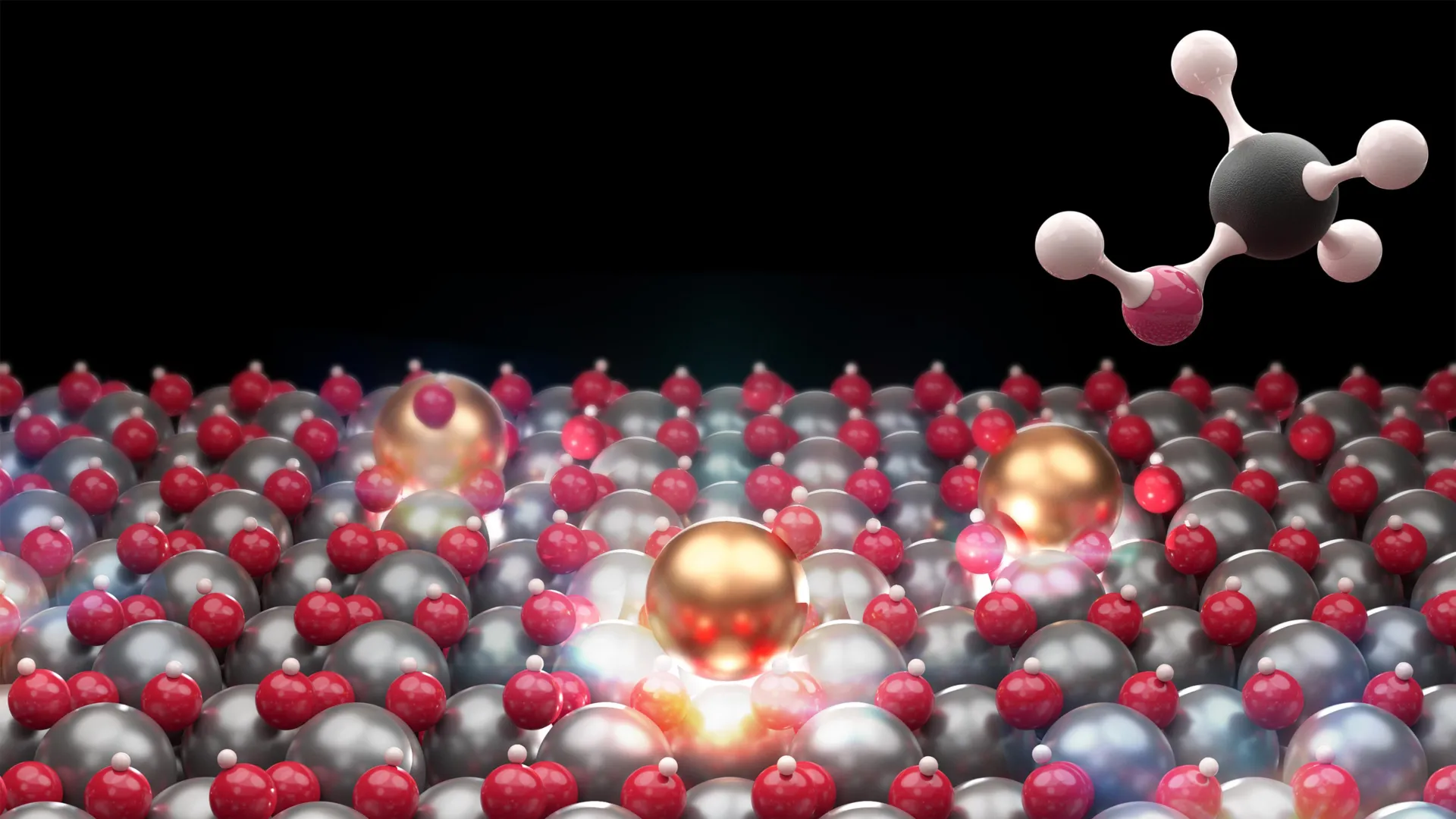
The team also achieved an unusually efficient use of the metal indium. In this catalyst, each individual indium atom acts as its own active site. This is a major shift from traditional approaches, where metals are grouped in particles.
Another key advantage is improved precision. In the past, catalyst development often relied on trial and error. This new design allows scientists to better observe and understand the reactions happening on the surface, opening the door to more deliberate and optimized catalyst development.
Methanol’s Role in Sustainable Chemistry
“Methanol is a universal precursor for the production of a wide range of chemicals and materials, such as plastics — the Swiss army knife of chemistry, so to speak,” says Javier Pérez-Ramírez, Professor of Catalysis Engineering at ETH Zurich.
Methanol is essential for producing fuels and materials, and it plays a growing role in efforts to move away from fossil fuels. If the hydrogen and energy used in the process come from renewable sources, methanol production could become climate neutral.
This approach also offers a new way to use CO2. Instead of releasing it into the atmosphere, it can be captured and turned into a valuable raw material.
Single Atom Catalysts Maximize Efficiency
“Our new catalyst has a single atom architecture, in which isolated active metal atoms are anchored on the surface of a specially developed support material,” Pérez-Ramírez explains.
In conventional catalysts, metals are typically grouped into small particles that can contain hundreds or even thousands of atoms. Many of those atoms are not directly involved in the reaction, making the process less efficient.
Single atom catalysts represent a more efficient alternative. By using metals at the level of individual atoms, scientists can make better use of scarce and costly elements. In some cases, this even makes it practical to use precious metals in industrial applications.
Working with isolated atoms can also change how the catalyst behaves. “Indium has already been used in this catalyst for over a decade,” says Pérez-Ramírez. “In our study, we show that isolated indium atoms on hafnium oxide allow more efficient CO2-based methanol synthesis than indium in the form of nanoparticles containing large numbers of atoms.”
Engineering Stable Single Atom Catalysts
To place individual indium atoms precisely on the surface of hafnium oxide, the ETH team developed several new synthesis methods in collaboration with other research groups. A critical factor was designing a support material that keeps the atoms stable while still allowing them to remain reactive.
One method involves burning the starting materials in a flame at temperatures between 2,000 and 3,000°C, followed by rapid cooling. Under these conditions, indium atoms remain on the surface and become firmly embedded.
The resulting catalyst is highly durable. The researchers showed that these single atom systems can withstand demanding conditions, including high temperatures and pressures. This is important because producing methanol from CO2 and hydrogen typically requires temperatures up to 300°C and pressures up to 50 times normal atmospheric levels.
Clearer Insights Into Reaction Mechanisms
Traditional catalysts made of nanoparticles have long been difficult to study. Although reactions occur at surface atoms, many signals in measurements come from atoms inside the particles that do not participate in the reaction. This makes it harder to interpret what is really happening.
With single atom catalysts, this problem is reduced. Because only isolated atoms are present, scientists can analyze reaction mechanisms with far less interference, leading to clearer insights.
Pérez-Ramírez has been working on improving CO2-based methanol production since 2010 and collaborates closely with industry. He also holds several patents in this field. According to him, the success of this new catalyst was made possible by strong collaboration across Switzerland’s research community: “The development of the methanol catalyst and the detailed analysis of the mechanism would not have been possible without this interdisciplinary expertise.”