

Developing an industrial-grade automated atomic force microscope (AFM) requires careful attention from the very first customer discussion to final commissioning on site. At Nanosurf, these two moments are particularly critical, as early design decisions ultimately determine whether the final system can meet demanding industrial specifications. Bridging these phases is Dr. Marco Corbetta, application and service engineer, who accompanies many custom AFM systems from concept to handover.
“I am involved right at the beginning, when the project is still being discussed, even before the order is placed. Later, I am called in again toward the end, after the system has been designed by the mechanical engineer, the components have arrived at Nanosurf, and the system has been assembled. At that point, I take over the system and perform the tests that were defined at the start, when I was first consulted during the initial project phase,” Marco says.
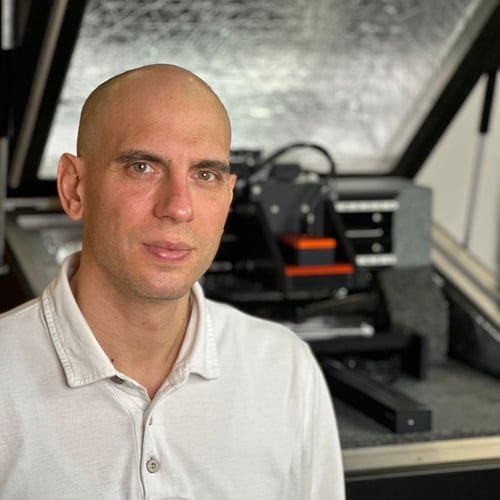
Dr. Marco Corbetta, application and service engineer at Nanosurf. Image Credit: Nanosurf AG
When a customer from an industrial setting reaches out to us, they may have precise ideas of what they need, or they might simply be looking for a solution to a problem. These initial discussions are led by the sales manager, the distributor, or the responsible team leader, who works closely with several Nanosurf specialists to identify the best solution. Marco is one of the experts contributing to this early concept phase, providing technical input to help define realistic, verifiable specifications.
“This is the most exciting moment for me because, in the end, you are giving your word to the customer. If you say a system can be built with precise specifications, then you must be able to deliver it,” explains Marco.
Once the agreement with the customer is reached and the target specifications are clearly defined, development begins, including critical parts such as the stage and software. At the end, when everything is ready, the system is assembled for the first time at Nanosurf headquarters in Liestal or at our production site in Pratteln, a few kilometers away.
The machine is then tested through a process called Factory Acceptance Tests (FAT). Here, Marco verifies that the instrument fulfills all agreed requirements or or identifies any aspects that require further optimization. FAT procedures vary because each customer has different requests. “These measurements are defined at the beginning of the project, and then I perform them later when I take over the assembled system,” Marco comments. At this stage, final tuning and fine adjustments are also carried out.
After shipping, the system arrives at the customer’s site, and it is assembled in its final location. During installation, the stage – typically a single block – is placed before the acoustic enclosure is assembled around the stage and the control cabinet is connected. After installation the entire testing process is repeated and documented in what is called the Site Acceptance Test (SAT). The SAT document then certifies that the specifications are met after installation.
Both FAT and SAT, which largely overlap, involve every mechanism of the instrument. The loading procedure, which consists of placing the sample on the measurement stage, must be checked to ensure it works correctly, that AFM measurements function as intended, and that the sample can be removed afterward. Some of these tests are automated, for example the loading process in the Alphacen 300 Drive.
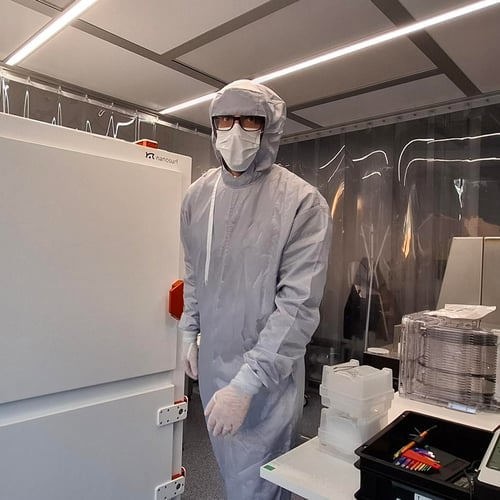
Dr. Marco Corbetta servicing a Nanosurf industrial AFM system in the cleanroom of a semiconductor manufacturer. Image Credit: Nanosurf AG
Other checks include the measurement range, such as the movement range of the XYZ axes. Sometimes there is a rotating measurement stage, which adds an Alpha axis, or the head may move in a way that introduces another axis. For all these axes, Marco verifies the maximum and minimum ranges, as well as the reproducibility of XYZ positioning. “If you perform an AFM measurement, then move the stage to another position and return to the original point, you measure again at the same location. The question is: how much has that point shifted?”
Noise is another critical factor that must be assessed before handing over the system to the customer. The two main sources are the inherent noise of the AFM itself, and the additional noise introduced when integrated into a stage. If done wrongly, integration can increase noise by a factor of ten or more because the stage may vibrate or behave unpredictably, which would cause the system to fail the agreed-on specifications. Therefore, the Nanosurf industrial solution team carefully accounts for stage-induced noise during the design phase.
Further tests, for example, include demonstrating that the system can measure an atomic step on Highly Oriented Pyrolytic Graphite (HOPG), which consists of layers of graphite stacked on top of each other, or assessing the reproducibility of height measurements by repeatedly measuring the height of a certified calibration grating and evaluating mean and standard deviation.
For the software, it is essential to confirm that the correct version is installed and that all customer-specific functionalities operate as intended. Since the software serves as the primary user interface, ensuring its flawless operation is just as critical as verifying performance metrics such as noise levels or repositioning accuracy.
Once everything is set up, it is time to run the system. Marco trains customers to operate Nanosurf instruments autonomously, which are designed to be intuitive and easy to use. He provides complete training for surface roughness measurements and other standard applications, while more complex tasks require support from the Nanosurf Applications team.
Marco accompanies industrial AFM systems from their first conceptual discussions to final acceptance and witnesses both the beginning and the end of their journey at Nanosurf. His role relies on trust in the rest of the team, who develop and build the system he promised to customers. By committing to those technical specifications and later demonstrating that they have been met, Marco puts his name on the line.