

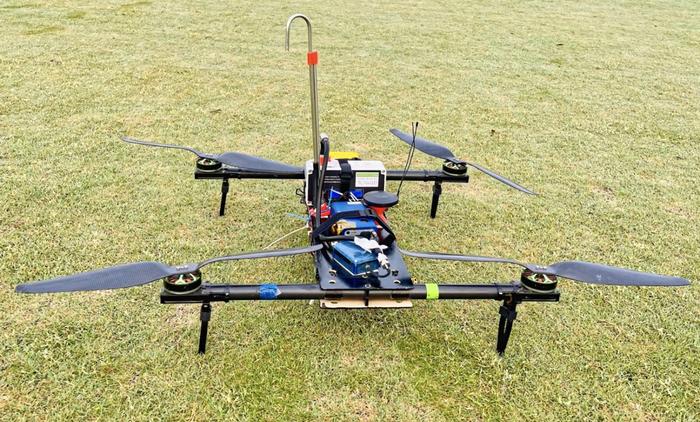



Cost-effective sensors on drones may be an effective tool for better investigating the lowest layers of the atmosphere. If ground-based air quality measurements were supplemented by such drone-based readings, air quality models and mitigation approaches could be improved, according to the team behind a recent study in the metropolitan region of Delhi, India.
The group showed that particulate matter (PM) concentrations depend heavily on height above ground level. For example, at a height of 100 metres, PM2.5 concentrations were up to 60 percent higher than at ground level. The results suggest that current model simulations significantly underestimate PM2.5 concentrations during morning smog phases, as the researchers have written in the journal Nature npj Clean Air.
The study was coordinated by Asst. Prof. Ajit Ahlawat from the Leibniz Institute for Tropospheric Research (TROPOS), with contributions from researchers in India, the Netherlands, Germany, China, Greece, and elsewhere.
With over 30 million people, the metropolitan area around India’s capital New Delhi is one of the largest and most densely populated megacities in the world. Air pollution levels are also among the highest. Particularly in winter smog, PM concentrations reach extremely hazardous levels.
Understanding smog in India
Heavy smog often prevails in northern India, especially after the monsoon and in winter. For this reason, a series of ground-based measurements have recently been carried out to better understand the causes and mechanisms of air pollution. Most studies conducted in India are based either on satellite observations from space or on ground-based measurements. In contrast, there is hardly any data available from the lowest layers of the atmosphere. However, the vertical distribution of air pollutants and meteorological conditions up to an altitude of about 1 km are of great importance because they have a decisive influence on how high the concentration of pollutants in the air can become.
In recent years, significant advances have been made in both drone technology and cost-effective particulate matter sensors. Mass production and miniaturization offer new possibilities, which were tested by researchers in a field trial in March 2021 at the Indian Institute of Technology (IIT) Delhi and compared with standard measurements from stationary measuring devices. To this end, the research team equipped and modified a drone from the Indian start-up BotLab Dynamics with low-cost fine PM sensors. This included “the construction of a custom-made vertical aerosol inlet,” as Ajit Ahlawat explains. This was positioned about 30 cm above the drone’s rotor blades. “This enabled us to take measurements that were as accurate as possible, which is otherwise a major problem with drones, whose rotor blades cause significant air turbulence.“
Moisture mitigation
Another challenge was the high humidity, which makes air sampling and analysis difficult. To tacle this, the researchers installed a custom-designed silica gel dehumidifier. In this way, they were able to investigate vertical fluctuations in air pollutant concentrations at different altitudes and at different times of day. The focus was on hazy and non-hazy morning hours in Delhi in order to find out more about the causes of smog.
Organic substances dominated during the day, while inorganic substances such as nitrate and chloride increased significantly at night. This trend indicates an increased contribution, which is likely due to the combustion of biomass and waste as well as industrial emissions during the evening and night hours. Nitrate and ammonium were strongest in the early morning, suggesting their condensation into the aerosol phase under humid and cold conditions. As the boundary layer height increased after sunrise, dilution effects led to a rapid decrease in chloride mass concentration. NOx levels peaked around 9 pm local time, caused by vehicle and industrial emissions trapped under a stable boundary layer. In contrast, PM2.5 rose steadily from around 80 µg/m3 at 6pm local time to around 150 µg/m3 at 8 am local time, underscoring the role of fresh primary emissions and secondary aerosol formation during smog formation. An example illustrates how much PM concentrations can vary depending on altitude: on 18 March, PM2.5 concentration rose by a remarkable 60 percent with increasing altitude, reaching around 160 µg/m3 at higher elevations compared to around 100 µg/m3 at ground level. The morning inversion had obviously caused the pollutants to accumulate particularly strongly in the lower boundary layer. Relative humidity was above 80% at night, which promotes the formation of secondary aerosols and the growth of particles through water absorption. This was also highlighted by the proxy indicator e.g. PM ratio used during the study. When the temperature rose above 30°C in the morning, the relative humidity fell below 40% and the haze dissipated.
The accumulation of pollutants and high humidity at night are the main reasons for the formation of ground-level smog layers in Delhi. The rapid dissipation of haze after sunrise is facilitated by the expansion of the boundary layer, reduced relative humidity, and increased photochemical oxidation. These findings underscore the need for emission control measures targeting nocturnal sources and humidity-driven secondary aerosol processes, as well as their understanding, particularly in vertical columns, in order to reduce smog in Delhi.
Another important finding emerged from a comparison of the measurements with the WRF-Chem model, which is frequently used worldwide to predict air quality: the results indicate that current model simulations significantly underestimate PM2.5 concentrations during morning smog phases. “This may be due to the dry bias of the model, which limits its ability to simulate aerosol hygroscopic growth at high humidity values,” said Prof. Mira Pöhlker from TROPOS and the University of Leipzig.
The team believes the study is an important step towards integrating cost-effective PM sensors into existing air monitoring systems and closing observation gaps in the lower boundary layer.
