


A software bill of materials (SBOM) provides transparency into the elements of an integrated software product. Such transparency is critical to identifying system vulnerabilities and thus mitigating potential security risks. There is growing interest in using SBOMs to support software supply chain risk management. In September 2024 Army leaders signed a memorandum requiring SBOMs for vendor-supplied software. More recently, the Department of Defense (DoD) Chief Information Officer, through its Software Fast Track Program, is requiring that software vendors submit their SBOMs, as well as those from third-party assessors, to enable detection of variances between SBOMs for the same software.
Different SBOM tools should produce similar records for a piece of software at a given point in its lifecycle, but this is not always the case. The divergence of SBOMs for individual pieces of software can undermine confidence in these important documents for software quality and security. This blog post outlines our team’s recent findings on why SBOMs diverge and recommends seven ways to improve SBOM accuracy.
SBOM Harmonization Plugfest
The SEI’s 2024 SBOM Harmonization Plugfest project, sponsored by the Cybersecurity and Infrastructure Security Agency (CISA), aimed to uncover the root causes of SBOM divergence, such as imprecise definitions or standards, how uncertainty is addressed, or other implementation decisions. The SEI brought together SBOM tool vendors, standards producers, and others in the SBOM community to produce sample SBOMs for analysis. The recently released Software Bill of Materials (SBOM) Harmonization Plugfest 2024, on which this post is based, outlines our team’s findings, analysis, and recommendations to help SBOM producers generate more consistent and reliable SBOMs.
We asked Plugfest participants to generate and submit SBOMs based on nine software targets chosen as a representative sample of various programming languages as seen in Table 1 below.
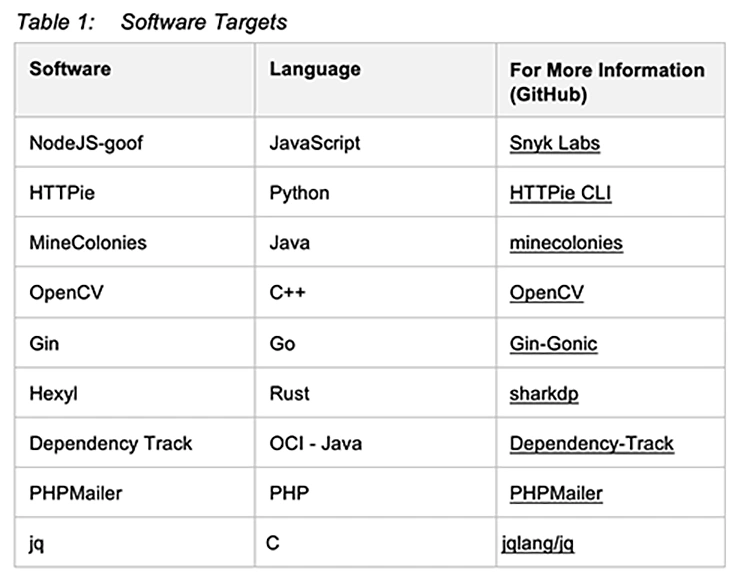
The SEI gained approval from most participants to make their submissions public. Those SBOMs that were approved for release are now available at SEI’s GitHub site.
Overview and Analysis of Submitted SBOMs
We received 243 SBOMs from 21 Plugfest participants. To ensure anonymity and to prevent any bias in our review, we anonymized participant names by assigning alphanumeric codes to each. One participant, who was assigned the code Y2, submitted many more SBOMs (102) than all the others (Figure 1). Y2 generated and submitted SBOMs in every format their tool supported (i.e., source and binary analysis as well as enriched and non-enriched).
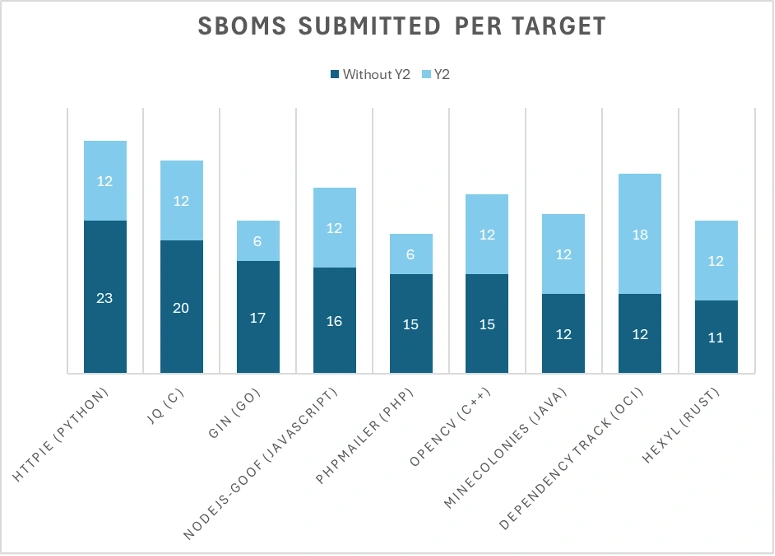
Figure 1: SBOMs Submitted per Target
Analysis
To ensure an objective analysis, we first determined evaluation criteria for our review of the SBOMs. We then determined automated approaches to extract information from the SBOMs to facilitate our development of software tools for analysis as well as our generation of baseline SBOMs, which we used for comparison purposes.
Evaluation Criteria
Assessing the consistency of the minimum elements of the submitted SBOMs was a critical component in determining their completeness and accuracy. A list of minimum elements specifies the baseline SBOMs should meet and facilitates information sharing. The criteria we used for minimum elements are those required for documenting a software product’s primary component and its included components as outlined in CISA’s Framing Software Component Transparency: Establishing a Common Software Bill of Materials (SBOM):
- SBOM Author Name
- SBOM Timestamp
- SBOM Type
- SBOM Primary Component
- Component Name
- Component Version String
- Component Supplier Name
- Component Cryptographic Hash
- Component Unique Identifier
- Component Relationships
- Component License
- Component Copyright Holder
Analysis Tools
Due to the many submissions, we developed tools to automate ingesting and processing SBOMs to collect, collate, and export data about them. Participants submitted SBOMs in SPDX and CycloneDX formats in a variety of encodings including JSON, XML, and YML.
We wrote code for processing SBOMs using Python within Jupyter computational notebooks hosted on an SEI internal Bitbucket repository, which also contained a copy of SBOM Plugfest submissions. We used two primary notebooks for analyzing SBOM submissions: one for CycloneDX and one for SPDX. We sought to extract the following from each SBOM:
- information related to the presence or absence of minimum elements
- information about software components, including their relationships to one another and with the target software
In each notebook, we collected information from each SBOM by doing the following:
- traversing the directory of SBOM submissions, importing JSON SBOM files, and decoding the JSON files so that data could be extracted
- extracting minimum elements from each SBOM where the data existed and noting where data was missing
- constructing a dependency tree based on the dependencies listed in each SBOM (These dependency trees contained information about software components and the types of relationships among those components as listed in the SBOM.)
- collating data from each SBOM into two common data structures: one for information related to minimum elements and the other for component information
We analyzed the data structures using Python data science packages, or we exported them as comma separated value (CSV) files for further analysis. We used information about the presence or absence of minimum elements to generate summary statistics for each software target and each SBOM type (source/build). We used dependency graph information to analyze the presence/absence of components and assess the depth of the SBOMs.
Baseline SBOMs
We selected three prominent open source tools, Syft, Trivy, and Microsoft’s SBOM Tool, to create baseline SBOMs for each of the nine software targets. The baseline SBOMs served as initial examples of what we might expect to see submitted by Plugfest participants. The baseline SBOMs also allowed us to develop analysis tools early in the project so we could start analyzing participants’ SBOMs as soon as they were submitted.
Findings from SBOM Analysis
The following are notable findings from our research on the SBOMs submitted for the Plugfest. These findings, ordered from the trivial to the more complex, explain the types of variances in the SBOMs as well as their causes.
- Component number, content, and normalization. We found significant variance in both the number of components and the content of the minimum required elements in SBOMs from different participants for the same software at the same lifecycle phase. Some variance in SBOM content is due to the lack of normalization; the same content was simply being written differently (e.g., software version detailed as v 2.0 or just 2.0).
- Software versions. Another cause for variance in SBOM content is that some software specifications allow for a range of possible software versions, but SBOMs allow only a single version to be documented for each dependency. This results in SBOMs having various versions listed across different participants for each target that allowed version ranges.
- Minimum elements. Some variance in SBOM content is due to differences in whether participants included minimum elements or not, which may be due to the somewhat artificial nature of generating SBOMs for a research project.
- Use cases. SBOMs have diverse use cases, which lead to different types of SBOMs. The wide variety of possible use cases is an additional cause for the lack of harmonization across SBOMs for the same target. If we had specified a use case, participants may have taken a more harmonized approach to how they generated, enriched, or augmented their SBOMs for that use case.
- Build and source SBOMs. Participants used different approaches to generate their build and source SBOMs, which led to differences in the discovered components. Some participants used a container build process to generate their build SBOM, and others built a standalone executable for their chosen runtime environment using the target’s language or build-framework-specific process. Build SBOMs also varied based on the environment and tool configurations each participant used. Source SBOMs capture dependencies declared or inferred from source code. Some participants used additional information from external locations, such as the artifact repositories referenced by dependencies or the contents of platform toolchain libraries, to infer additional dependencies.
- Dependency interpretation. A review of submitted explanatory readme files and discussions with participants indicated some differences in the interpretation of dependency. Some submissions included dependencies of first-party components that are not typically deployed, such as target documentation build tools, CI/CD pipeline components, and optional language bindings.
7 Recommendations for Improving SBOM Quality
The following recommendations based on our research and analysis will improve the quality of SBOMs and help ensure consistent content in SBOMs for the same target.
-
Emphasize inclusion of the following minimum elements:-
SBOM Type.
Include the SBOM Type to document the lifecycle phase for which this SBOM was generated (e.g., Source, Build). We recommend that this attribute be required rather than optional. -
Component Version String.
Emphasize the importance of reporting the version exactly as provided by the supplier. This reporting minimizes the need for normalization due to data being inconsistently reported (e.g., one SBOM reports
v 2.0
and another reports
2.0
). -
Component Supplier Name.
Include the name of the entity that provided the contents of the software being described. This helps users of the SBOM understand which third parties were part of the supply chain. A common registry of component suppliers would help normalize this entry. For open source software components, which do not have a traditional supplier, a direct reference or link to the project repository should be provided. -
Component Cryptographic Hash.
SBOM guidance should clearly state what components are being hashed when a cryptographic hash is included. Make it more straightforward for SBOM users to know how to verify the hash value. Alternatively, when supplying cryptographic hashes, SBOM creators should be explicit about what was hashed. -
Component License.
Emphasize the need to provide licensing information or to note that the license information is not known or was not included.
-
-
Improve normalization of SBOM elements.
Much divergence in SBOMs is due to lack of normalization (e.g., version numbering as mentioned earlier or
date/time
which may be written as 2025-06-15 or simply as August 2025). Standardize on using the term
supplier
for a
primary supplier
and the term
manufacturer
for a
secondary supplier
. -
Document how the term
dependencies
is interpreted in the SBOM generation process.
Develop guidance to distinguish dependencies by category (e.g., runtime, tests, docs). -
SBOM generators should document their approach to generating SBOMs.
This will help consumers better understand potential differences in SBOMs for the same software. Also document the use case for which the SBOM is being generated. Different use cases may require differences in SBOMs. -
Use the appropriate tool for the environment.
SBOM creators and users should ensure they are using an appropriate SBOM tool for their specific environment. SBOM tools typically focus on a subset of the programming languages and build environments. -
Support developer community SBOM efforts.
Some developer communities are working to include SBOM generators in language tools and build frameworks to make it much easier for projects using those languages and frameworks to generate SBOMs as upstream suppliers. These efforts have an outsize impact because they lower the barrier for creating SBOMs and push the SBOM generation further upstream to project maintainers who have detailed knowledge of their own source code and build processes. -
Develop and validate SBOM profiles.
To help stakeholders communicate more effectively, they could develop and validate SBOM profiles, each profile being a well-defined restriction placed on one or more SBOM standards to clarify meaning and allowable values for each field, its cardinality, and structural aspects. The
OWASP Software Component Verifications Standard (SCVS) BOM Maturity Model
profiles feature is an example. Another approach would be to define a JSON schema that extends the existing schemas for CycloneDX and/or SPDX and adds the necessary clarifications and restrictions for a profile.
Future Work on Ensuring SBOM Quality
SBOMs are of growing importance to safeguarding the security of all software systems, including DoD and critical infrastructure systems. As more organizations require use of SBOMs, there will be greater need to ensure their quality and completeness, including providing transparency for undeclared dependencies. Decisions to keep SBOM elements opaque may be rethought if third party SBOMs can provide needed transparency. This research project is part of a continuing SEI effort to improve the quality of SBOMs.