

As a developer, tell me if you relate to this – Docker commands are easy to understand but difficult to apply meaningfully. Out of the countless tutorials that I followed, most stopped at syntax, leaving me unsure about what to build next. (Here is an exception – A step-by-step Docker tutorial for complete beginners) As a solution, I decided to try my hand at real-life Docker projects, meant to give beginners like me a taste of the platform. I quickly found that the fastest way to understand containers, images, networking, and Docker Compose is to build small but practical projects that reflect real usage. Without hands-on projects, Docker remains theoretical, no matter how many commands you memorise.
In this article, I have tried to curate ten beginner-friendly Docker projects that are simple to start yet impressive enough to showcase real skills. Each project focuses on a specific Docker concept and builds confidence step by step. These projects are not random demos; they are structured, practical, and ideal for anyone looking to strengthen their Docker fundamentals through hands-on learning.
So without any further ado, here are the 10 beginner-friendly Docker projects you can try your hands on today.
Category 1: Docker Fundamentals
These projects for beginners help you understand core Docker concepts by working with simple, single-container setups.
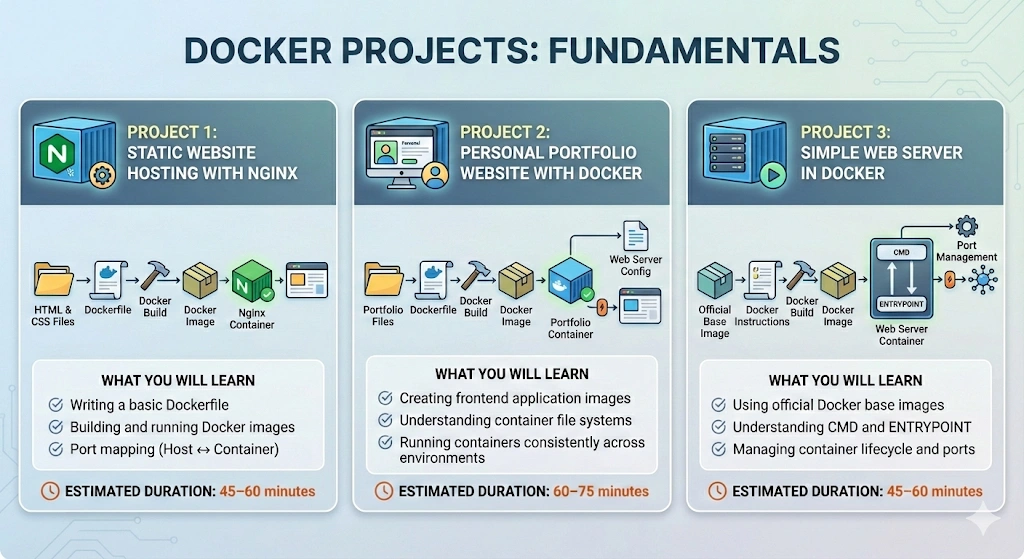
Project 1: Static Website Hosting with Nginx
This project is the simplest way to see Docker in action. You will take a basic static website built using HTML and CSS and serve it using an Nginx container. Instead of installing Nginx locally, Docker handles everything inside an isolated environment. This helps you understand why containers are lightweight, portable, and consistent across systems. You will write a basic Dockerfile, build an image, and run it as a container. By the end of this project, Docker will stop feeling abstract and start feeling practical.
What you will learn
- Writing a basic Dockerfile
- Building and running Docker images
- Port mapping between the host and the container
Estimated duration
45–60 minutes
GitHub Link
Project 2: Personal Portfolio Website with Docker
In this project, you will containerise a personal portfolio website and run it using Docker. Instead of worrying about system dependencies or server configuration, Docker packages everything into a single image. This mirrors how real-world developers deploy frontend applications across environments. You will copy website files into a container, configure a lightweight web server, and expose it using Docker. The project reinforces how Docker ensures consistency between development and deployment, making it a strong beginner project with clear portfolio value.
What you will learn
- Creating Docker images for frontend applications
- Understanding container file systems
- Running containers consistently across environments
Estimated duration
60–75 minutes
GitHub Link
Project 3: Simple Web Server in Docker
This project focuses on running a basic web server entirely inside a Docker container. You will use a prebuilt server image, configure it using Docker instructions, and expose it to your local machine. The goal is to understand how Docker handles processes, ports, and runtime commands. Unlike static hosting, this project introduces server configuration and container execution flow. It gives you a clear view of how applications actually start and run inside containers, which is a critical concept before moving to multi-container setups.
What you will learn
- Using official Docker base images
- Understanding CMD and ENTRYPOINT
- Managing container lifecycle and ports
Estimated duration
45–60 minutes
GitHub Link
Category 2: Multi-Container Applications
These projects for beginners introduce Docker Compose and show how multiple containers work together as a single application.

Project 4: Dockerised To-Do List Application
This project introduces you to a real multi-container setup using Docker Compose. You will build a simple To-Do application where the frontend and backend run in separate containers. Instead of managing each container manually, Docker Compose allows you to define and run everything using a single configuration file. This project demonstrates how services communicate with each other inside a Docker network. It also reflects real-world application architecture, where different components run independently but work together seamlessly.
What you will learn
- Using Docker Compose for multi-container apps
- Service-to-service communication
- Container networking fundamentals
Estimated duration
75–90 minutes
GitHub Link
Project 5: Multi-Container Application with Docker Compose
This project builds on Docker Compose by introducing an application with clear service dependencies. You will run a backend service alongside a supporting service such as Redis or MySQL, all managed through a single Compose file. The focus here is on understanding how containers start, connect, and depend on each other. You will see how Docker handles internal networking without exposing everything to the outside world. This project closely resembles how backend systems are structured in production environments.
What you will learn
- Defining multiple services in Docker Compose
- Managing service dependencies
- Internal container networking
Estimated duration
90 minutes
GitHub Link
Project 6: One Database Shared by Multiple Containers
This project focuses on data persistence and shared services in Docker. You will set up a single database container that is accessed by multiple application containers. This mirrors a common real-world setup where several services rely on the same data source. The key takeaway here is understanding how Docker volumes work and why containers themselves should remain stateless. Once completed, you will clearly see how Docker separates application logic from persistent data.
What you will learn
- Using Docker volumes for data persistence
- Sharing services across multiple containers
- Designing stateless containers
Estimated duration
75–90 minutes
GitHub Link
The previous GitHub project also covers all aspects for this one
Category 3: Real-World App Deployments
These beginner-friendly projects show how Docker is used to deploy popular, production-style applications.
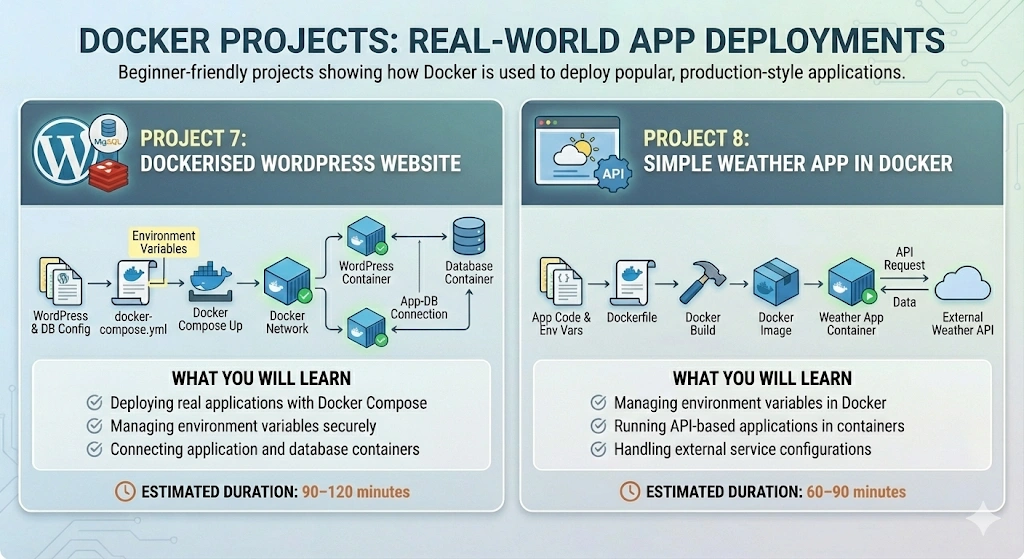
Project 7: Dockerised WordPress Website
This project introduces you to deploying a widely used, real-world application using Docker. You will run WordPress alongside a database container using Docker Compose. Instead of manually configuring servers, Docker handles the entire setup through containers. This project closely mirrors how many small businesses and production teams deploy content management systems today. It also reinforces the idea that Docker is not just for developers, but for running complete applications reliably across environments.
What you will learn
- Deploying real applications with Docker Compose
- Managing environment variables securely
- Connecting application and database containers
Estimated duration
90–120 minutes
GitHub Link
Project 8: Simple Weather App in Docker
This project focuses on containerising an API-driven application. You will run a simple weather app that fetches data from a public API and serves it through a web interface. Docker ensures the app runs consistently, regardless of system setup. This project introduces the use of environment variables for API keys and configurations, which is common in real deployments. It is a great bridge between basic containers and production-style applications that rely on external services.
What you will learn
- Managing environment variables in Docker
- Running API-based applications in containers
- Handling external service configurations
Estimated duration
60–90 minutes
Category 4: Docker Image & Build Skills
These projects for beginners focus on how Docker images are built, optimised, and prepared for real deployments.

Project 9: Create a Custom Docker Image
This project shifts focus from running containers to understanding how Docker images are actually built. You will create a custom Docker image from scratch for a simple application. Instead of relying entirely on prebuilt images, you will define the base image, install dependencies, and configure runtime instructions yourself. This project helps you understand image layers, caching, and why well-designed images matter for performance and maintainability. It is a simple project, but one that significantly deepens your Docker understanding.
What you will learn
- Building custom Docker images
- Understanding image layers and caching
- Writing clean and efficient Dockerfiles
Estimated duration
60–75 minutes
Project 10: Multi-Stage Docker Build for a Node.js App
This project introduces one of the most important Docker optimisation techniques used in production environments. You will build a Node.js application using a multi-stage Docker build, where one stage handles development, and another produces a lightweight production image. This approach drastically reduces image size and improves security. Although the concept sounds advanced, the implementation is beginner-friendly and extremely valuable. Completing this project gives you exposure to production-grade Docker practices that many beginners never touch.
What you will learn
- Using multi-stage Docker builds
- Reducing Docker image size
- Separating build and runtime environments
Estimated duration
75–90 minutes
GitHub Link
Conclusion
Docker becomes powerful only when you stop reading about it and start building with it. The projects in this list are designed to do exactly that. Each one focuses on a real Docker concept, which takes you much farther than just running commands for the sake of it. What I can promise you is this – once you complete these Docker projects for beginners, you move from understanding containers in theory to using them with confidence. You learn how applications run, communicate, scale, and persist data inside Docker. More importantly, you build intuition, something you can almost never learn from tutorials. Finish these projects, and Docker will no longer feel like an extra tool on your resume, but a skill you can actually use.
Login to continue reading and enjoy expert-curated content.